Kristen Gyles | Who wrote the SBA?
Loading article...
-
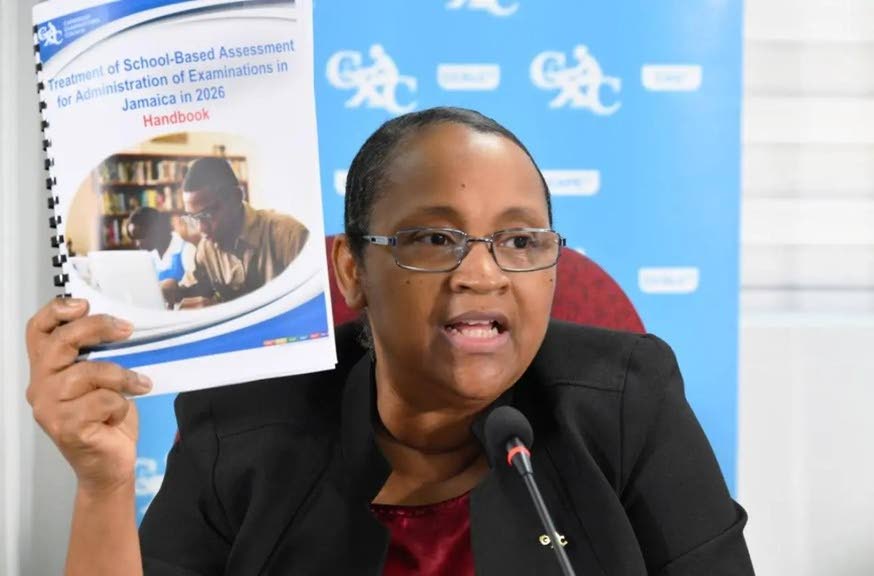 Caribbean Examinations Council (CXC) Director of Operations Dr Nicole Manning displays a copy of the School-Based Assessment (SBA) Concession document during a press conference held at the Overseas Examinations Commission in St Andrew in January. Photo - File
-
Caribbean Examinations Council (CXC) Director of Operations Dr Nicole Manning displays a copy of the School-Based Assessment (SBA) Concession document during a press conference held at the Overseas Examinations Commission in St Andrew in January. Photo - File
-
 Photo - File
I have had the privilege of not only performing School-Based Assessments (SBAs) for subjects I sat at the CSEC level, but also marking SBAs for students sitting CSEC exams. In my days sitting CSEC, the mathematics exam did not carry an SBA component.
By the time I transitioned into another phase of life, functioning as an educator, it did. I understood what the intention was behind the introduction of the SBA for mathematics. Especially in a world where so many people claim children will never utilise what they learn in school, it made sense for CXC to provide an opportunity, through the introduction of the SBA, for students to apply their understanding of mathematics concepts to real-life scenarios, albeit through a guided ‘project’.
The intention may have been a good one, but impact is another story altogether. From my experience marking mathematics SBAs, my view is that not only are SBAs not materially important to a student’s overall understanding of mathematics concepts, they are also ineffective at testing the student’s knowledge, understanding, or application of either.
SBAs are teacher-guided assessments, assignments, or projects that students do as a part of their overall evaluation under a subject area. Although the teacher is expected to provide some guidance to the student, it is the teacher who marks and grades the SBA using criteria provided by CXC.
For some practical subject areas, the SBA is hands-on. The student must do the SBA himself or herself. For example, the food and nutrition SBA involves demonstrating sound kitchen planning and food hygiene while preparing stipulated dishes or meals that fall under a specific nutritional profile, and presenting them in a particular manner. Similarly, SBAs for subjects like clothing, textiles and fashion and physical education are mostly practical in nature.
However, for non-practical subjects, like history and social studies, students must produce a written document based on research and analysis. This is where artificial intelligence (AI) comes in. AI is more than capable of conducting both research and analysis and, unsurprisingly, CXC has expressed that several challenges have been identified with the efficacy of SBAs to reflect student capabilities, against the backdrop of the use of generative AI becoming more widespread.
REFORMED SBA
As a result, CXC announced a reformed SBA framework that will result in the SBA component for several subjects being replaced by an Alternate Paper 032, which will be assessed under examination conditions. Students will be provided with a list of topics to be covered on the Alternate Paper 032 a month prior to the exam and will be allowed to bring reference notes with them into the exam room. The change is intended to restore confidence that the work being evaluated reflects what the student knows and can do.
The concern regarding the use (or overuse) of AI is a very relevant concern in 2026. However, if we are to be honest, the issue of SBAs not effectively assessing student capabilities is really not just about the use of AI. The extent to which students are aided in their completion of written SBAs can never truly be known, whether by a teacher or by CXC. There is no way to truly determine the author or compiler of a written piece of work like an SBA. Furthermore, after several drafts or iterations of the same SBA based on the teacher’s guidance or instruction, the work oftentimes looks nothing like the initial work submitted. Prior to the use of AI, many teachers were hand-holding underperforming students through the entire SBA completion process and spoon-feeding them instructions to ensure they got a passing grade on their SBA.
Benevolent, yes. But it defeats the point of the evaluation.
Generally speaking, written SBAs have been a wonderful tool for rewarding hardworking and dedicated students. Students who wanted a good grade would work very hard at their SBA and work closely with their teacher to ensure that they got a good SBA grade. However, SBAs have not, in many cases, reflected the students’ actual understanding of the subject area.
I was one of those hard-working and dedicated students. I resolved from early to get as good a grade as I could on my SBAs to help cushion the effect of any mishaps in the exam. For context, SBAs carry a weighty contribution to a student’s overall grade. So, when I sat subjects like CSEC history and CAPE Caribbean studies, I made sure to do my absolute best to get the best grade possible for my SBA to maximise my overall grade. I was richly rewarded for my hard work. But now I see that that truly is not how examination ought to be.
Neither CSEC nor CAPE exams are about diligence, dedication, or hard work. They are to test a student’s genuine understanding of the subject area. However, in 2026, a student may actually end up with a fabulous grade for their SBA without either diligence or a good understanding. After all, all one has to do is say, ‘Jump’, and AI will ask, “How high?”.
Some have expressed the concern that there is likely to be an overall decline in CSEC and CAPE grades following the phasing out of the SBA for some subjects. Maybe there will be. That would only prove the point that SBAs are not giving a true reflection of students’ actual education levels. As with any change, some will be apprehensive, but CXC has a duty to ensure that CSEC and CAPE exams actually make sense and assess students’ true performance. So far, it looks like they are on the right track.
Kristen Gyles is a free-thinking public affairs opinionator. Send feedback to kristengyles@gmail.com and columns@gleanerjm.com