
Greenwood Great House: Testimonial to two centuries of glory
Published:Saturday | November 19, 2011 | 12:00 AM


Christopher Thomas, Gleaner Writer
WESTERN BUREAU:
Close to the border where the parishes of Trelawny and St James meet rests the Greenwood Great House, which has overlooked the surrounding community for 211 years.
Although not as popular as the legendary Rose Hall Great House, Greenwood Great House is a national monument due to its history and the enduring presence of antique items on its walls.
Today, this great house maintains a historical museum, with much of its original furniture, family portraits, and rooms still intact. It contains the largest plantation library in the island, with up to 300 books, some dated as early as 1697. It also houses exotic musical instruments and antique china and silverware.
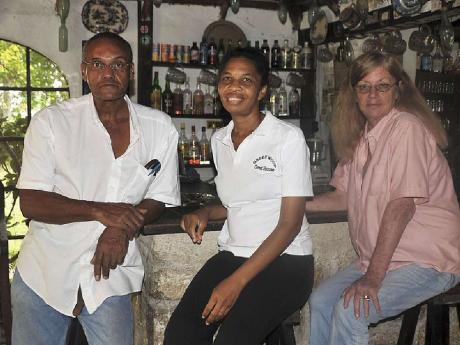
Its museum tours are managed by current owner, Thomas 'Bob' Betton, who purchased the property in 1976 and has lived there with his wife, Ann, ever since.
"I was taken to England as a child, and after I grew up, I purchased some houses in London during the 1960s to 1970s," Betton recounted.
"I came to Jamaica on holiday and thought it was the most beautiful place on Earth, and a lot of childhood memories came back, so I really enjoyed it. When I went back to England, I couldn't settle in anymore, so I decided to sell the houses and come here."
Built in 1800 and situated 15 miles from Montego Bay and seven miles from Falmouth, the 15-room house was owned and occupied by the Barrett family of Wimpole Street in London, England.
FAMILY HISTORY
Noteworthy members of this family included Richard Barrett, who would later become custos rotulorum of St James, and famous Victorian era poet Elizabeth Barrett-Browning.
The family's first noted ancestor, Hersey Barrett, was an officer in the 1655 expedition commissioned by Oliver Cromwell to capture Hispaniola from the Spanish empire, but which captured Jamaica instead. Hersey Barrett eventually settled in Jamaica, and later, his family joined him during the 1660s.
Originally, they resided in the Barrett Town area, which was named after them, and by the mid-18th century, the family had prospered greatly, possessing some 84,000 acres of land from Little River in St James to Falmouth, Trelawny, and owning more than 2,000 slaves.
Unlike most planter families in Jamaica at the time, however, the Barretts were kind to their slaves and even taught them to read, an act which was considered a criminal offence.
Interestingly, Greenwood was one of the few great houses that were not torched during Jamaica's slave uprising in 1831.
The Bettons were residing in Mandeville, Manchester, before they made arrangements to look at a property in Barrett Hall, St James.
"On my way up this windy street, I saw this elderly Englishman, John Binns, who had just come out of a local taxi. He fanned me down, I pulled over, and he was very charming, and told me he'd flown in from England after a major operation," Betton remembered.
"Binns' taxi had a puncture, the driver didn't have a spare, so he was being cooked in the car, could I give him a lift up? I had to bundle him in the back of the car."
It turned out that Binns was the then owner of the Greenwood Great House property and was seeking to sell the place.
LABOUR OF LOVE
"I've been here ever since, trying to promote the place in my own way," Betton remarked. "It's been 35 years now, a long time, but I have no regrets. It's a labour of love."
The Greenwood Great House is open for tours from 9 a.m. to 6 p.m. daily, and its operations are licensed by the Jamaica Tourist Board. Functions are also hosted at the property by special request.
"A lot of Jamaicans, when they come up here, the most important thing is the duppy (ghost) story ... . I don't push this aspect, but it's part of the legend, so it continues," Betton commented.
"If I'm taking a Jamaican group through, and the grandfather clock starts ringing, you see horror in their faces and they're covered in goose pimples. This is established in Jamaica. But I prefer the emphasis to be on the historical aspect."
Betton acknowledged that business isn't always as good as he would like, but he attributes this to Jamaica's generally slow pace of life and takes comfort in the fact that he has paid his debts.
He also declared that the property's fame in travel guides as a historical site makes his work worth it.
"The people enjoy the tours, and we've never had any sort of bad feedback. It is not being promoted or accepted in Jamaica as it should, but one day, even if I'm not here, I'm sure it will," Betton said confidently.
"It's a unique place. I've toured a lot of houses, because I used to like travelling, so I did a lot of travelling all over Europe, and there's nothing there in comparison to this."