
Editorial | Fighting cable theft
Published:Monday | March 10, 2025 | 12:07 AM
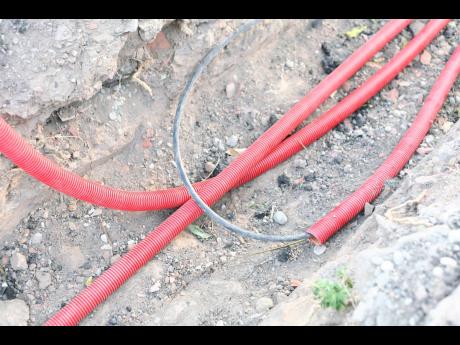
What was not disclosed in last week’s cutting of fibre cables belonging to Jamaica’s two big telecommunications service providers, Flow and Digicel, was whether large chunks were taken and how and where the incidents occurred.
The question, in other words, is whether this was a random act of vandalism, or if, like when copper cables used to be stolen for sale to the scrap metal trade, it was also an economic crime. With respect to effect, the outcomes are not different. Indeed, last week, after the incidents, several thousand Flow and Digicel customers were left without mobile telephone and Internet service. That would have inconvenienced people and disrupted businesses, costing, possibly, tens of millions of dollars.
What the different motivations for the crime might however influence, is how the authorities think about immediate solutions, including where and how they place their emphasis. This will require that they determine if another front has opened, or is opening, in the theft of the infrastructure of utility companies.
“We take this opportunity to again ask for the public’s support as we work to deliver best-in-class telecommunications services for the benefit of our nation,” Digicel and Flow said in a joint statement. “Attacks levelled on our critical infrastructure by vandals not only disrupts our operations, but impact the productivity, safety and functioning of the broader community that depends on these services.”
Which is true, and why this newspaper supports the Government’s intention, repeated by the technology minister, Daryl Vaz, to make the theft and vandalism of telecommunications infrastructure “more prohibitive in terms of … the level of fines and imprisonment”.
DOMESTIC TERRORISM
Currently, as Stephen Price, the head of Flow Jamaica, has in past complained, these acts are primarily treated as petty larceny, attracting relatively small fines or short prison terms. The behaviour, he suggested, should be seen almost as acts of domestic terrorism.
In the early 2000s, the theft of copper cables from the telecoms networks – as well as among anything metal from anywhere – was rampant in Jamaica. For instance, in the 2010s, huge brass bearings, weighing thousands of pounds, were stolen from the Frome, Monymusk and Worthy Park sugar factories. Even a sculpture by celebrated artist Edna Manley was removed from a museum.
Even in its perversity, there was a logic of sorts in these thefts – at least from the perspective of the thieves. The material was economically valuable. It was apparently easily sold to the scrap metal trade, which was twice suspended in the early 2000s while more stringent operating regulations were put in place.
Indeed, at one stage, there were restrictions on the sale of copper, a ban whose lifting, Flow’s Mr Price has argued, correlated with a new spate of cable thefts in the 2020s.
QUESTIONS
There are, however, questions of whether fibre cable is as easily tradeable, and whether there is a market for the stolen product in Jamaica.
Fibre cables are extremely thin strands of glass or plastic over which data is transmitted in the form of light. These strands are clad with protective layers.
Fibre-optic cables are substantially faster and more efficient than copper cables, which transmit data as electrical signals.
While fibre cables are recyclable, the process is not as straightforward and the opportunities seemingly limited. In that context, damage such as was suffered by Flow and Digicel may be wanton acts of vandalism, which is likely to be more difficult to prevent, or to identify the perpetrators when they occur.
In the event, the companies and the authorities will have to be even more vigilant and hope, too, that harsher penalties for these acts prove to be deterrents. At the same time, the authorities have to be more aggressive in their oversight of the possible outlets for illegally acquired material to crimp the trade of stolen copper cables, and/or any burgeoning business in fibre cables.
At the same time, utility companies have to consider how to harden their infrastructure against natural disasters and theft, including accelerating programmes to run cables underground.