
Editorial | CARICOM and Rickey Singh
Published:Tuesday | July 8, 2025 | 12:08 AM
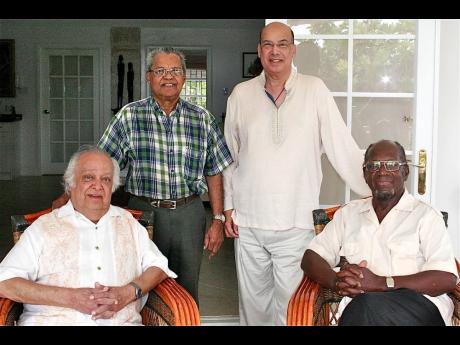
Fate could hardly have chosen a more symbolic moment with respect to the passing of the journalist Rickey Singh. It happened as Caribbean Community (CARICOM) leaders began to gather in Montego Bay for the 49th summit.
Apart from his legendary courage, few things defined Mr Singh as much as his commitment to Caribbean integration and his appreciation of the logic of CARICOM, on which he reported from its inception, and through its various frustrating contortions and meanderings.
It would, therefore, be a fitting tribute to Rickey Singh, and the many others, alive and dead, who recognised, embraced, and promoted the ideals of integration, if the leaders emerged from the Montego Bay conference with clear, implementable decisions to practically advance the community.
These must include a settled mechanism for the free movement of labour within the community, which is an essential if CARICOM, in accordance with the intentions of its governing treaty, is to transform itself into a genuine single market and economy. Indeed, if free movement had advanced substantially, beyond an aspiration of the Revised Treaty of Chaguaramas, it might have benefited Rickey Singh during some of his early travails.
Additionally, the leaders must finalise the scheme to allow a critical mass of community members to proceed on the implementation of policies on which there is broad consensus, but some members are not yet ready or in a position to act upon.
Of course, these are not the only things upon which CARICOM must move with urgency, in an increasingly topsy-turvy global environment, where the unstructured dismantling of the rules-based order reinforces the good sense of CARICOM as an institution and the potential value of the insulation, albeit limited, it offers to its individual members. Which was what Rickey Singh instinctively understood and promoted.
UNBOUNDED ENERGY
Mr Singh, who died in Barbados on Saturday, age 88, was an Indo-Guyanese, who, for decades, until her death in 2015, was married to Patricia ‘Dolly’ Singh, an Afro-Guyanese. Physically, he was a small man, with, until illness in recent years, unbounded energy and will. He was a giant of regional journalism.
But Rickey Singh was not a man to be placed in a simple slot. He was, undeniably, a man of the Left. But he was also a committed evangelical Christian who preached regularly. He was absolutely incorruptible. He maintained relationships with people across ideologies and faiths. And as for a man of his period, his “Rolodex” was expansive.
Rickey Singh came of age during the period of political and ethnic turbulence in 1950s and ’60s Guyana, the English-speaking CARICOM member on the shoulder of South America. He started as a reporter on the Guyana Graphic newspaper in the second half of the 1950s, soon developing into an intrepid journalist with a clear independent streak whose reporting on politics was often frowned on by the People’s National Congress (PNC), the party of Forbes Burnham. The PNC had come to office after the British colonial overlords, in concert with America’s CIA, had, in 1953, removed Cheddi Jagan’s then Marxist-oriented People’s Progressive Party (PPP) from government.
Guyana was not only deeply ethnically and ideologically divided. By the 1960s, the cracks had become multifarious as the country’s economy declined and Mr Burnham and his party, having adopted a brand of “Cooperative Socialism”, were accused of authoritarian tendencies.
By the 1970s, large numbers of Guyanese of all ethnic groups were leaving the country over issues ranging from politics to the state of the economy to ethnic divisions. The Burnham government had marked ‘enemies’ in the press, Rickey Singh among them.
TRANSFER
It was widely believed that it was in part under pressure from the Burnham government, and also to ensure his safety, that in the early 1970s, Roy Thompson (Lord Thompson of Fleet), who owned the Graphic, engineered Mr Singh’s transfer to one of his regional papers in England, where he reported on crime.
Mr Singh endured that ‘exile’ for half a year before quietly returning to Guyana rather than, as was expected, moving his family to the UK. He insisted that he was a Caribbean man and would raise his family in a West Indian context.
In 1974, he moved to Trinidad and Tobago, preaching at a Pentecostal church, but soon became the founder editor of Caribbean Contact, a monthly newspaper of thought and analyses of Caribbean affairs, published by the Caribbean Conference of Churches (CCC), the regional body of mainstream churches. Caribbean Contact, as did the CCC, reflected the social and political ferment in the region at the time.
But Rickey Singh and Caribbean Contact apparently discomfited Eric Williams’ government, which survived a military coup in 1970. The Williams government rescinded Mr Singh’s work permit, so he and Caribbean Contact moved to Barbados.
After the violent 1983 implosion of the New Jewel Movement (NJM) government and the US invasion of the island, which Mr Singh opposed, the Tom Adams government revoked his work permit. His work permit was reinstated when Errol Barrow’s Democratic Labour Party returned to office three years later.
Throughout all the turbulence, two things remained constant with Rickey Singh: his integrity and clarity of thought and his absolute commitment to the Caribbean and regional integration. Mr Singh felt a responsibility to Caribbean citizens to whom CARICOM’s leaders have an obligation.