Editorial | The dilemma of roads
Loading article...
-
 Minister in charge of works, Robert Morgan.
-
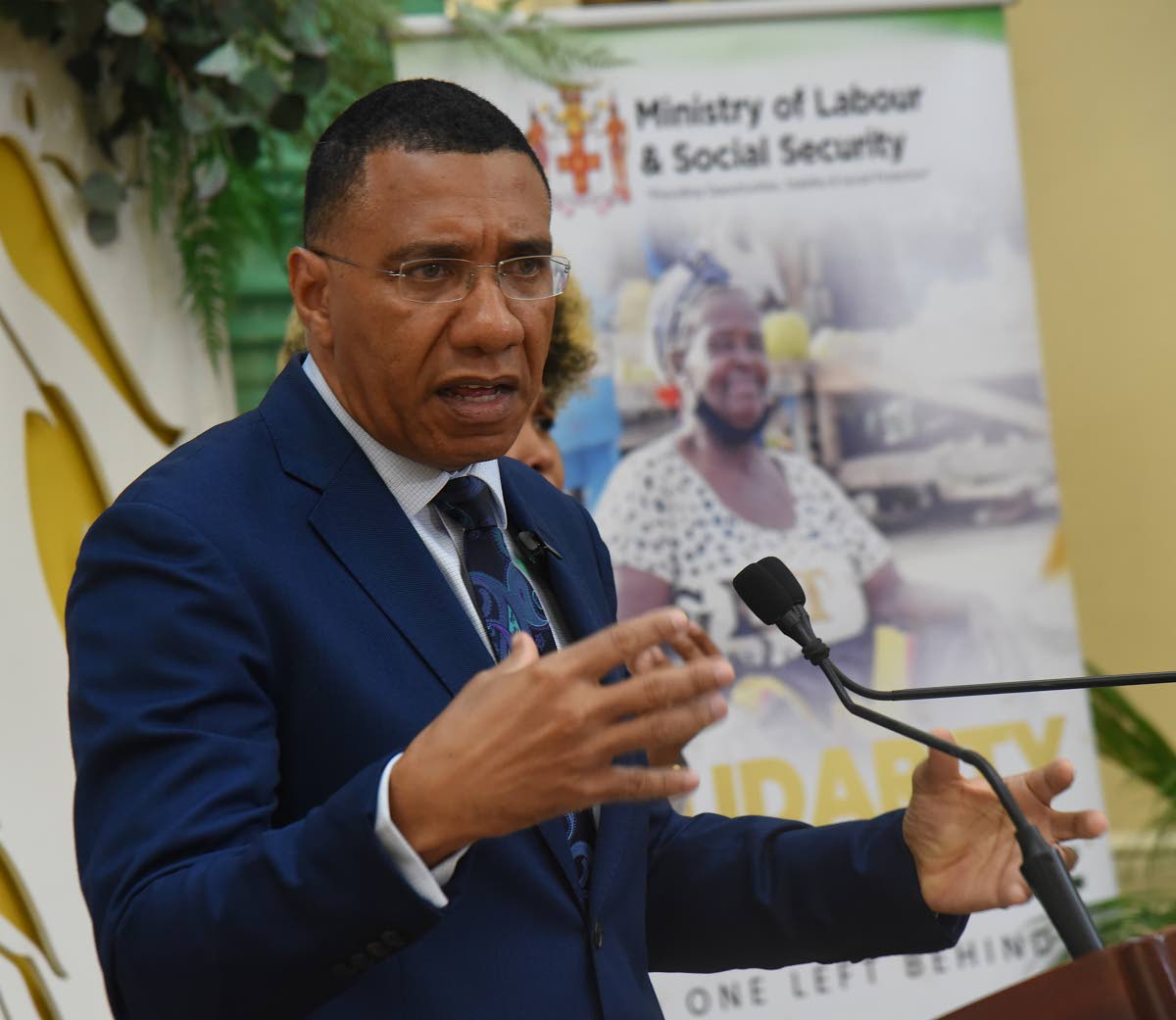 Prime Minister Dr Andrew Holness.
Robert Morgan’s remarks at the recent World Bank round table on infrastructure suggest that the Holness administration is pushing ahead with its plan for a new agency to manage and repair Jamaica’s roads.
But like when Prime Minister Dr Andrew Holness first broached the idea publicly over a year ago, it remains unclear what the precise mischief is that the Government intends to cure, or what the new body will accomplish that the National Works Agency (NWA) is incapable of doing, unless the argument is that it is not only poorly managed, but has gone so bad to be incapable of reform or repair.
Established in the early 2000s, the NWA is an executive agency, one of those semi-autonomous bodies that is part of the public sector, but not entirely constrained by civil service rules. They have greater freedom of operation.
The NWA largely assumed the functions of the old Public Works Department (PWD). But its primary job is to manage the design, construction and maintenance of major bridges and roads. There are over 5,000 kilometres of the latter.
It is widely acknowledged that despite many high-profile campaigns, with sparkling acronyms, for the repair of highways and secondary thoroughfares, Jamaica’s roads remain mostly in bad shape – rutted and potholed. Even after recent fixes. In December 2024, Prime Minister Holness suggested that turning things around was beyond the abilities of the NWA.
“[T]he crisis that we face with roads now, the NWA is not sufficient to manage it,” Dr Holness said.
He insinuated that the agency was faced with something of a mission creep, saying that the NWA’s original mandate was to be “the national engineers, advising Government on engineering matters (and) overseeing the engineering of major construction projects”.
“Now, they are being asked to administer roads, even roads that are not under their jurisdiction … and there are other functions that have arisen under the management of roads which the NWA was not capacitated to do,” he said. “We need to be able to have rapid responses to deteriorating road conditions. We may very well have to create an entity to facilitate this… .”
What was surprising about the prime minister’s statement was the suggestion that the NWA was, in a way, dragged into territory for which it was not intended. From the start, the idea that it was in charge of the maintenance of major roads – even if it outsourced the actual work – was sold to Jamaicans.
MISSES FUNDAMENTAL ISSUES
There have been a few refinements of the concept of the new body – now referred to as the One Road Agency (ORA) – since the prime minister first mentioned it and Mr Morgan’s intervention at the World Bank-sponsored discussion. Nonetheless, there is still the sense that the Government has misdiagnosed the problem, which will likely lead to unsatisfactory outcomes.
According to Mr Morgan, the minister with responsibility for infrastructure, in which Dr Holness is the de jure minister, the ORA will provide “a single national framework for standards, quality assurance, compliance monitoring and performance reporting across all road classes, while bringing disciplined implementation to the national network”.
Most Jamaicans will be forgiven for believing – having been led to believe so – that the agenda outlined by Mr Morgan was already among the responsibilities of the NWA, except that it and the Toll Authority, which regulate the rates for tolled roads, will fall under the ORA.
While government documents cast the proposed ORA as a “ practical reform aimed at ending fragmentation and creating one coherent framework for how roads are regulated, maintained and delivered”, they suggest that the new agency will not “disempower” the local government authorities, which control municipal roads.
There may be something coherent to be unravelled from all of this. Yet, the effort misses the fundamental issues – two of them.
First, to reprise James Carvelle: It’s the economy, stupid.
Jamaica’s roads have been in poor shape for a long time because the economy has not grown sufficiently to create the surpluses necessary for investment in public infrastructure – not only roads. The investment deficit has been compounded over the past dozen years by fiscal reforms that emphasised running high primary surpluses in an effort to reduce the country’s debt as a proportion of GDP. As necessary as that might have been, it was a trade-off that came with consequences.
So, roads are not only infrequently maintained, but jobs are often skimped on – whether on original engineering and construction, or during repairs. Add these factors to the hollowing out of the Jamaican State over the past three decades that has left it short of technical expertise to fulfil its mandate.
There are indeed problems to be solved. But the solutions must be thoughtfully and robustly considered. The answers are not usually found in superimposing a new bureaucracy on an existing one.