Aubrey Stewart | Navigating democracy’s necessary tension
Loading article...
-
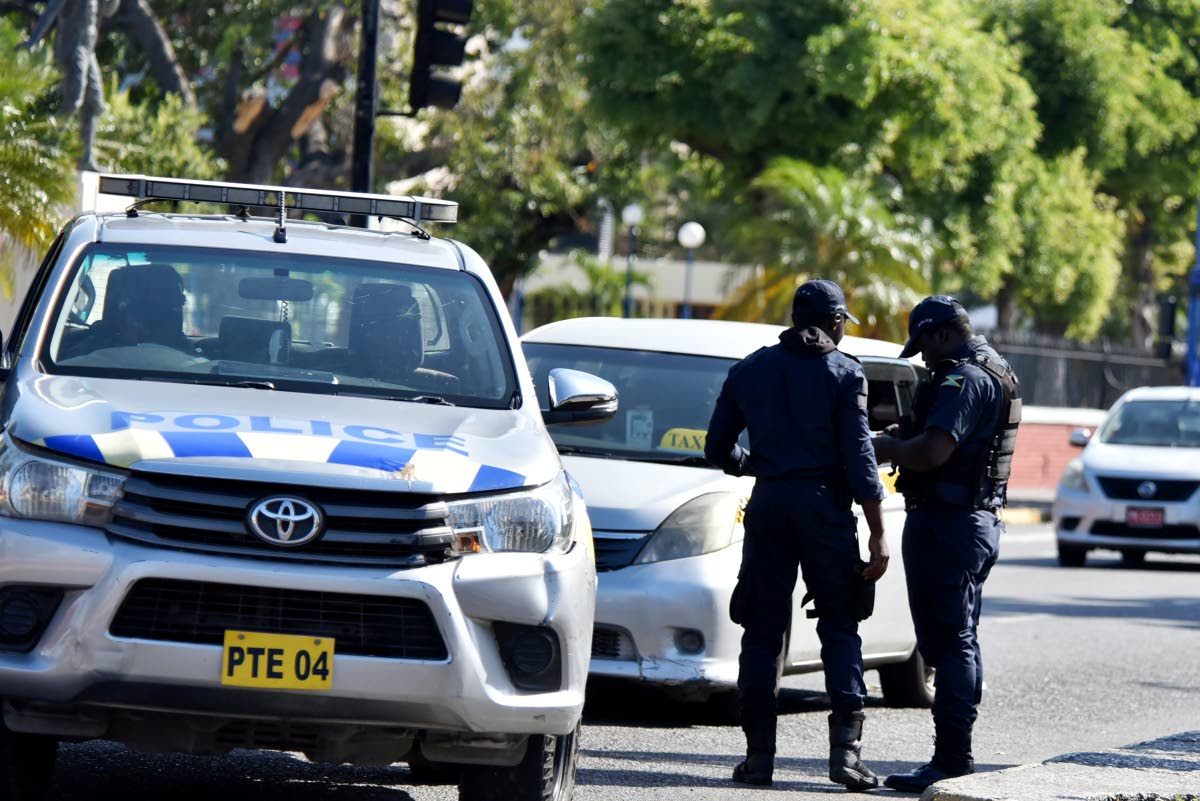
In this file photo JCF personnel are seen verifying documents at a spot check.
-

Aubrey Stewart
Often, there is a public clash between the Jamaica Constabulary Force (JCF) and the Independent Commission of Investigations (INDECOM). Commissioner Kevin Blake argues that officers deserve support when confronting dangerous criminals; INDECOM presses for stronger accountability measures and body-worn cameras. The pattern has become predictable enough that observers have stopped treating it as news.
The ostensibly rancorous exchanges are proof that the relationship is broken or is, at best, irrecoverably adversarial. Those who back the police argue that officers are being judged in retrospect by people who were never in the field; those who back INDECOM insist that accountability cannot yield to institutional convenience. The point is not which view is correct, if either one even is, or whether the relationship between INDECOM and the JCF is “good”. What matters is whether it is doing what democratic governance requires of it.
Democratic governance in a country where between 2015 and 2025 there were 14,396 murders, 12,767 shootings, and 1,634 fatal encounters involving the security forces, seems like an unlikely precept. For a country not at war, these numbers are staggering. In a society sustaining casualties on this scale, who bears responsibility, and to whom do they answer?
The commissioner of police looks at those 27,163 incidents and sees a force stretched to its limits. INDECOM looks at the 1,634 security force fatalities and questions, how many genuinely involved an adversary who fired first? They are looking at the same situation from different often irreconcilable vantage points, but this is not, and should not be, a concern. It is precisely what the institutional design intends.
Democracies are built on a system of checks, balances, and accountability. Governments answer to legislatures, public agencies to auditors and courts, and officials to the citizens whose lives their decisions shape. No institution granted meaningful authority is exempt from that logic, including the police.
CONSEQUENTIAL POWERS
Indeed, the JCF holds some of the most consequential powers the State can confer: its officers can stop, search, arrest, detain, and, in extremis, use lethal force. Those powers are indispensable to public order and citizen protection, but their significance is exactly the reason they cannot be exercised without the independent oversight that INDECOM exists to provide.
Its mandate is independent scrutiny when citizens are injured or killed by state actors. It is not designed to replace the police or to impede operational policing. It is the mechanism by which a democratic society makes a commitment to its citizens that when someone dies at the hands of the State, the question of why will be asked by someone with no institutional stake in the answer.
Between 2024 and July 2025, INDECOM investigated 288 fatal shootings involving members of the security forces. The cumulative pattern warrants concern: operations that end in death, thin independent evidence, families pursuing answers through official channels that often produce none, and communities required to trust institutions that cannot always account for what occurred.
The accountability challenge is structural It predates the body-camera debate and will persist long after every officer is equipped with one.
POLICE SIDE OF THE STORY
Accountability, though, is one half of the equation.
Police officers work in environments that are genuinely dangerous and often unpredictable, where decisions that will later be scrutinised for months are made in seconds. The complaint that such decisions are then judged retrospectively, by people who faced none of the same risks, is not without force. Officers and their representative bodies have long argued that what they view as excessive scrutiny discourages proactive policing and that drawn-out investigations, combined with sustained public criticism, corrode both morale and operational confidence.
Those concerns deserve serious engagement rather than dismissal. Research has found that officers can become measurably more cautious under conditions of intense public scrutiny though the evidence on so-called “de-policing” is contested and context-dependent. What most officers appear to want is not freedom from oversight but confidence that it will be conducted fairly, efficiently, and by people who understand what the work actually demands.
Commissioner Blake points to outcomes. Murders fell by more than 40 per cent in 2025. Those gains came from officers moving into dangerous communities, dismantling criminal networks, and taking firearms off the streets. They were not the product of public commentary or op-eds.
For many serving officers, that operational record is what any conversation about accountability must take as its starting point.
DEMOCRACY’S DISCOMFORT
The assumption that the JCF and INDECOM ought to get on is itself worth questioning. Auditors are not expected to be friendly with the agencies they audit. Judges are not there to agree with prosecutors. Parliament does not exist to endorse the Executive.
The relationship between INDECOM and the JCF was never going to be easy, nor was it meant to be. Oversight was designed to be independent, and independence generates friction by definition.
A police force that escapes independent scrutiny will eventually forfeit public confidence; an oversight body that fails to press the institutions it monitors will become a formality. The friction between INDECOM and the JCF is not evidence of institutional failure. It is what accountability looks like when it is functioning as intended.
The practical challenge is keeping both institutions professional, evidence-driven, and genuinely focused on the interests of the public they serve rather than the institutional interests of their own organisations.
The challenge Jamaica faces is preserving security and accountability.
The relationship between the JCF and INDECOM will never be easy because the responsibilities they carry are inherently in tension. One is tasked with confronting violence and disorder. The other with ensuring that in doing so, the State remains answerable to the law and the public it serves.
Democracies are not sustained because institutions agree with one another. They endure because institutions are designed to question, constrain, and challenge one another. The disagreement between the JCF and INDECOM may at times be uncomfortable, but comfort was never the objective. Public trust was.
The measure of success is, therefore, not whether the argument ends but whether it continues to be conducted in the service of the people.
Dr. Aubrey Stewart is a public policy researcher and consultant evaluating the effectiveness of government policies and programmes. Email: aubreymstewartiv@gmail.com and astew055@fiu.edu