Editorial | AI and education
Loading article...
-
-
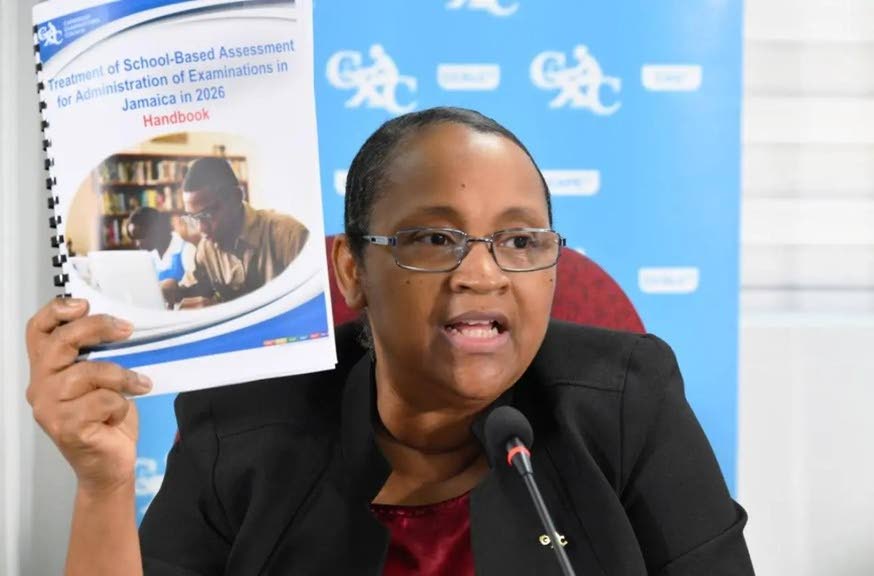 Caribbean Examinations Council (CXC) Director of Operations Dr Nicole Manning displays a copy of the School-Based Assessment (SBA) Concession document during a press conference held at the Overseas Examinations Commission in St Andrew in January of this year.
Whatever people’s perspectives may be on the Caribbean Examinations Council’s (CXC) decision to phase out its school-based assessments (SBAs), the move, as the Jamaica Teachers’ Association (JTA) says, should be a catalyst for urgent action towards a national policy on the use of artificial intelligence (AI) in the island’s schools.
Indeed, it is a position that The Gleaner has previously advocated. Our surprise is that neither the teachers’ union nor the education authorities have been more aggressive on this front. As the JTA noted in its statement last week, given the capabilities of these technologies and the pace at which they are advancing, determining how AI should be engaged in the teaching-and-learning process must be a national project rather than a series of individual efforts.
“Schools cannot be left to navigate these complex ethical, instructional and assessment issues individually,” the JTA said. “CXC’s announcement must be treated as a warning to the entire education system. Artificial intelligence cannot simply be prohibited, ignored or feared.”
An institution of the Caribbean Community, CXC is the principal examining body for secondary education in English-speaking Caribbean countries. For half a century its testing regime included SBAs. These allowed students to work independently on projects outside the classroom, which were then assessed by their teachers. CXC periodically conducted quality-assurance reviews.
But, earlier this month, the examination body announced that it will completely eliminate SBAs by 2028. The first to go, in next year’s May/June examinations, will be those for its Caribbean Advanced Proficiency Examination (CAPE) subjects that do not rely heavily on practical or project-based learning. CAPE SBAs in practical subjects will end in 2028, the same year that all SBAs at the Caribbean Secondary Education Certificate level will be discontinued.
CXC’s concern is that, with the increasing use of generative AI technologies by students, it can no longer guarantee “the integrity and authenticity of student assessments”.
Though coincidental, CXC’s disclosure of its intention to end SBAs followed closely on the release of a survey conducted by two University of Technology (UTech) researchers — information systems professor Paul Golding and Tiou Clarke, a lecturer in UTech’s College of Business. The survey found that 100 per cent of university and college students, and 96 per cent of high-school students, use AI tools for academic tasks. Approximately 87 per cent of faculty members reported using the technologies to prepare for classes and other professional activities.
It is reasonable to assume that the findings of the UTech researchers are largely replicated across the Caribbean, reinforcing CXC’s concern that uninvigilated students outside examination settings might use AI bots and assistants to complete their SBA projects — and that such use would be difficult to detect.
However, as the JTA observed, while AI technologies should not be allowed “to erode intellectual honesty, independent thought and confidence in our qualifications”, their potential value in advancing Jamaica’s educational outcomes ought not to be squandered.
“The task before us is to integrate AI responsibly, while ensuring that every certificate awarded continues to represent the genuine knowledge, skills and capabilities of the student,” the JTA said.
The Gleaner’s Editorial Board endorses that position, as well as the teachers’ union’s call for the education ministry to facilitate broad discussions among teachers, principals, universities, parents, assessment specialists and AI experts on crafting a national policy for the responsible use of AI.
This conversation could well lead to practical solutions to the concerns raised by CXC, which are already present and growing in Jamaican educational institutions.
However, the dialogue must not be limited to the ethical use and technical application of AI in education. It must also address who has access to these technologies, which hold the potential to create a new — and likely more perilous — version of the digital divide.
Already, significant resource gaps, including disparities in access to digital technologies, exist among Jamaica’s educational institutions. Schools in rural areas and poor urban communities, where students already lag academically, have far fewer resources. Schools and students with greater access to AI technologies are likely to widen their existing advantage.
Any national AI policy for education must confront this issue honestly and robustly.