Kristen Gyles | Misplaced school priorities
Loading article...
-
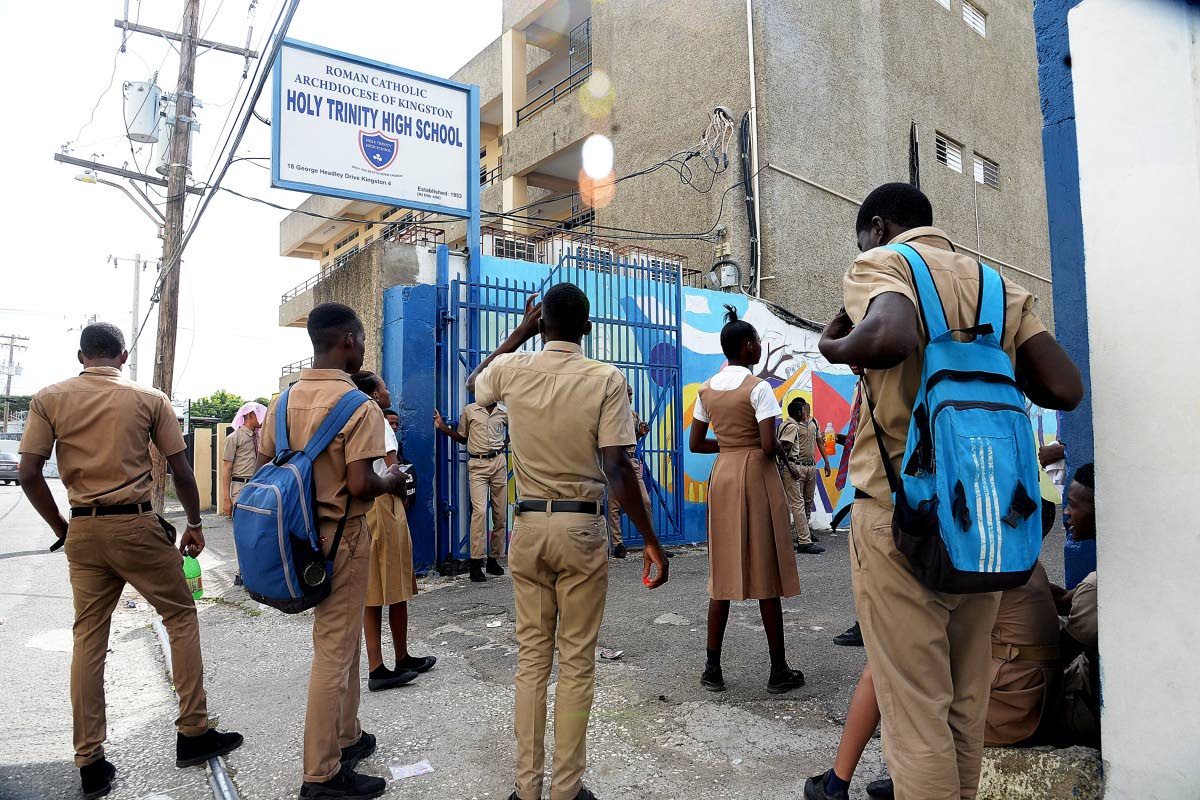 Students from Holy Trinity High School gather near the school gate after they were not permitted on ther school compound for a number of reasons ranging from bleaching and their pants being too tight. Photo - File
-
Students from Holy Trinity High School gather near the school gate after they were not permitted on ther school compound for a number of reasons ranging from bleaching and their pants being too tight. Photo - File
-
 Photo - File
I wish schools would hate illiteracy and innumeracy as much as they hate tight khaki pants and hair extensions.
The priorities of the education system deserve serious examination. In too many Jamaican schools, we appear to have become remarkably efficient at policing the appearance of students while remaining far less serious or urgent about whether those same children can read fluently, write competently, solve maths problems or leave high school properly prepared for work, further education and life in general.
Grooming and deportment definitely have their place. Schools should teach young people about personal presentation, discipline, hygiene, respect and appropriate conduct. But there is a difference between promoting grooming standards and making appearance a central measure of success.
The all-too-familiar scene that is re-enacted at the start of practically every school year is one where the student arrives at school with hair extensions, ankle socks, tight pants, untrimmed hair or the ‘wrong’ watch or school bag. The response is swift. The student is reprimanded, sent home, made to trim the hair, change the bag, let out the pants ‘foot’ or perform some other corrective action. Parents are called, meetings are arranged, and rules are enforced with an intensity that suggests the future of the nation hangs on the width of a pant leg.
Meanwhile, that same child, in many instances, struggles to read a paragraph, write a coherent response or calculate a percentage.
CONSIDER THIS
Every high-school administrator should consider this. Of all the correspondences between the school and parents, what percentage of calls and emails relates to academic performance and what percentage relate sto some other subsidiary matter, like grooming infractions? Imagine a case where more than 50 per cent of students in a school are failing to achieve passes in five or more subjects in their CSEC exams and yet the school calls more meetings with parents to discuss how low their son’s hair must be trimmed than meetings to discuss the type of support the child will need to achieve mastery of subject areas in which they are falling behind.
In the same way that the standards for grooming are so strictly enforced, why not do the same in relation to academics? Let every child know they can and must learn, and learn well. Let them see that underperformance is neither tolerated nor embraced, and that it is not the standard. Ensure that parents are called when students appear unlikely to pass their exams with good grades.
The United Nations Children’s Fund (UNICEF) has reported that while Jamaican children spend 11.7 years in school on average, this is equivalent to approximately 7.2 years of actual learning when benchmarked against top-performing education systems. So, the actual time the students are spending in school is simply not being spent optimally.
It is estimated that last year, only 19.2 per cent, or roughly 6,200 students, passed five or more subjects, including mathematics and English. While preliminary CSEC results suggest improvement in some subject areas for 2026, the numbers continue to demand urgency rather than complacency. Thousands of children are still leaving the system without the academic credentials they need.
NATIONAL OBSESSION
Perhaps the national obsession should not be whether a student’s pants are two inches too tight but should instead be whether that student can read well.
It should be whether he or she can calculate interest on a loan, interpret a payslip, understand a contract, analyse information online, write an application letter or complete a mathematical problem without a calculator doing all the thinking.
And this is where the idea of aiming for Grade I passes becomes important.
A Grade I in CSEC should not be treated as a trophy for the academically gifted. It represents a high level of mastery. Likewise, at CAPE, students should be pushed towards the highest levels of achievement rather than defining success simply as scraping through. The Caribbean Examinations Council (CXC) notes that CAPE passes encompass grades I through 5, meaning that a “pass” alone does not necessarily represent excellence.
The goal, therefore, should be for every child to leave the Jamaican school system having been given a genuine opportunity, and the necessary support, to achieve Grade I performance in the CSEC subjects they pursue, and to reach the highest possible standard at CAPE.
That requires a totally different culture.
Parents should be called when their child has fallen two reading levels behind, just as quickly as they are called because their child came to school with an unacceptable hairstyle. Remedial programmes should be treated as urgent interventions rather than something students participate in only after failing repeatedly.
Yes, we should still teach deportment and still teach discipline, but discipline should ultimately serve learning and not replace it. The real measure of a school should be what its students know and can do when they walk through the gates for the last time.
Kristen Gyles is a free-thinking public affairs opinionator. Send feedback to kristengyles@gmail.com and columns@gleanerjm.com