‘A Rose of Sharon’ explores difficulty in communicating
Loading article...
-
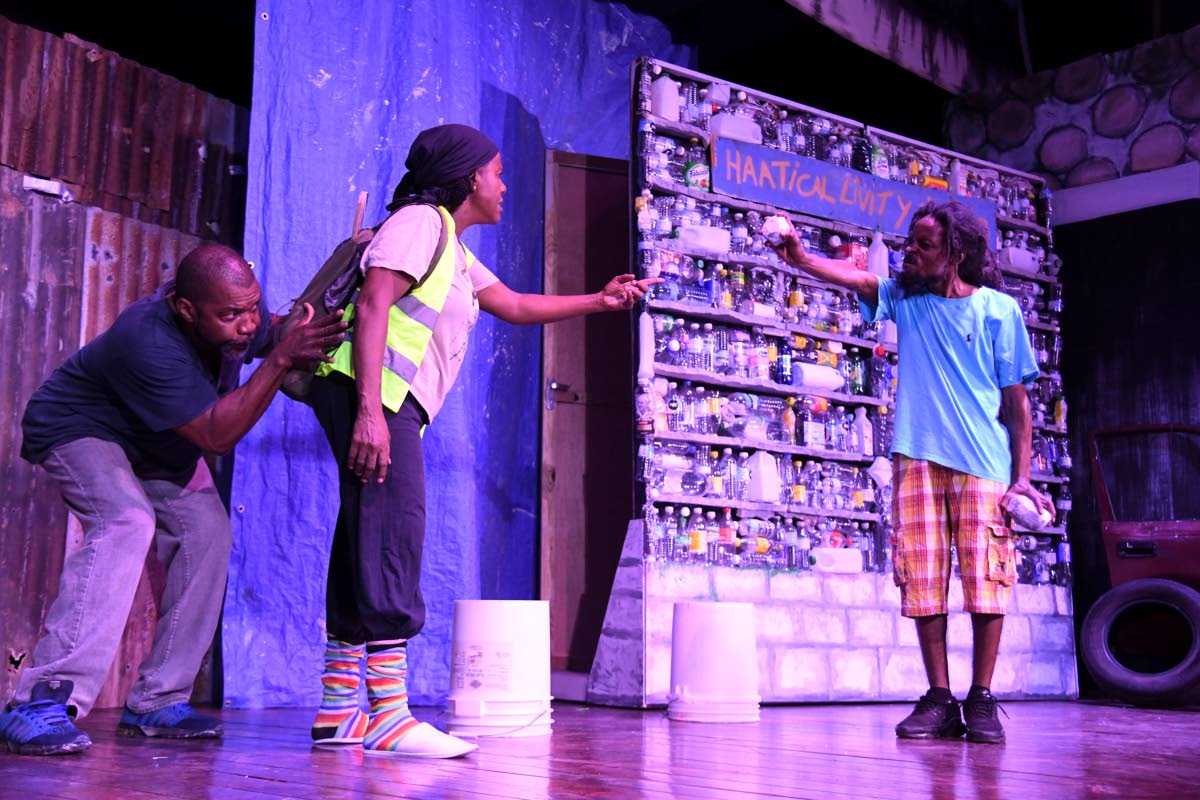 In this scene from Basil Dawkins’s ‘A Rose of Sharon’, Farrina (Dennis Titus) left, hides behind Vida (Deon Silvera) as she protects him from Tall Man (Derrick Clarke) who threatens to harm him. ‘A Rose of Sharon’ is now playing at the Little Little Theatre in Kingston
-
 Director of ‘A Rose of Sharon’ TK Dawkins.
‘Tis the season to be jolly … and to go to the theatre, which just now is on the upswing. Three plays opened last week in the Corporate Area – the Pantomime Company’s Big Yaad Vibes at Little Theatre; Patrick Brown’s Boopsie’s Homecoming, at Courtleigh Auditorium and Basil Dawkins’ A Rose of Sharon at Little Little Theatre. And, a week ago, playwright-producer, Balfour Anderson, WhatApped me the news that his intended Christmas week opening of a production at Green Gables Theatre had been postponed to mid-February, around Valentine’s Day.
On Saturday afternoon, minutes before his show, Dawkins wasn’t sure if it was his 44th or 45th new work. If his remounted productions were counted, the figure would be appreciably higher. He usually has a show a year, so simple arithmetic would show that he’s been in theatre for a long time – though compared with the Pantomime, now 84 years old, he’s still in his youthful days.
When his regular director, and daughter, TK Dawkins, got the script of A Rose of Sharon, she was, she confessed, “a little concerned” about its wordiness. Dawkins’ fans, and there are hundreds, know that he tends to be preachy, that his plays all carry profound messages about life. But the current work goes to the extreme, and there are almost as many long monologues as there are snappy conversations.
Not to worry. As TK’s email to me commenting on the first performance continued, “…but I’m very glad it worked out and that the audience seemed to enjoy it”. Yes, the play is very enjoyable, with almost a laugh a minute, thanks to a combination of excellent directing by TK and acting by the three performers.
They are Deon Silvera (Vida), Dennis Titus (Farrina) and Derrick Clarks (Tall Man). Each time they have a long speech, they dramatise it, making full use of the stage, with accompanying gestures, facial expressions and appropriate variations in voice. They are a joy to watch, even though their dialogue is often repetitious and apparently contradictory. In another play, this would seem a weakness; however, in this one, the seeming contradictions underline the major theme of the play, the difficulty people have in communicating.
The very name is a puzzle. Dawkins told me that it referred to “a Jesus-quality,” but didn’t specify which one. It could be Jesus’ love for the poor, for Vida, who is poor herself and lives in a gully under a bridge somewhere in Kingston, but takes in two poverty-stricken men to live with her in her shack. This is not as altruistic as it might sound. From the moment she welcomes the handsome, well-built Farrina, a deportee from the United States who wanders into her home, she makes it clear that she has romance in mind.
Initially, Farrina resists. When we meet him, he’s very depressed and not interested in sex. His deportation had removed him from his beloved daughter and granddaughter and he is desperate to get back to the US to see them. He speaks with an American accent, which Vida loves, but which Tall Man has problems with.
In turn, Farrina finds Tall Man’s speech – patois, liberally sprinkled with Rastafarian jargon – quite incomprehensible at first. Not surprisingly, the men start off being hostile to each other, but as they begin to understand each other’s speech and personalities, friendship develops.
There are echoes here of George Bernard Shaw’s play, Pygmalion, and the famous musical, My Fair Lady, which is based on it. Those who know the movie won’t be surprised that music, in the form of a song that Farrina wrote while in prison awaiting deportation, plays a big part in bridging the communication gap and uniting the three.
It wouldn’t be fair to future audiences to reveal more of the plot, but those who know Dawkins’ work know that he writes comedy-drama, or “dramedy,” and that his plays end happily. This has been so since his first play, Flat Mate, produced in 1980.
A fascinating feature of the single set is a floor-to-ceiling wall built entirely of dozens of plastic bottles. It represents the drinks shelf of a well-stocked bar. Robin Baston, the designer, is to be congratulated on the highly unusual set. It matches the unusual nature of the play, whose name, online research indicates “is a Biblical expression, though the identity of the plant referred to is unclear and is disputed among biblical scholars”.
entertainment@gleanerjm.com