High-school teacher wins big in storytelling competition
Loading article...
-
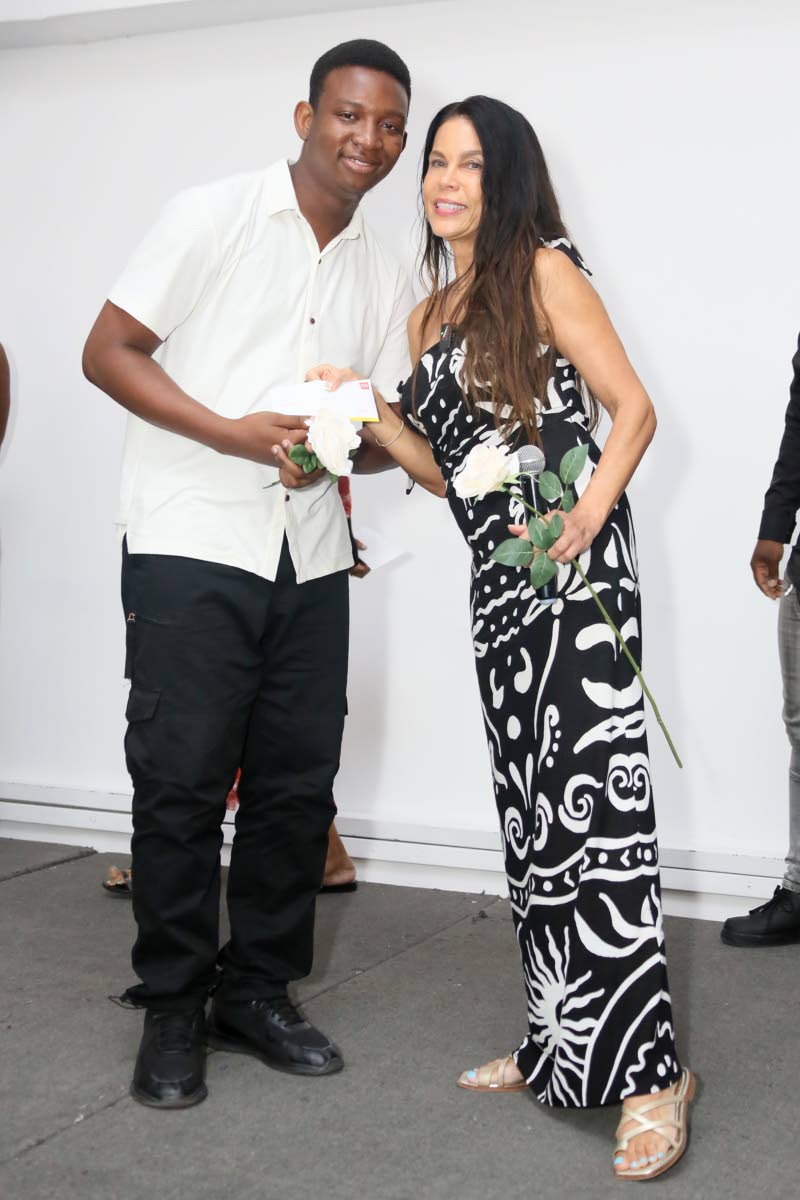
Producer Debra Ehrhardt presents Jamar Grant with his first-place prize for ‘In Search of More-Rock’ at the fifth annual What’s Your Story, Jamaica? Storytelling Competition.
-
 Jamar Grant delivers his winning story, ‘In Search of More-Rock’, during the fifth annual What’s Your Story, Jamaica? storytelling competition.
-
 Jamar Grant (centre), winner of the What’s Your Story, Jamaica? Storytelling Competition for ‘In Search of More-Rock’, is joined by second-place finisher C Shaw-Reid (left) with ‘A Blessing and a Curse’, and third-place finisher Tanisha Bent with ‘Devil on the Church Bench’.
-
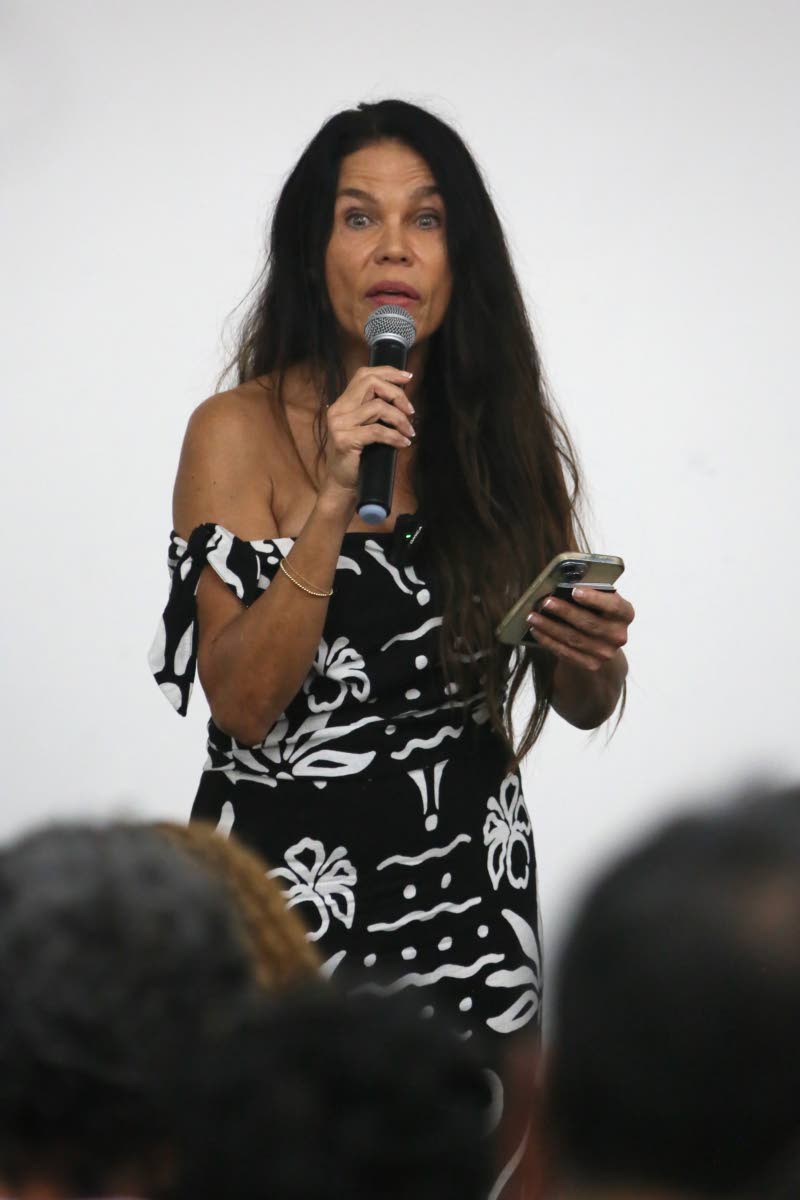 Producer Debra Ehrhardt captivates the audience with a story during the fifth annual What’s Your Story, Jamaica? storytelling competition.
Twenty-our-year-old high school teacher Jamar Grant put Shakespeare’s insightful observation, “Sweet are the uses of adversity,” to good use on Sunday and earned himself $375,000. Like thousands of others, he has been telling of his experiences with Hurricane Melissa, which ravaged the island last October. But by crafting and using his story in a special way, he has won himself first prize in the fifth Annual What’s Your Story, Jamaica? Storytelling Competition.
Grant and the eight other finalists who performed at the S Hotel in New Kingston had been rehearsing for the past several weeks under the guidance of the competition’s founder, Los Angeles-based, Jamaican actress and storyteller Debra Ehrhardt. She told The Gleaner that this year’s competition marks “a real turning point”.
“It’s the largest competition we’ve ever had – not just in numbers, but in reach. We have contestants travelling from all across the island, some driving for hours. Also, new is the depth of the stories. This year, the storytellers are going deeper – becoming more personal, more vulnerable, and more courageous. The stories feel braver, more honest, and more reflective of who we are as a people right now,” Ehrhardt said.
The stories heard by a full house on Sunday were indeed “brave” and “honest”, with many dealing with embarrassing and/or intimate encounters. No doubt, the size of the prizes in the million-dollar competition proved a strong incentive for the tone. Six of the nine finalists received cheques of $32,000 each, while the second runner-up, Tanisha Bent, got $150,000, and the first runner-up, Suzette Shaw-Reid, skipped joyfully away with $275,000.
Bent’s story, Devil on the Church Bench, explored her long, passion-filled, but eventually non-sexual relationship with a married man; Shaw-Reid’s A Blessing and a Curse meandered through the difficulty she had understanding the social media jargon of a set of Gen Z youngsters who came to work at the company where she was in human resources, eventually learning it and becoming very helpful to the company; while Grant’s story, In Search of More-Rock (his community), was about the nonchalant, even careless attitude many residents had when warned about the coming of Melissa, and the subsequent devastation it caused.
The other six finalists were Rasheed Lewis ( Run Your Own Race); Jada Simpson ( Small Pot, Big Noise); Kenneth Grant ( Bawly Bawly); Justin Awn ( That Night on Constant Spring Road); Jerome King Johnson ( No More Closet); and Marlon Thompson ( My Ghetto Story).
WINNER
In a post-competition interview, the overall winner revealed a background that would’ve honed his public speaking talent. At Godfrey Stewart High School in Sheffield district, Westmoreland, he’s in charge of the Speech and Drama Club, which he said has “a magnificent programme”. The school got the Jamaica Cultural Development Commission (JCDC) Best Senior Institution in Speech award for 2025; he was valedictorian at a University of the West Indies graduation in the Faculty of Humanities and Education; and he has won many JCDC awards in speech competitions. Asked what he planned to do with his prize money, he said his first very thought was of donating a portion to his church.
The winners were chosen by a combination of ballot voting by the audience and five specially invited judges – educator Gracia Thompson; economist Dr Damien King; University of Technology President Dr Kevin Brown; television presenter and theatre director TK Dawkins; and author and motivational speaker Kwame M.A. McPherson.
As she closed off the evening, Ehrhardt asked patrons to start thinking about entering next year’s competition with their own true, six-minute-long stories. “Looking ahead,” she wrote in her email, “my focus is growth with purpose. I want to take this work beyond the stage and into schools, introducing storytelling as a tool for self-expression, empathy, and confidence-building among young people. My goal is to help nurture the next generation of Jamaican storytellers – not just performers, but thoughtful communicators who understand the power of their own voice.”
She also mentioned being advised, after graduating from drama school in New York in the late 1960s, to lose her Jamaican accent if she wanted to work consistently as an actor in the US. She stated, “At the time, the belief was that a Caribbean accent would limit the roles I could be cast in, particularly in American theatre and film. The advice wasn’t given unkindly – it was framed as practical, even helpful – but it stayed with me.”
In fact, she ignored the advice and, ironically, is now internationally known both for the Jamaican storytelling competition and her five Jamaica-based, one-woman plays, Mango, Mango, Invisible Chairs, Jamaica, Farewell, Cock Tales, and Look What Fell Out De Mango Tree.
entertainment@gleanerjm.com