Sheldon Shepherd gives thanks with debut album
Loading article...
-
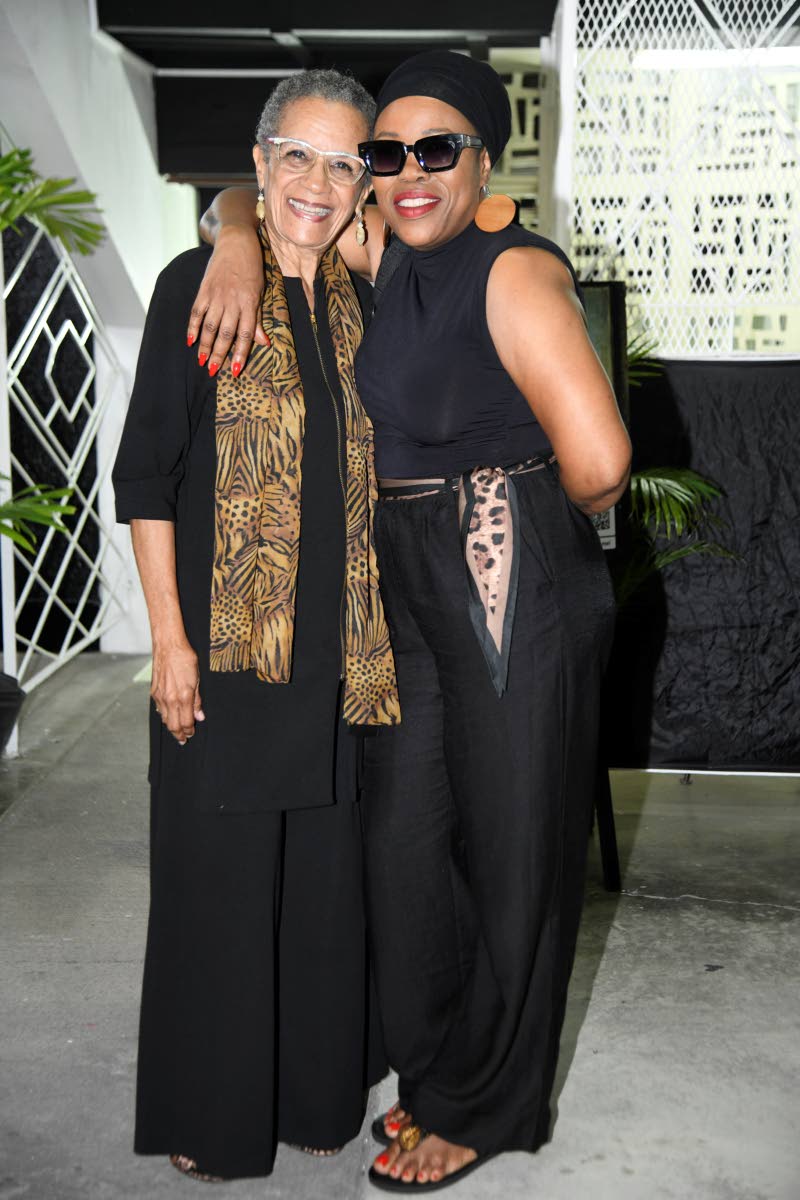 Veteran broadcaster Fae Ellington (left) shares the frame with Queen Ifrica at Sheldon Shepherd’s album listening event at the Philip Sherlock Centre for the Creative Arts at The University of the West Indies, Mona campus, on September 9. Photo - Antoine Lodge
-
Veteran broadcaster Fae Ellington (left) shares the frame with Queen Ifrica at Sheldon Shepherd’s album listening event at the Philip Sherlock Centre for the Creative Arts at The University of the West Indies, Mona campus, on September 9. Photo - Antoine Lodge
-
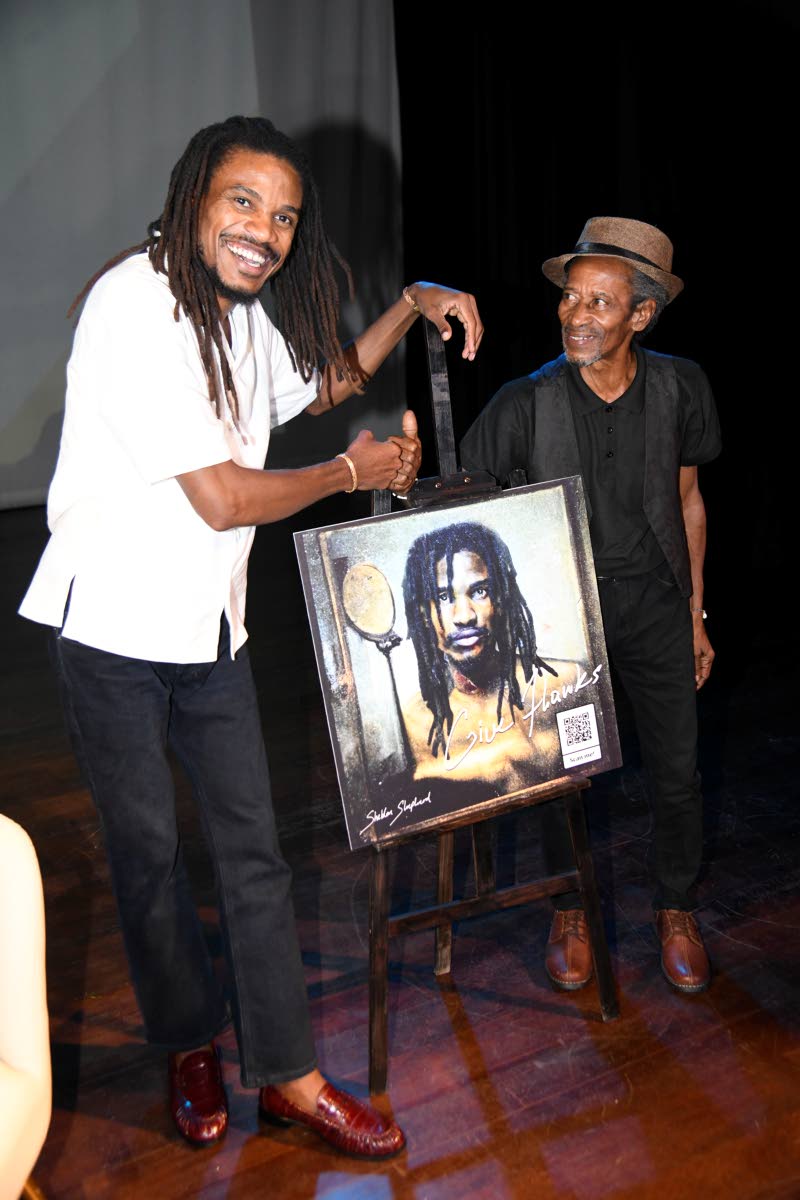 Sheldon Shepherd (left) and his father, Keith Anthony Shepherd, pose beside an easel displaying the cover of Shepherd’s debut solo album, ‘Give Thanks’. Photo - Antoine Lodge
-
 Sheldon Shepherd during his ‘Give Thanks’ album listening event at the Philip Sherlock Centre for the Creative Arts. Photo - Antoine Lodge
-
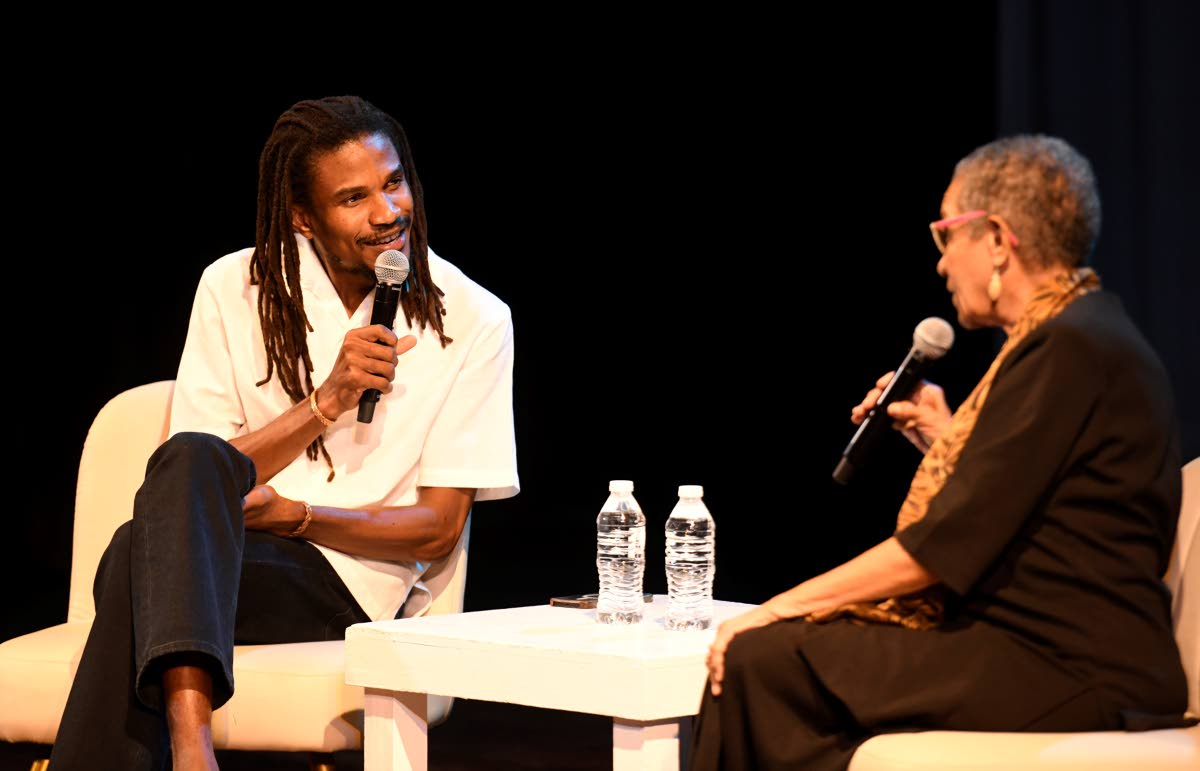 Sheldon Shepherd (left) shares the stage with veteran broadcaster Fae Ellington during a conversation following the listening event for his debut album, ‘Give Thanks’. Photo - Antoine Lodge
-
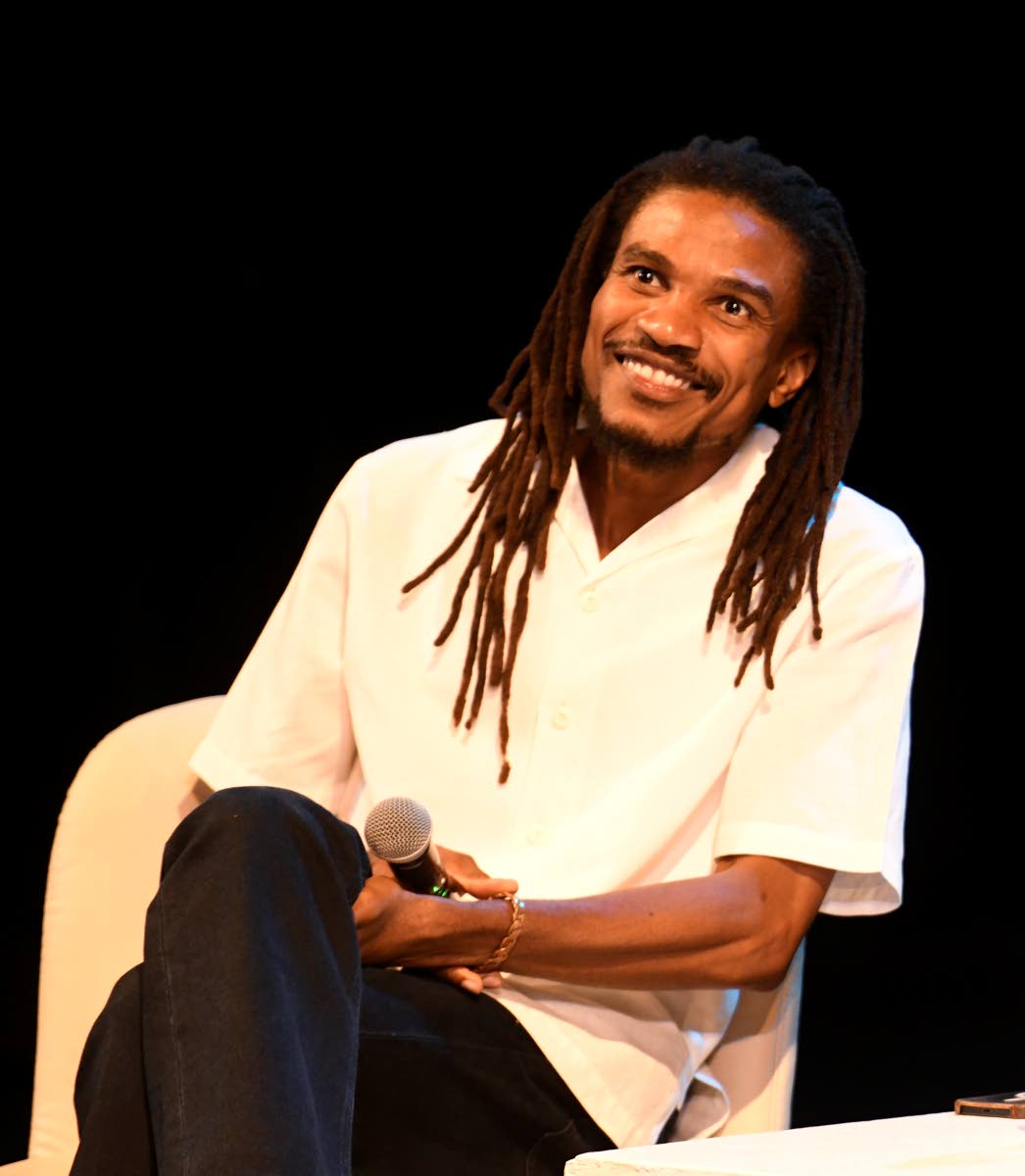 Sheldon Shepherd engaged members of the audience during the special event. Photo - Antoine Lodge
In the small hours of November 11, 2023, Sheldon Shepherd jumped out of his bed in New York, stumbled into the living room, found a sheet of paper and started to write. What came was a poem about Neville Garrick – Bob Marley’s famed art director, the hand behind the Rastaman Vibration and Exodus covers, and the man Shepherd had spent months becoming on the set of the movie, Bob Marley: One Love. The two had grown close between scenes, hiding out in Shepherd’s trailer, where Garrick shared stories about his family, including his son Nesta, and a Bob Marley nobody outside of his inner circle ever met.
“He humanised Bob to me. He told me Bob was like his big brother who looked out for him and took care of him,” said Shepherd.
They bonded over a shared love of art and Fortis as Shepherd and Garrick both attended Kingston College and studied art under the same teacher. Shepherd finished the piece, sat with it, and read it back.
“I read it back, and I said, ‘this sound like a eulogy’,” he recalled.
Three days later, on November 14, Garrick died in California. He was 73.
Shepherd never sent him the poem. He says he does not regret it now, but he has not stopped hearing it either.
He told that story at the Philip Sherlock Centre for the Creative Arts at The University of the West Indies, Mona campus, where media and invited guests heard his debut album, Give Thanks, in full ahead of its September 18 release. The 11-track project comes out on his own NoMaddic Movement label, distributed by Tuff Gong International, and was followed on the night by a conversation with veteran broadcaster Fae Ellington.
The album that arrived uninvited
Asked why a first solo album now, after much time had passed since his No-Maddz years, Shepherd says it wasn’t planned.
“I did not choose to make this project,” he told Ellington. “The project actually came through me as opposed to from me.”
The machinery assembled itself much the same way. He was hosting the Reggae Geel festival in Belgium in 2024 when Cedella Marley – Bob Marley’s daughter and chief executive officer of Tuff Gong International – asked what was happening with his music. He told her he had been recording, no longer as part of a collective. She asked to hear it. He emailed tracks, and she came back offering distribution. He is careful to say he is still the label. Tuff Gong, he said, agreed to go further than distribution and put some financial weight behind the record.
“Meet me halfway,” he said he told them. “And Tuff Gong said, alright, sure, we meet you halfway.”
For an independent artiste, he added, that is the relationship you want.
Pressed on which of the 11 pieces cuts closest, Shepherd did not hesitate: track seven, Ode to Dub Poetry. It came to him in New York, he said, and it did not arrive as an idea. It arrived as a person.
“Dub poetry in the form of a woman,” he said. “She was crying. And she was saying to me, ‘I don’t think they love me’. And I started to cry within the moment.”
Asked later why that piece was the most personal, he returned to the same image.
“It came as a narrative about the genre, and how I think the genre was feeling – the genre was feeling left out. And she whispered in my ear, and I felt the intimate vibrations of it, and that left a particular mark on me,” said Shepherd.
The poem that followed moves through the tradition’s roll-call – Oku Onuora, Mikey Smith, Jean ‘Binta’ Breeze, Benjamin Zephaniah, Linton Kwesi Johnson – and nods to Reflection in Red, regarded as the first Jamaican dub poetry recording. Shepherd said he wrote the closing lines specifically to answer the woman rather than leave her weeping. He wanted the piece to end on a positive vibration, he said, to tell the genre it is still here with us.
On why the work leads with Patois as the main driver, he was blunter still: “English cannot do it,” said Shepherd, before crediting Louise Bennett-Coverley with teaching Jamaicans to love the language of Patois, and through it, themselves.
Dub poetry, he added, is neither a “fenke fenke” genre nor a frivolous one.
“Dub is the music and poetry is the word,” he said, arguing that a dub poem only becomes a song when people move to it. Where a songwriter might scat a melody and fill in the language afterwards, a dub poem arrives finished. It comes with rhythm, cadence, melody, story, every nuance at once – and you write it down fast, or you lose it.
Four at a lunchroom table
The album’s other spine runs back to a Kingston College lunchroom at the turn of the millennium, where a handful of schoolboys sat designing the group that became No-Maddz. One of them was Eric Sterling.
Sterling migrated to England after school – a parting Shepherd remembers as a small grief between two young men – and set about learning production and engineering so he would be useful to his friends later. Two decades on, he produced what Shepherd put at 65 per cent of Give Thanks.
The remaining credits carry their own unexpected origins. The opening track, One A Dem Youth Deh, was written by Shepherd’s father, Keith Anthony Shepherd, and is the piece he won more festival awards with than any other as a boy.
He did not set out to record it.
“I never even chose it,” he said. “It actually chose to be on the project.”
A Philadelphia dub producer heard an a cappella he had posted online, built a production around it, and wrote afterwards, asking permission.
Bad Boy Ratty began as a commission – a theme song requested for a stage play – and grew into something else once Shepherd noticed the symmetry between Jimmy Cliff’s Ivanhoe Martin in The Harder They Come, the character modelled on the outlaw Rhygin, and his own award-winning lead in Better Mus’ Come.
He played the finished track in the car for a Kingston College contemporary who had performed an early schoolboy version of the same material with him, and watched the man break down. Seeing a grown man cry over it, he said, meant a great deal.
Custodian, not leader
The conversation turned philosophical in its last stretch.
Shepherd described layering the album deliberately with what he calls resounding harmony and gave his working definition of the idea beneath it:
“Resonance is the vibration that creates harmony.”
Ellington asked what he fears most. He talked about years of praying on his knees in fear and a night in a New York hotel when he caught himself at it and felt phoney – then reasoned his way to a different position.
“The biggest thing we fear in life is mortality,” he said. “The idea of it. To not be in this physical realm anymore.”
We run to the doctor because we do not want to die, he said, and in the fearing we damage ourselves. Anxiety, he concluded, is a waste because “none of us are getting out of this alive”.
What he is most grateful for turned out to be smaller than expected: the sun rising, his eyes opening, his breath. Everything else, he said, is brawta – the talent, the skill, even the family. And even then, “I don’t own my children,” he said, borrowing from the Lebanese-American writer Kahlil Gibran the idea that they are not ours.
Then Ellington turned the conversation to the room itself. The hall sits by August Town, where Alexander Bedward built a movement that unsettled colonial Jamaica a generation before Marcus Garvey, who, in popular memory, has mostly been reduced to the man who tried to fly. Ellington, who worked on a Marriott production about the preacher, said the research shows Bedward “prophesied” that UWI’s acres would one day become a seat of learning.
There is a further symmetry neither of them had to reach for. In 1901, Bedward was made a bishop and given the title of “shepherd”. The coincidence of names did not escape him, and he was firm about what his own meant.
“A shepherd is not a leader,” he said. “The shepherd is someone who takes care.”
He described himself as a custodian and said he never signed up to be anybody’s leader.
Late in the evening, he asked for the house lights to come up so he could see who had turned out – his father among them, along with Onuora, the father of Jamaican dub poetry, Queen Ifrica, and schoolmates from Kingston College and Franklin Town Church of God.
Almost everyone in the room, he said, he had telephoned personally.
“It’s family.”
Asked what he was giving thanks for, he pointed at them.
“Jamaicans actually like me,” he said. “So I’m very thankful for them.”
Evon T. Krishna Benjamin is a writer, poet, and cultural analyst. Email feedback to entertainment@gleanerjm.com.