
Gleaner Classics
Gong gets St Ann send-off, reggae style
Published:Friday | May 21, 2021 | 2:03 AMA Digital Integration & Marketing production
Much has been said about Bob Marley not being interred in National Heroes’ Park, but his funeral in Alexandria (one of two that day), where he was born, was very much like that of a hero’s. His final resting place, a mausoleum, has stories to tell of that fateful day, but so do the pages of The Gleaner, a story coming from 55 miles away at the National Arena in Kingston.
Published May 22, 1981
BOB MARLEY BURIED IN ST. ANN
It was more like a carnival
AMID SCENES OF sadness, Jamaican reggae superstar, the Hon. Robert Nesta Marley, O.M., was buried on May 21, 1981, in a newly built mausoleum in the sleepy village of Nine Miles, near to Alexandria, St. Ann, where he was born 36 years ago.
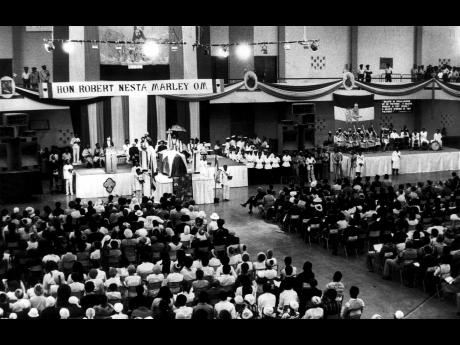
A carnival atmosphere marked the ceremony at the National Arena in Kingston where the second of two funeral services were held in the morning and on the route to the little village some 55 miles away in rural Jamaica.
Both inside and outside the Arena, which was packed to capacity for the service attended by the Governor-General, the Prime Minister and the Leader of the Opposition, higglers made roaring business selling soft drinks, fruits and Bob Marley memorials - from red, green and gold buttons with his face on the front to huge wall-size posters showing him in his natural poses.
Loud shouts of acclamation greeted the Governor-General, the Most Hon, Sir Florizel Glasspole, the Prime Minister, the Hon. Edward Seaga: and the Leader of the Opposition, Mr. Michael Manley, on their arrival at the Arena.
Sir Florizel's reading of the First Lesson was punctuated by shouts of “Jah Rastafari” from one section of the balcony. Mr. Manley was given a very warm ovation after reading the Second Lesson; and Mr. Seaga was given a standing ovation by some after his "Remembrance”, in which he announced the setting up of "Jamaica Park", as a shrine for Jamaicans who had excelled in Sports, Culture and Science, internationally.
THE ATMOSPHERE WAS ALMOST totally devoid of the traditional sombre air of Jamaican funeral.
Loudspeakers blared Marley hits from the Arena's stage and tape recorders, while some people danced and sang. There were no seams, no flowers. So plentiful were the vendors that the announcer at the Arena had to request that selling be avoided inside the Arena "because it is a funeral service that is in progress”.
The Police effectively controlled a huge crowd which threatened to get out of hand and on several occasions. After the service, the Police had to forcibly remove large numbers of "dreadlocks” who forced their way into buses and other vehicles hired for the trip to St. Ann, and to lock the Arena's doors to control the flow of people out at the hall.
OVER 20 MILLION
Marley, who sold over 10 million records in as international career which spanned the entire decade of the 1970's and spilled over into 1980, died of cancer on May 11 in the Cedar of Lebanon Hospital in Miami Florida, while on his way home from treatment for his illness in Germany.
Marley's mother, Mrs. Cedella Booker, her daughter Pearl Booker and a female friend known as "Ora”. Sang a song entitled "Hail" and got a warm ovation for the effort.
Bob's widow, Rita, a popular singer in her own right, teamed up with Judy Mowatt and Marcia Griffiths (of the "I Threes) to sing two of the late singer's hits, "Rastaman Chant" and "Natural Mystic", while Prime Minister Seaga and His Eminence Archbishop Abouna Yesehaq, who conducted the service, quoted from some of Marley's most popular works during the ceremony.
THE OFFICIAL FUNERAL started at the Ethiopian Orthodox Holy Trinity Church in Maxfield Park in Kingston at 8 a.m. His Eminence, Arch bishop Yesehaq, head of the church in the Western Hemisphere, conducted the service.
After the church service, the casket was taken to the National Arena in a motorcade, deliberately passing Tuff Gong Recording Studio, at Hope Road, which was built by the late singer.
At the Arena dozens of foreign journalists, mainly photographers, battled with officials to take pictures of the casket draped with the flag of Jamaica, and of Bob's family, including his mother and his widow, who watched from the second row of seats. Officials of the religious organizations associated with Bob, mainly the Twelve Tribes of Israel, fought a losing battle trying to prevent the taking of pictures inside the Arena.
As soon as the casket was art in place on the huge Arena stage, thousands of people started flooding into the hall.
SKILL COLE AGAIN
The setting was extremely colourful with a neon light flashing Bob's Twelve Tribes adopted name "Joseph". The backstage was draped in red, green and gold with the words, “The Hon Robert Nesta Marley”, printed loud and bold in black and white stretched across the top. There were several paintings of the late Emperor Haile Selassie at intersections above the drapes and two tablets with texts from the Holy Bible.
There was one main snag in the ceremony when Allan “Skill” Cole, a former Jamaica footballer and manager of Marley, who is also a member of the Twelve Tribes of Israel, refused to recite the scripture lesson planned by the Ethiopian Orthodox Church.
Archbishop Yesehaq and his priests and deacons were obviously upset but allowed Mr. Cole to continue to read his own selection.
In a statement near the end of the service, Archbishop Yesehaq said: "Bob Marley, because of bringing international recognition to the music of this land - reggae music and placing Jamaica, as it could be said literally on the map of the world as a land of dignified culture, contributed significantly to the development of this country and its people.
"For this, I may venture safely to say that he can be ranked in the order at National Heroes; Marcus Garvey, Paul Bogle, William Gordon, Sir Alexander Bustamante, Norman Manley and Nanny who did great work for their country."
The Archbishop said that, as a prophet, Marley was able to touch the hearts of everyone, regardless of race, colour or creed. As a Rastafarian, Marley had brought dignity to that movement.
“They are a people who are continuously struggling towards their identity and should be encouraged in the development of their talent and skills for the benefit of the country. I say this with the hope that they will be fully aware about their home, not only in Africa, but also in Jamaica," the Archbishop said.
REMEMBRANCE
Prime Minister Edward Seaga said in his Remembrance: "Bob Marley's mission was to pursue humanity's search for justice and togetherness. In so doing, he created message and melodies and he superimposed these on the infectious reggae rhythm of Jamaica.
“Jamaica was always a part of his international work. His work is now over and be returns to his home. Visionary that he was, be foresaw this, as he hurriedly flew back to his homeland when he realised his work was over, death meeting him on the way. He immortalised these words in his own creation: “Fly away home to Zion, fly away home. One bright morning when my work is over, I will fly away home.”
"May his soul find contentment in the achievements of his life and rejoice in the embrace of Jah Rastafari," the Prime Minister said.
Marley could not be easily erased from the mind as he was a part of the collective consciousness of the nation and he would continue to be a vital part of the consciousness of the nation, the Prime Minister said.
There was good reason why this should be so. Marley's vibrations penetrated the mind with a central message that was universally understood. His message was against injustice, a comfort to the oppressed, a search for peace and a cry for hope.
"He has left behind more than the message of his songs," said Mr Seaga. He has bequeathed to us the message of his life; that with hard work and self-discipline there is an open road to success.
Mr. Seaga said that in conveying his thanks to him for the honour of being given the Order of Merit (O.M.), Marley had said to him: "Big man, if you can do it, do it."
Also taking part in the service at the Holy Trinity Church were the Rev. Father Kes Amaha Selassie Dewar, who gave “Absolution of the Son”: Deacon Wlde DaWitt who read the litany; Kes. Gabre Selassie Fitzgerald, who read the First Lesson and Kes. Tesfa Zion, who read the Second Lesson.
On the procession, the casket was carried in an open-back hearse. Members of the Ethiopian Orthodox Church and the Twelve Tribes of Israel, as well as dozens of journalists, security men and musicians and other members of the public, followed in rented buses after the late singer's family.
The United Africa Band, led by saxophonist Cedric Brooks, provided the musical accompaniment for both church services.
This is a production independent of The Gleaner Company (Media) Limited's newsroom. For feedback: contact the Digital Integration and Marketing Department at Newsletters@gleanerjm.com