Dennis Minott | Could Trump eat grass before reason returns?
Loading article...
-
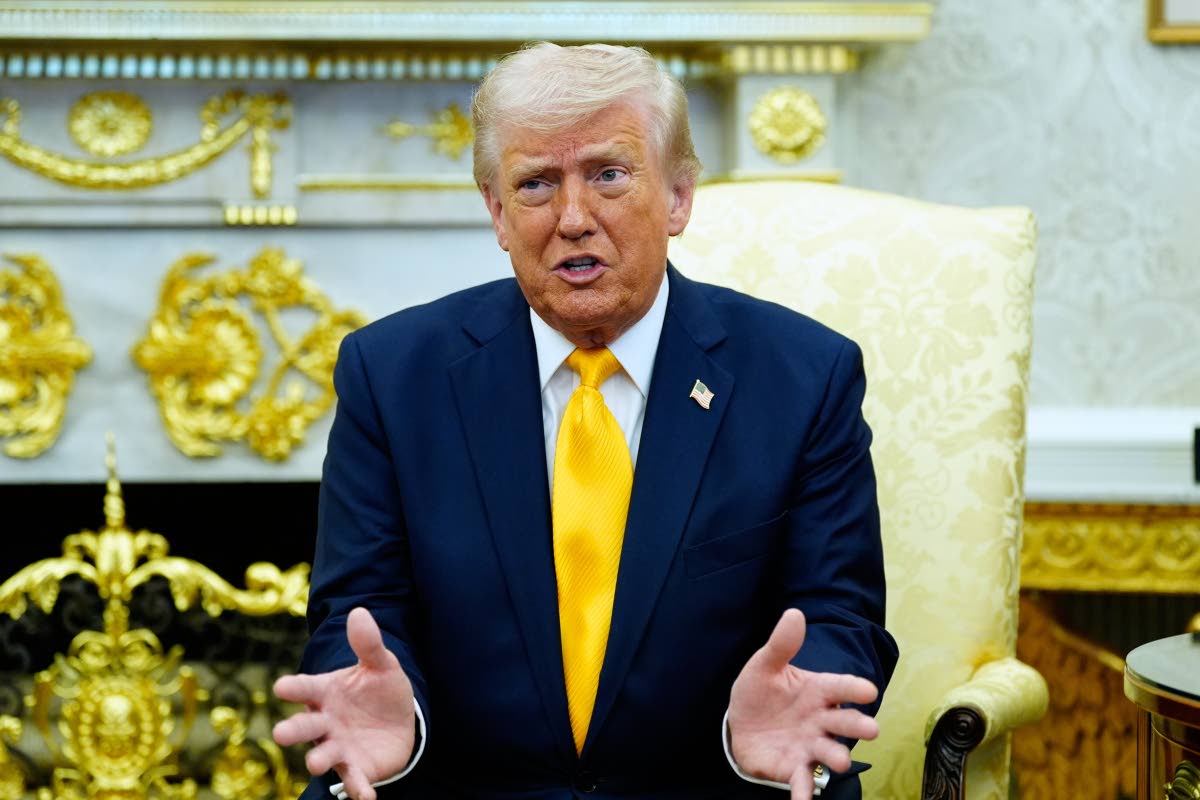 President Donald Trump speaks during a meeting with Japan’s Prime Minister Sanae Takaichi in the Oval Office of the White House.
-
 Dennis Minott
There are moments in history when metaphor ceases to be decorative and becomes diagnostic. We are living through such a moment. The question–whether Donald Trump might “eat grass before reason returns”–is not a casual provocation. It is a moral inquiry framed in biblical language, asking whether power, when unrestrained by humility or wisdom, inevitably hastens its own undoing.
The story of Nebuchadnezzar, recorded in the Book of Daniel, remains one of the most penetrating psychological portraits of political hubris ever written. Standing atop his palace, surveying the splendour of Babylon, the king declares: “Is not this great Babylon, that I have built… by my mighty power, and for the honour of my majesty?” . In that instant of unguarded self-exaltation, something fractures. The narrative tells us that reason departs from him. He is driven from human society, reduced to a bestial existence, until he relearns a truth he had forgotten: power is never absolute.
Whether one reads this account as history, allegory, or theological drama, its lesson is unmistakable. Leadership untethered from humility becomes dangerous–first to others and then to itself.
In contemporary geopolitics, echoes of that ancient rooftop resound with unsettling clarity. When a modern leader speaks in the language of “total authority”, treats long-standing treaties as disposable inconveniences, or reduces complex nations – whether Iran, Cuba, or even Greenland – to objects of transactional negotiation, we are not merely hearing policy. We are hearing a philosophy of power. It is a philosophy in which the world is not a community of sovereign actors but a chessboard awaiting the will of a singular player.
This is the delusion of self-sufficiency.
It is a structural danger. For when governance becomes indistinguishable from personal branding, the distinction between statecraft and self-advertisement collapses. Decisions cease to be anchored in institutional memory or collective wisdom and, instead, become extensions of impulse and persona. That was the precise condition that preceded Nebuchadnezzar’s fall – not weakness but the folly of overconfidence masquerading as strength.
Yet the ancient king was not without warning. Daniel stood before him – a voice of inconvenient truth – urging him to “break off” his excesses and practise righteousness. The tragedy lay not in the absence of prudent counsel but in its dismissal.
Our age, too, has its Daniels. They are the career diplomats, intelligence professionals, regional scholars, and seasoned statesmen who understand that power must be exercised with proportion. They caution against escalation, urge the preservation of alliances, and remind leaders that consequences, though sometimes delayed, are never absent. But when such voices are sidelined in favour of flatterers, ideologues, or familial confidants, the nature of governance itself begins to change. The palace becomes a hall of mirrors, reflection replaces reality, and applause substitutes for truth.
In such a setting, error does not correct itself. It multiplies.
The biblical image of Nebuchadnezzar eating grass like an ox is not mere spectacle. It is a profound metaphor for the collapse of proportion. The king does not lose his throne first; he loses his perspective. He becomes estranged from the human condition he was entrusted to govern. That estrangement is the true madness.
For Washington, the warning is stark. A state that confuses might with infallibility risks drifting into isolation – not by design but by consequence. Allies grow cautious. Adversaries grow opportunistic. The architecture of stability, constructed over generations, begins to weaken under the weight of impulsive decision-making.
For Jerusalem, the lesson is more subtle but equally urgent. To ground national security too heavily in the temperament of a foreign leader – however powerful – is to build on shifting sand. Enduring security rests not on personalities but on principles, institutions, and a consistent pursuit of justice.
For Tehran, the caution takes yet another form. Reactionary pride, nourished by grievance and resistance, can mirror the very arrogance it seeks to oppose. Defiance without reflection is not strength. It is symmetry. And symmetry, in geopolitics, often leads to escalation rather than resolution.
Thus, the Nebuchadnezzar narrative is not an indictment of a single leader. It is a mirror held up to all centres of power. It reveals a shared human vulnerability: the temptation to absolutise authority and the blindness that follows.
But what, then, of the question itself? Could Trump “eat grass before reason returns”?
Taken literally, the answer is plainly no. Modern governance is buffered by institutions, constitutional limits, and electoral accountability. No single individual, however dominant, is permitted to collapse in such a visibly dramatic fashion without consequence.
Yet metaphorically, the question acquires a sharper edge.
“Eating grass” signifies a loss of grounding — a detachment from reality so complete that power becomes incoherent. In this sense, the danger is not theatrical madness but incremental distortion. It is the gradual normalisation of impulsive rhetoric, the erosion of truth as a governing principle, and the quiet displacement of expertise by instinct. It is the moment when policy begins to follow personality rather than principle.
History suggests that such conditions are not exceptional. They are recurring.
The redemption in Nebuchadnezzar’s story lies not in his fall but in his restoration. After his period of madness, he “lifted his eyes unto heaven” (Daniel 4:34), and his understanding returned. He recognised that his authority was conditional, not absolute. In that recognition lay the recovery of both reason and legitimacy.
That is the enduring hope within the warning.
For modern leaders, restoration need not require humiliation, but it does require recognition. It requires an acceptance that no nation – however powerful – operates beyond consequence; that restraint is not weakness, but wisdom; and that leadership is ultimately measured not by the volume of its assertions but by the discipline of its judgements.
In a nuclear age, this is not merely a moral reflection. It is an existential imperative.
We stand, therefore, at a precarious juncture. The language emerging from major capitals suggests a troubling drift towards the personalisation of power at precisely the moment when global stability demands its depersonalisation. The stakes extend far beyond reputations or elections. They encompass the fragile equilibrium upon which human security depends.
The Book of Daniel does not predict future but clarifies choices.
We may continue along a path where bravado substitutes for wisdom, where alliances are transactional, and where dominance eclipses diplomacy. Or we may heed the ancient warning, recognising that true greatness in leadership lies not in the assertion of absolute power but in its careful limitation.
Nebuchadnezzar learned that lesson after losing his reason.
One hopes that our own age will not require so severe a correction ... in Washington or ...
Dennis A. Minott, PhD, is a physicist, green energy consultant, and long-time college counsellor. He is the CEO of A-QuEST. Send feedback to columns@gleanerjm.com.