Adekeye Adebajo | Black Atlantic’s dogged quest for reparations
Loading article...
-
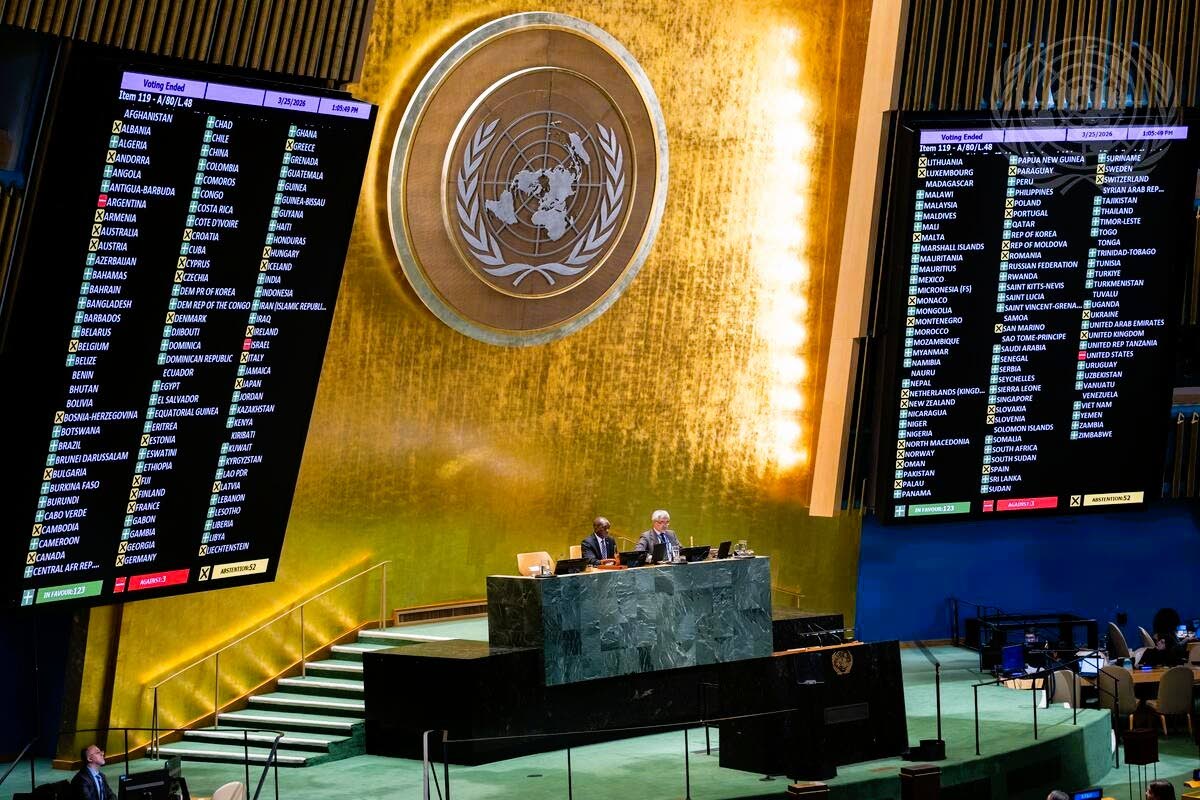 A view of the General Assembly Hall following the vote on resolution declaring the Trafficking of Enslaved Africans and the Racialised Chattel Enslavement of Africans as the Gravest Crime Against Humanity.
-
 Adekeye Adebajo
In 2023, the African Union (AU) mandated Ghana to lead the reparations struggle of Africa and its diaspora, under the energetic leadership of Nana Akufo-Addo, who built strong bridges with the Caribbean.
Last week, on March 25, his successor, John Mahama, presented a historic resolution to the United Nations (UN) General Assembly which declared transatlantic slavery – in which 12-15 million enslaved Africans were transported to the Americas and the Caribbean between 1450 and 1888 – to have been “the gravest crime against humanity”.
This sordid commerce had been led by governments, slavers, and businesses from Britain, France, Portugal, Spain, the Netherlands, Denmark, and Sweden. Rather perversely, European and American governments compensated slaveowners and their descendants, rather than the enslaved and their heirs. The British government, for example, paid £20 million (£3 billion today) to 46,000 slaveowners and their descendants over a 182-year period, after the abolition of slavery across the British Empire in 1833.
SACRED DRAMA AT THE UN
Last week’s UN resolution described the transatlantic slave trade as “a systematic, widespread and institutionalized regime of violence, exploitation, dehumanization and racial subjugation”, noting that its consequences included “the large-scale destruction of African societies … and the entrenchment of racialised inequalities that continue to structure international relations.” The systematic subjection of African women to sexual violence and forced reproduction was highlighted. The document further called for contributions to be made to reparations-related programmes being established by the AU and the Caribbean Community (CARICOM); a formal apology; and measures of restitution, rehabilitation, and compensation.
Following seven rounds of tortuous negotiations, the resolution was finally adopted by 123 out of 193 UN members (63%), with 52 countries abstaining. A solid Afro-Caribbean bloc was joined by states across Latin America (actively lobbied by Brazil) and Asia. The Europeans – the most culpable for transatlantic slavery and colonialism, and thus most responsible for paying reparations – abstained, while only the “terrible triplets” of America, Argentina, and Israel voted against the resolution, led by a nativist Trump administration which has sought to erase America’s 250-year history of slavery. The UN document pointedly reminded European governments of their own description of slavery at the 1815 Congress of Vienna as “repugnant to the principles of humanity and universal morality”.
PERFIDIOUS EUROPE
During the UN debate, the Europeans disingenuously condemned the transatlantic slave trade as “heinous”, but then sought to hide behind legal technicalities, accusing Afro-Caribbean diplomats of having created a “hierarchy of crimes”; complaining that these barbarous acts were not crimes at the time that they were committed, and insisting that international laws could not be applied retroactively. These same Europeans, however, forgot that, as colonial powers, they had simply invented legal concepts such as the notorious terra nullius (no man’s land) to justify their theft and pillage of territories in Africa, the Caribbean, the Americas, and Asia.
As Kenyan scholar-activist Ali Mazrui noted: “For several centuries, rules of European statecraft and diplomatic history had made it perfectly legitimate for a European power to colonize and subjugate a non-Western society.” Australian scholar Hedley Bull similarly explained: “The governments and peoples of Asia, Africa, and Oceania, who were subject to these rules, had not given their consent to them. The international legal rules … were not only made by the European or Western powers, they were also in substantial measure made for them.”
African-American lawyer-activist Randall Robinson forcefully argued that “the black holocaust is far and away the most heinous human rights crime visited upon any group of people in the world over the last five hundred years”, with 34 per cent of African-American children still born on or below the poverty line. Barbadian historian and chair of CARICOM’s Reparations Commission, Hilary Beckles, similarly noted that “slavery and genocide in the Caribbean are lived experiences despite over a century of emancipation”.
Before this recent UN resolution was passed, previous resolutions in 2006 and 2007 had simply noted the commemoration of 200 years of the abolition of the slave trade, and the remembrance of its victims. This was the first UN resolution to declare transatlantic slavery to have been a crime against humanity, and to seek redress for its continuing structural consequences involving persistent socio-economic disparities between Africa, the Caribbean, and the West, and within black communities across the Americas (40 per cent of all enslaved Africans had gone to Brazil and Cuba).
TORTUOUS ROAD TO NEW YORK
This has been a long struggle. Last year, the AU declared a “Decade of Action on Reparations” (2026-2035). Africa and its diaspora have thus sought to translate this moral crusade into concrete action through this recent UN resolution which traced the contemporary history of the Black Atlantic’s anti-slavery efforts. The Organisation of African Unity (OAU) had consistently pursued reparations (including monetary compensation and debt annulment) and restitution (particularly of cultural artefacts pillaged during slavery and colonialism) for historical crimes and mass atrocities. This culminated in the OAU’s 1993 Abuja Proclamation on Reparations.
The 2001 UN World Conference Against Racism in Durban had described transatlantic slavery as “abhorrent barbarism” that “should always have been” a crime against humanity. The conference also championed the inclusion of the history and contributions of Africans in international educational curricula, as well as fully integrating into public services, and increasing social services to, black communities across the globe.
CARICOM’s 2014 ten-point plan pushed for investments by European slaving nations in the region’s health, education, and cultural sectors, as well as technology transfer. The 2023 AU Accra Proclamation on Reparations (involving close collaboration with CARICOM) further crafted concrete policy recommendations for the Common African Position on Reparations and Healing, an Afro-Caribbean Programme of Action, and an African Caribbean Joint Mechanism on Reparative Justice.
BLACK LIVES MATTER
As a result of these struggles, the Afro-Caribbean-led reparations movement has had some recent successes. From 2019, American states and cities such as Evanston, Asheville, and Amherst started to implement reparations projects in black communities, as well as equal housing schemes. Black Lives Matter, Rhodes Must Fall, and other civic movements mobilised anti-racism protesters around the globe in 2020 – following George Floyd’s death at the hands of a white policeman in Minneapolis – more effectively than at any time in living memory.
In 2021, the German government apologised and announced reparations of €1.1 billion for a century-old genocide in Namibia, while the following year, the Netherlands government apologised for the Dutch role in the transatlantic slave trade and established a €200 million fund to address its impacts. In 2023, the Church of England announced a £100 million investment fund for communities afflicted by slavery. The insurance conglomerate, Lloyd’s, was pushed by reparations protesters to apologise for its role in transatlantic slavery in 2020, before the company announced a £40 million fund, three years later, to invest in communities impacted by slavery. Oxford, Glasgow, Harvard, and Yale universities have all established programmes of restitution to address their having benefited from the slave trade, sometimes through creating scholarships for the descendants of slavery and colonialism.
With last week’s unprecedented UN resolution on transatlantic slavery, Global African citizens continue – in the teeth of staunch opposition from xenophobic governments and political parties across America and Europe - their dogged efforts to build a viable global reparations movement to redress one of the worst crimes ever perpetrated against any group of people in the history of the world.
Professor Adekeye Adebajo is a senior research fellow at the University of Pretoria’s Centre for the Advancement of Scholarship in South Africa. Send feedback to columns@gleanerjm.com