Christopher Burgess | Rum bar recovery and reconstruction
Loading article...
-
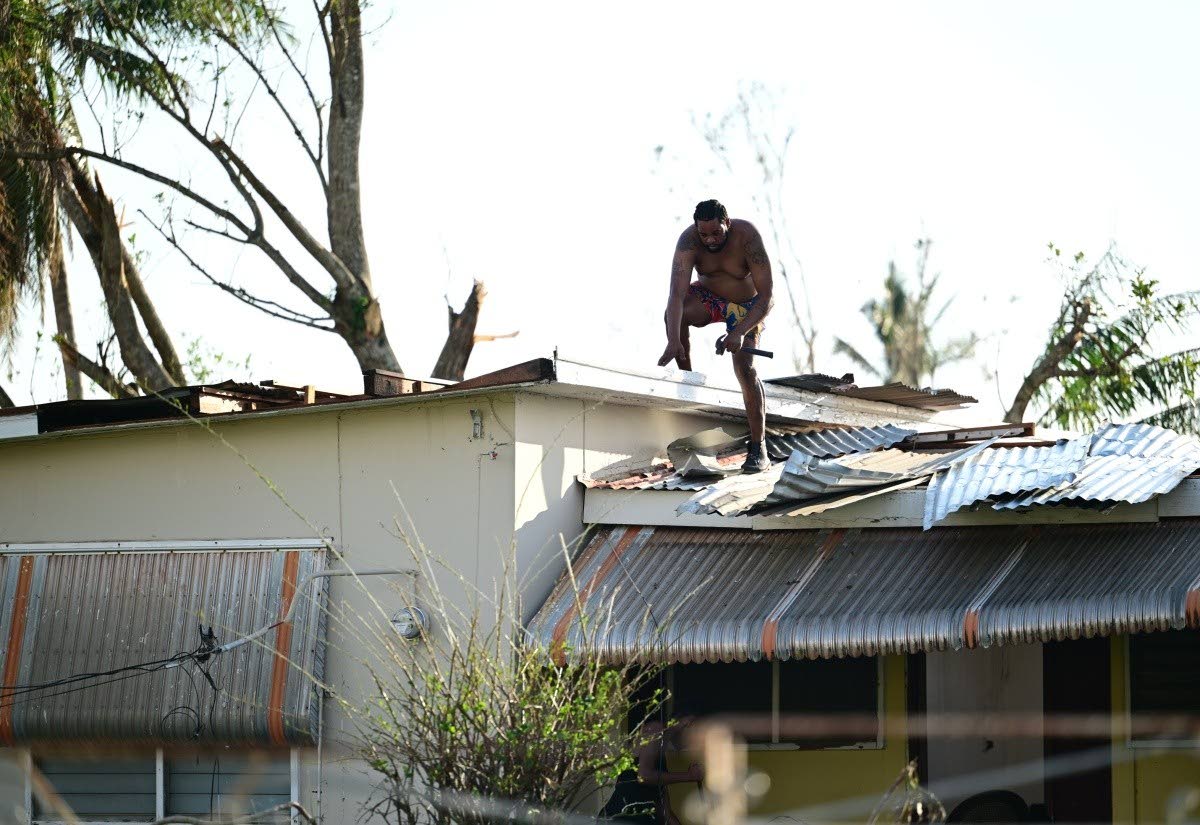 A homeowner in Black River, St Elizabeth, conducts roof repairs in the aftermath of Hurricane Melissa.
-
 Christopher Burgess
Five months after Hurricane Melissa, rebuilding in the worst-affected communities is drifting back towards fragility.
With formal rebuilding only now beginning, under the MLSS (Ministry of Labour and Social Security) J$10-billion ROOFS programme, many households in Westmoreland, St James, and St Elizabeth could not wait five months for shelter and rebuilt using salvaged zinc and improvised methods simply to survive. While this has been described as resilience by some, history shows that rebuilding with weak materials and poor detailing leads directly back to failure in the next hurricane.
In 1990, Engineer Alfredo Adams, of the Jamaica Institution of Engineers, in his seminal report on the impact of Hurricane Gilbert, warned: “Within eighteen months of the hurricane, small buildings in the informal sector seem to drift toward faulty designs based more on economy than hurricane resistance.”
Formal reconstruction also risks repeating past failures. The NaRRA (National Reconstruction and Resilience Authority) Bill, tabled two weeks ago, is centred on Cabinet issuing lists of “approved” projects to the authority to execute. The bill lacks governance structures, origination powers, technical guidance, and financial independence that made the ONR (Office of National Reconstruction) effective after Hurricane Ivan in 2004 and similar authorities effective in The Bahamas and Dominica after Category 5 events. The NaRRA Bill, in its current form, risks being a mere project-management unit and falls short of what is required of a build-back-better reconstruction authority.
“Resilience” and “build-back-better” are useful ideas in an era of climate change that requires more than cash distribution to the poor and sound bites. It requires strong institutions, governance, technical leadership, and oversight of reconstruction.
HURRICANE RECOVERY HISTORY
Successful recovery depends on governance structure and speed. After Hurricane Charlie in 1951, government-led rebuilding promoted stronger materials, such as block and steel, which continue to shape today’s housing stock, now over 75 per cent masonry, according to STATIN.
After Hurricane Gilbert in 1988, recovery was largely informal. With no central authority, rebuilding in the informal housing sector was left to socially challenged households. Known weaknesses in roof fastening and detailing were not corrected. Vulnerabilities re-emerged during both Hurricanes Beryl and Melissa, particularly in western Jamaica.
Following Hurricane Ivan in 2004, Jamaica demonstrated a better model. The Office of National Reconstruction (ONR), headed by The Honourable Danville Walker, was established within a few weeks, coordinating funding, enforcing technical standards, and linking grants to inspection and staged rebuilding. Rocky Point, Bourkesfield, and Portland Cottage were major relocation sites where over 1,200 new houses and service lots were provided. This structured approach produced stronger outcomes and remains a benchmark for effective recovery.
RUM BAR MONEY
Today, Jamaica faces a rebuilding challenge of unprecedented scale, according to Dennis Zulu of the United Nations. The ROOFS grant programme, capped at J$500,000 for severely affected households, is inadequate for the typical house size and unlikely to deliver resilient reconstruction for most families. Already, there are reports of inadequate communication and difficulties with registration and with delays in receiving benefits. There are credible reports that a significant number of people are also converting material grants to cash and travelling long distances to access the grants. Without verification, technical guidance, and inspection, there is a real risk that funds have been diverted to BE used to replicate weak construction practices or to satisfy immediate household needs. Essentially, rum bar money.
After Haiti’s 2010 earthquake, cash grants improved short-term welfare but reproduced weak houses. The Cash Learning Partnership, which included Oxfam and the British Red Cross, found that without technical guidance and inspections, cash did not result in safer homes.
Regional and local experience consistently shows that centralised, legislated rebuilding with technical oversight works while dispersed, unsupervised cash grants do not work and risk repeating the same cycle observed after Hurricane Gilbert, Haiti’s earthquake, more recently, among the recipients of Hurricane Melissa grants.
COMPETENCE VERSUS CASH
Coordination and oversight have been highly effective in the rebuilding of The Bahamas and Dominica. After Hurricane Dorian, The Bahamas established the DRA (Disaster Reconstruction Authority) within months. Dominica, following Hurricane Maria, created a dedicated execution agency with a mandate for climate-resilient rebuilding CREAD (Climate Resilience Execution Agency of Dominica). Both approaches combined centralised authority, mandatory technical standards, and oversight of works.
By contrast, loose cash disbursement and fragmented responses have consistently failed locally and regionally. Haiti’s post-earthquake recovery demonstrated that cash-heavy, unsupervised rebuilding does not produce durable housing. Likewise, nine years after Hurricane Maria -- which caused 3,000 deaths and USD90 billion in damage in 2017, Puerto Rico is still missing 200,000 citizens who migrated to mainland USA. The vast majority being less than 24 years old, the same people required to build the future. Jamaica now risks a similar outcome with ROOFS and NaRRA.
Reconstruction remains loosely coordinated, with cash disbursements proceeding ahead of technical guidance and structured oversight. A structured approach would engage the engineers of UTECH and UWI, or the 500 locally registered engineers and JDF 1st Engineering Regiment, to technically supervise the “build back better” ROOFS programme with the cash grants.
GET NARRA RIGHT
A modified National Reconstruction and Resilience Authority Bill presents an opportunity to correct the trajectory, to give Jamaica a chance to build-back-better.
First, NaRRA requires independent, board-led governance with representation from commercial, engineering, social, gender, planning, and the private sector to ensure oversight, as seen in the DRA in The Bahamas and the Port Authority of Jamaica and NWC Board that mandates qualified engineers and experienced commercial persons.
Second, NaRRA must be empowered to originate and structure bankable build-back-better programmes and enforce technical standards that should be embedded in the act. As it stands now, Section 17 of the bill says, “The Cabinet shall cause to be issued to the Authority an official list of approved reconstruction and resilience projects.” Why would Government not empower the authority to originate reconstruction projects? This is contrary to the structure of both local authorities and regional rebuilding authorities. Take, for example, both Dominica’s CREAD and the National Housing Trust that can originate bankable projects. As currently framed, the bill limits NaRRA to a coordination role rather than an originator, driver, and executing agent of resilient development.
Cash grants and QR-code vouchers are easy to administer and attractive for press briefing, but they will not deliver resilience. What was required of the MLSS was coordination of cash grants with technical guidance, verification, and enforceable standards to ensure that outcomes are stronger and more durable. Otherwise, we risk cash grants being redirected to immediate personal and household consumption.
Without changes to the NaRRA Bill, NaRRA risks becoming a coordinating office rather than a true reconstruction authority, like our regional peers. Instead, NaRRA must be empowered to lead, design, and deliver resilient recovery. Otherwise, “build back better” risks becoming little more than a sound bite as the socially vulnerable communities rebuild fragility.
Dr. Christopher Burgess is a registered civil engineer, climate scientist, land developer, and the managing director of CEAC Solutions. Send feedback to columns@gleanerjm.com.