BALLOT RIFT
Loading article...
-
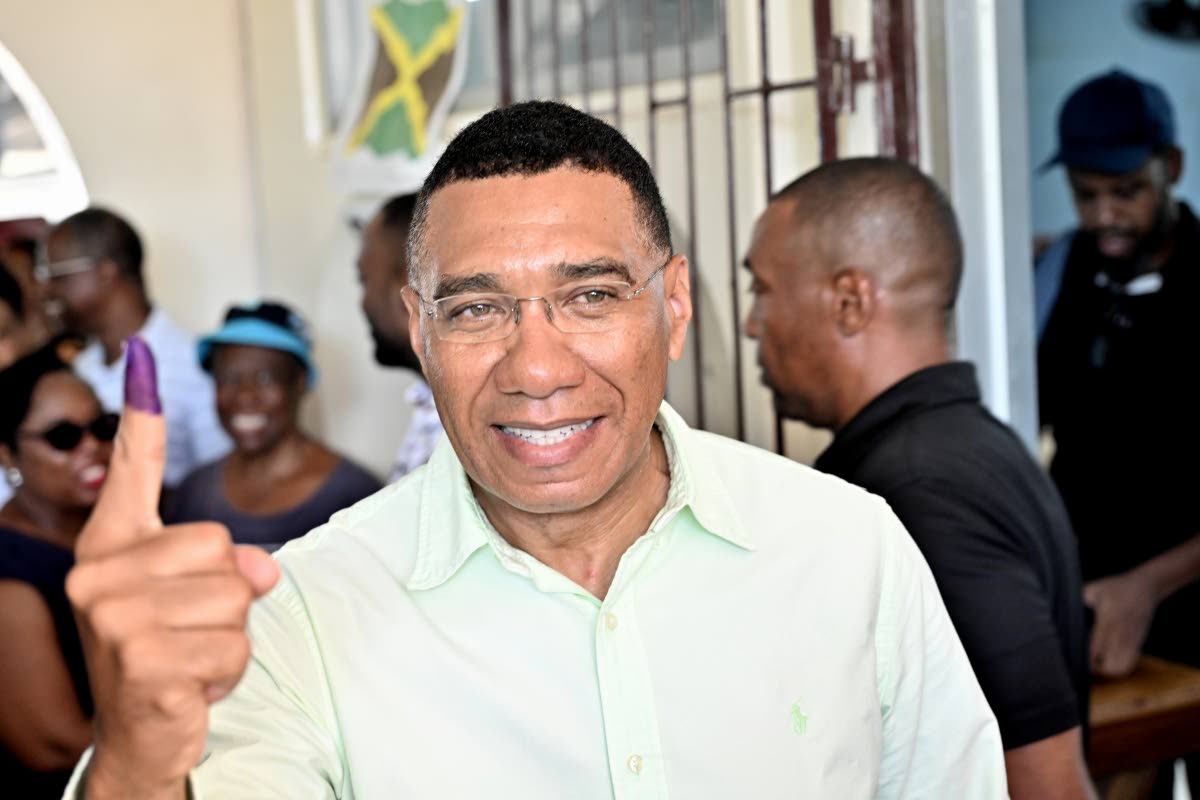 The victorious JLP candidate, Prime Minister Dr Andrew Holness.
-
 Paul Buchanan, defeated candidate in the 2025 general election.
The Supreme Court is expected to rule next month on the case filed by Paul Buchanan against the Constituted Authority, which rejected his bid to have the St Andrew West Central general election declared void.
Justice Sonya Wint Blair is set to deliver her judgment on December 8, following Tuesday’s judicial review of the Authority’s decision.
Buchanan, the People’s National Party (PNP) candidate in the September 3 election, is seeking several orders through his attorney, Hugh Wildman. These include declarations that the Authority’s refusal to act on his complaints was unlawful, irrational, and void; an order of certiorari to overturn the ruling; and an order of mandamus directing the Authority to refer the matter to the Election Court.
Buchanan, a land economist, claims the election – won by Prime Minister Dr Andrew Holness of the Jamaica Labour Party (JLP) – was tainted by irregularities such as double voting, voter intimidation, and ballot-box tampering. He argues that these allegations are supported by sworn affidavits submitted to the Constituted Authority.
Five affidavits were filed in support of the challenge.
In one, Marsha Powell, a cluster manager at Seaward Primary School, alleged that there were instances of double voting. She said she saw a presiding officer issue a second ballot to electors after they claimed that the first was spoilt even though the first ballot had already been placed in the box.
She also claimed that the atmosphere at the Seaward Primary cluster was “not one free from fear” and that PNP indoor and outdoor agents were harassed and threatened.
She added that overcrowding by JLP supporters made it unsafe for non-JLP voters and mentioned that the presiding officer was unable to control the polling station, leading to overcrowding, threats, and a “fearful environment”.
Powell alleged that at one point, there was a brawl involving the presiding officer, a JLP indoor agent, and the police.
Added to that, she said a policeman monitoring the gate left at 5 p.m., after which persons were allowed to enter the compound as they pleased.
She also charged that unauthorised men climbed over the wall and invaded the polling station, causing chaos and making her fear for her safety.
She said counting stopped due to the chaos and that ballot boxes were left unattended and “unaccounted for”. The boxes arrived at the counting centre after 10 p.m., Powell alleged – five hours after polls closed.
In a second affidavit, Everton Sands, a driver-runner for polling divisions one to four, claimed that the police escorting the ballot boxes for the Drewsland Avenue cluster deviated from the approved courier route, driving through JLP-dominated and hostile crowds.
The approved route was reportedly Washington Boulevard to Molynes Road to Seaward Avenue to Bay Farm Road to the Waltham Park Counting Centre.
Sands claimed to have lost sight of the vehicle transporting the boxes along Olympic Way for three to five minutes.
A third affidavit from Dr Warren Blake, campaign adviser to Buchanan, claimed that at several locations, including the Olympic Gardens Health Centre and Seaward Primary, he observed large, disorderly crowds of JLP supporters making noise, drinking, playing loud music, and behaving in a “boisterous manner”.
Blake, who ran against Holness in the 1997 general election and subsequently lost a court-ordered re-election, said the atmosphere at Seaward Primary and Trinitarian Basic School was “very intimidating”. He argued that he did not feel safe to stop and speak to outdoor agents.
The medical doctor said JLP supporters at Trinitarian Basic School appeared to have “taken over the place” and were acting menacingly.
Blake said he believed that the noise, crowds, and general atmosphere would have discouraged non-JLP voters, leading to a “substantial distortion and/or a subversion of the process of free and fair election”.
Indoor agent Iteisha Johnson, in another affidavit, said conditions inside her polling division were “chaotic and noisy”, with line-jumping, arguments, and voters leaving without casting ballots. She recounted seeing JLP supporters wearing black ski masks as she exited the compound, leaving her frightened.
Avia Myles, another indoor agent at Seaward Primary School, claimed that supervised voting occurred.
She said she saw a voter who had returned from the voting booth with their ballot open and blank. The presiding officer told him to mark the ballot and went behind the voting booth with the voter to show him what to do, which happened more than once. The officer then assisted other voters and placed their ballots in the box, she alleged.
Myles further alleged that the Electronic Voter Identification System (EVIS) malfunctioned on the day, and so she was unable to verify the identity of people who did not have their voter identification cards but were on the voters’ list.
The woman also alleged that during counting, the presiding officer indicated that she was feeling ill and left without returning.
Myles said she was asked to count ballots for a polling division even though the counting for the previous division was not done properly.
She also claimed that she was not allowed to put her sticker on the ballot box and that a JLP sticker was put on instead.
The five affidavits were submitted along with Buchanan’s as part of the evidence in the matter now before the Supreme Court.
Buchanan argued that the Authority misinterpreted key evidence, including Powell’s affidavit, which he said outlined multiple acts of double voting rather than a single incident. He contends that the Authority wrongly assumed the role of the Election Court by assessing the standard of proof instead of simply determining whether sufficient evidence existed to warrant referral.
However, in a November 4 affidavit, Retired Justice Ferdinand Smith, chairman of the Constituted Authority, said the body acted “rationally and fairly”, maintained neutrality, and properly applied relevant case law. He urged the Supreme Court not to grant Buchanan’s requests.
In its October 1 decision, the Authority said Buchanan relied on Section 37(e) of the Election Petition Act, which deals with violence or irregularities capable of distorting or subverting the process of free and fair elections. It concluded, however, that the evidence presented did not meet the threshold required under the statute.
Holness won the seat with 7,054 votes to Buchanan’s 4,953. The margin prompted public debate because Holness had been trailing by nearly 100 votes after 87 of the 105 ballot boxes were counted. The remaining 18 boxes, which shifted the outcome, came from polling stations at Seaward Gardens Primary and Infant School, according to the director of elections.
kimone.francis@gleanerjm.com