Flair | Sonjah Stanley Niaah sends the elevator down
Loading article...
-
 Professor of cultural studies in the Faculty of Humanities and Education at The University of the West Indies (UWI), Mona campus, and director of the Centre for Reparation Research at UWI’s Regional Headquarters, Sonjah Stanley Niaah. Photo - Jhalon
-
Professor of cultural studies in the Faculty of Humanities and Education at The University of the West Indies (UWI), Mona campus, and director of the Centre for Reparation Research at UWI’s Regional Headquarters, Sonjah Stanley Niaah. Photo - Jhalon
-
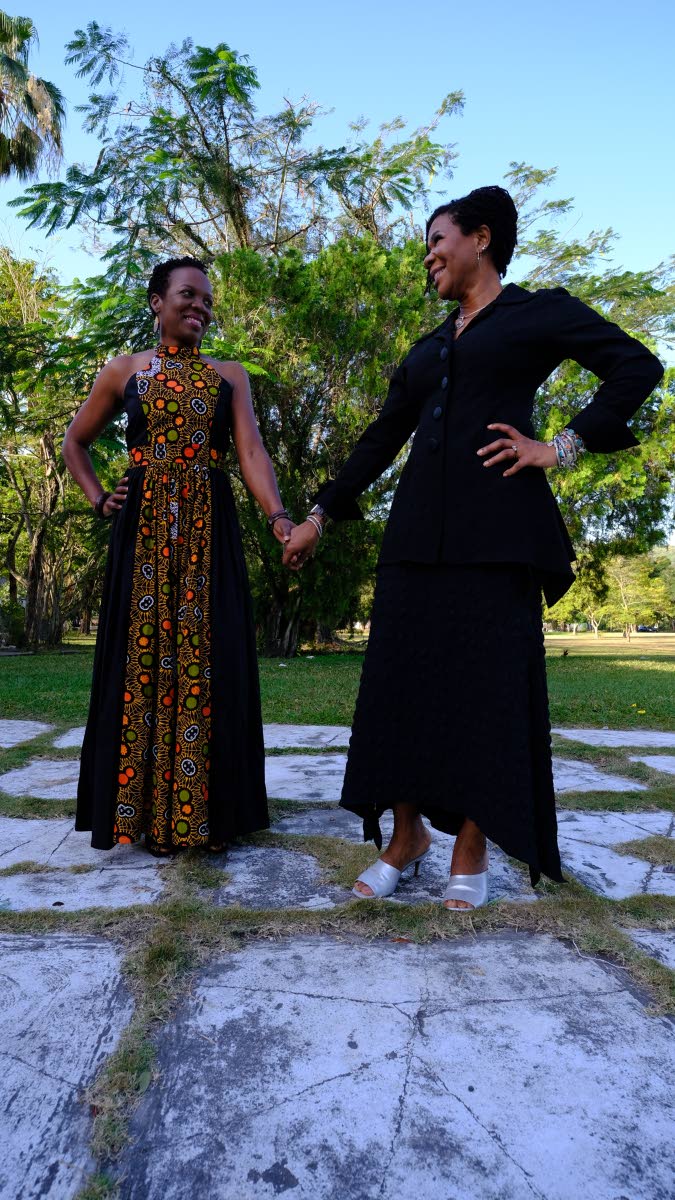 Professors Carmel Roofe (left) and Sonjah Stanley Niaah are all about sisterhood and the upliftment of the next generation. Photo - Jhalon
In Sonjah Stanley Niaah’s world, glass ceilings should not merely be breached. They are meant to shatter.
For this professor of cultural studies in the Faculty of Humanities and Education at The University of the West Indies (UWI), Mona campus, and a frequently sought-after voice for deep examinations of the social nuances of Jamaican culture, shaking up the status quo is simply another day on the job.
“The glass ceiling absolutely exists. Men have been at this for a longer time in the [workplace],” she told Flair on the set of a photoshoot outside The University Chapel with her professorial peer, Carmel Roofe. There are warm hugs, girl talk, and suggestions made for a lunch date between the setups for portraits.
“Men have been able to form bonds, develop systems for acceleration and activation of people in particular spaces and keep themselves there. Women have been breaking through that ceiling, but not in all cases being consistent at making sure that women are in those spaces,” she shared.
It has all been an eventful but rewarding journey for the self-described “country girl from Sandy Bay, Hanover”.
While she has managed to successfully leverage her own profile to advance collaborations with international partners and the regional tertiary institution, Stanley Niaah, who is also the director of the Centre for Reparation Research at UWI’s Regional Headquarters, wants others to self-actualise their inherent potential.
“I am an outlier in the faculty,” remarked Stanley Niaah. “We have been trained to sit in the corner and write your book, not to publish collaboratively, not to even look for grant funding, so I am an outlier. I have been involved in projects worth about $2 billion now, in terms of research.
Networking, naturally, is big on her agenda, and it’s a playbook she advises others to use.
“I share as I go along all the ways in which my students and junior colleagues would be able to access spaces, so it is about sending down the elevator, and I do that every step of the way.”
Raised in a nuclear family — with a policeman father, clerical assistant mother, and a brother and sister — Stanley Niaah attended Barracks Road Primary in Montego Bay, and then Mount Alvernia High in the parish.
Waxing nostalgic about fun childhood memories, she recalled: “My parents were very adventurous people. We drove all around Jamaica and [were] always visiting one relative or another in St Ann or St Elizabeth, so I fell in love with geography from early on.”
After sixth form at Montego Bay Community College, the next logical step saw her being accepted to read for a degree in geography, with a minor in geology.
“I then lived in the States for two years, developed an interest in psychology and came back to Jamaica and went right back into school and started a master’s in sociology with a concentration on social psychology,” she recalled. This area of study triggered a sensibility that she would carry with her throughout her career.
Her research on dancehall, titled ‘Kingston’s Dancehall: A Story of Space and Celebration’, led to her bypassing the master’s degree and upgrading from the Master of Philosophy in Cultural Studies to a doctorate.
The 55-year-old — mother to sons Mau and Josiya and married to Dr Jahlani Niaah, senior lecturer in the Institute of Caribbean Studies at UWI — has remained an advocate for culture as a tool for societal change. “You hear a song on the radio, it is such a powerful tool, you already know the words in no time flat, on account of the repetition of the music, you love the rhythm and all the things that come together to make a song. That’s culture.” Culture, she says, can be mobilised as a tool for behavioural change.
She dispelled the negative connotations that make contemporary music a whipping post for high-minded critics, but sees a broader connectivity for positive outcomes. “We talk about negative music and scamming music, and the ways young people are bleaching. How about a real rehabilitation programme in the sites of incarceration that would have a music component because it is such a powerful tool for them to create music? How about investing in music in primary and high schools?”
When she is not on the job, the professor said she de-stresses “with outdoor activities and internal reflection through hiking and yoga”.
“I also love to dance. Dance is my spirit language, and once the music starts playing, I’m out. When I hear music I love, I automatically start choreographing the next move in my mind.”
For the moment, Stanley Niaah is basking in her recent professorial appointment alongside three other female colleagues. She paused to give it context. “There is more to that story,” she politely interjected when asked to share her thoughts. “Not only were four [women] being appointed in the faculty in any given academic year, but it was in the context of a female dean, Professor Silvia Kouwenberg, within the faculty as well. That female dean was the one with the pleasure of putting forward these applications and defending them in the usual way of the university’s board, and that was a pleasure for me.”