John Leiba’s journey through prostate cancer
Loading article...
-
 Leiba keeps moving, maintaining the active lifestyle that has long been part of his routine. Photo - Contributed
-
Leiba keeps moving, maintaining the active lifestyle that has long been part of his routine. Photo - Contributed
-
 Running enthusiast and prostate cancer survivor John Leiba gives the lens a thumbs-up after completing the 5K route at the 2026 Blue Run/Walk event on September 20. Photo - Contributed
-
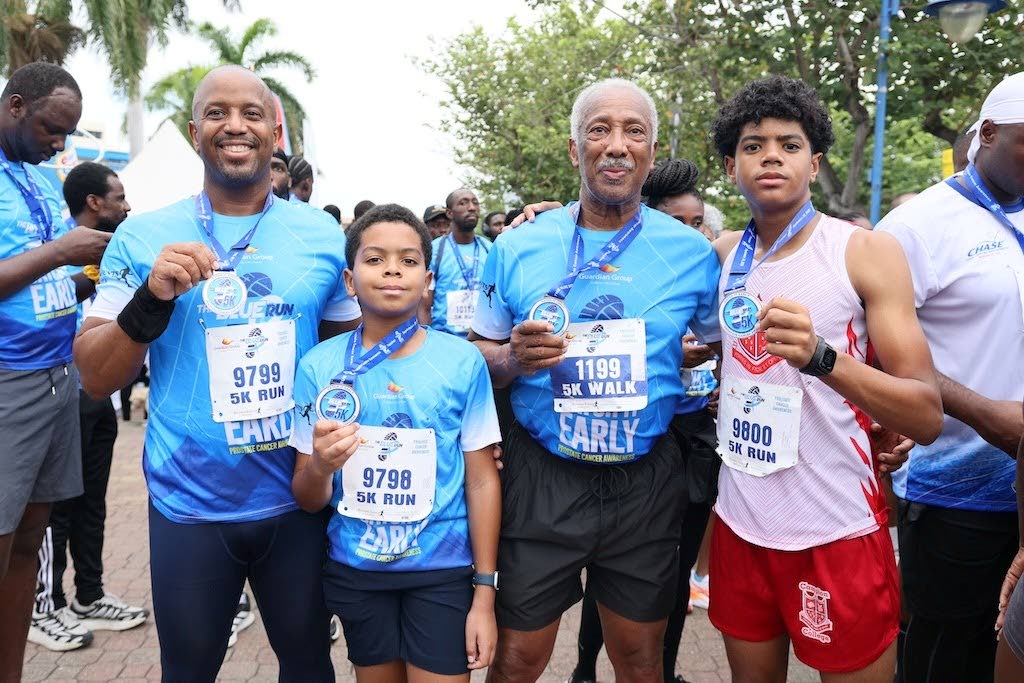 Generations of Leiba men turn out in support of the 2026 5K Blue Run/Walk to raise awareness for prostate cancer. Pictured from left are: Emile Leiba, attorney-at-law; Alex Leiba; John Leiba; and Jonathan Leiba. Photo - Contributed
For most of his life, John Leiba has known what it means to keep moving. At 77, the Spanish Town native still carries the discipline of a man who once ran six miles every morning, five days a week, and completed his best marathon at age 50 in three hours and 19 minutes. But prostate cancer entered his story quietly. Leiba had no pain, no noticeable change in his health and no symptoms to suggest that something was wrong. Instead, regular health checks revealed a prostate-specific antigen (PSA) reading that kept rising.
Leiba says he has always been particularly vigilant about his health, describing himself as “paranoid” and visiting his doctor, Peggy Myers Morgan, at least twice a year. Medication initially brought the reading down, but it eventually increased again. That change prompted further medical attention and, ultimately, a biopsy that confirmed he had prostate cancer.
The diagnosis came in 2022, when Leiba was 73. The absence of symptoms meant there had been nothing to prompt him to believe something was wrong. Regular monitoring had instead provided the warning that led to further investigation.
Running and physical activity have been part of Leiba’s life for decades. He has coached young athletes, built a distinguished career as an attorney-at-law, served as president of the Jamaican Bar Association, and continues to give his time to organisations including the Scouts Association of Jamaica and the Jamaica Baptist Union.
His response to the diagnosis was immediate. “I am going to fight this cancer. It cannot defeat me,” he said.
Leiba told his wife and his home doctor first, and both were supportive. He consulted with more than four doctors before deciding on radiation treatment.
The treatment lasted more than 10 weeks, with sessions five mornings each week. Most of the process went well, although the final week brought a painful urinary tract infection and constipation.
The difficulties did not end when the treatment did. Challenges continued, particularly when nerve damage affected his legs. Running, an activity that had been part of Leiba’s life for decades, suddenly became difficult.
“I woke up one morning and not only could I not run, but it took me 27 minutes to do a mile,” he recalled.
Leiba continued going to Constant Spring Golf Course to exercise, but people he had once walked alongside began moving ahead of him. His feet would swell, and he spent considerable time trying to bring the swelling down.
“There was nothing I could do about it,” he said.
Incontinence created another difficult adjustment.
“If I needed to go to the bathroom, there was not much time,” he explained.
A general loss of strength also affected his everyday life. Driving to the country became tiring, and the physical limitations represented a significant change for someone who had always been so active.
Leiba responded by working to rebuild his strength. He did pull-ups every day and eventually managed 20 on his last birthday. Recovery became a three-year process of gradual improvement. Today, Leiba is cancer-free.
His family provided strong support throughout the journey, while his faith in God became another important source of strength. Leiba also recognised that he had been fortunate because his cancer was confined to his prostate.
Dr Freddie Clarke, his former schoolmate, reinforced that perspective.
“Johnny, you are lucky; the cancer is confined [to] your prostate. Not many men are so lucky,” Clarke told him.
ENDURANCE
Years of running had taught Leiba the value of endurance. His cancer journey demanded another kind of endurance as he navigated treatment, nerve damage, incontinence, and a long physical recovery.
Leiba accepts that the experience has come with losses, but he remains grateful.
“There are some things which I have lost, but I’m happy to pay the price,” he said.
His experience has also shaped the message he now shares with other men.
Men who are diagnosed with prostate cancer, he says, should “attack the problem and do it early”.
He compares prostate cancer to a fire beginning with a kitchen curtain.
“You can put it out immediately, or you can wait and then try to put out the entire kitchen or the entire house,” he added.
Leiba believes the consequences extend beyond the individual man.
“This is not just about you. It is about your family,” he said. “Irresponsibility will not only affect you but them as well.”
lifestyle@gleanerjm.com