
‘Crocs are shy’
Diving into crocodile conservation on NEPA’s wild adventure at Holland Bay
Published:Monday | March 31, 2025 | 8:46 AM


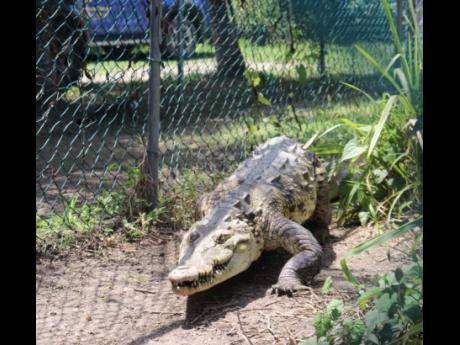
“Crocs are shy. They stay away from noise, and they don’t like crowds. They get stressed easily.”
Such were the words of conservationist Lawrence Henriques as he sought to allay fears concerning one of Jamaica’s earliest inhabitants – the crocodile.
He was speaking to journalists who were invited by the National Environment & Planning Agency (NEPA) to tour the Holland Bay Crocodile Sanctuary in St Thomas.
The media tour aimed to increase awareness of crocodile conservation, highlight the sanctuary’s initiatives, and dispel myths surrounding the often-misunderstood reptile.
The tour featured exclusive access to the sanctuary’s crocodile rescue and rehabilitation efforts and interviews with wildlife experts, environmental advocates, and conservation partners such as the Hope Zoo Kingston and JamCroc Initiative.
“NEPA thought it important to stage the media tour amidst the frequency of contact between humans and crocodiles in recent times, a concern that is attributed to the expansion of human settlements into territories that for hundreds of years, were home to the crocodiles,” the agency said.
STOP TYING UP CROCODILES
Some human encounters have resulted in the animal being harmed or even killed. The very passionate conservationist is urging Jamaicans to stop tying up the crocodiles and to just leave them alone, adding that, if there’s a problem or an obvious threat, then they should call NEPA.
According to Henriques, when in close proximity to a crocodile, people need to understand that the animal is not a threat to them. In highlighting the relatively gentle nature of the crocodile, Henriques explained that the reptile is not a social being and is more likely to turn away from humans than to be around them.
“These animals don’t even like each other when they reach a certain size. They tend to keep their distance and have their own turfs. They don’t move in groups,” he said.
He warned, however, that people should stay away from crocodile nests, because, like any mother, the animal is very protective of its offspring. As such, he said that people need to be mindful of the nesting season, which, in Jamaica, is typically between November and June.
Additionally, he advised vigilance if walking along the sea, near a vegetative area with a watery body behind it, as female crocodiles don’t nest very far from a water source. This, he explained, provides the ideal space for the female to take her young into the water once they have hatched.
“If you see a mound (which could be a crocodile nest) with crocodile tracks nearby, then these are tell-tale signs that a crocodile may be around and that you should move away,” he cautioned.
Outside of such instances when the crocodile is likely to be very protective, Henriques said that the animal is basically harmless unless provoked. He also advised against feeding the animal, as this will encourage more frequent contact with humans.
“If they associate humans with foods, they are more likely to advance towards people when they see them as they are expecting to be fed,” Henriques explained.
He also suggested that schools and homes in areas where crocodiles are present should be fenced off to limit contact with the animal.
IMPORTANT PART OF JAMAICA’S HERITAGE
Joseph ‘Joey’ Brown, Curator for the Hope Zoo, who also participated in the tour, pointed out that it is not sustainable to have crocs in facilities and that Jamaicans need to learn to live with the animal.
He noted that the crocs are an important part of Jamaica’s heritage as they have been on the island long before us and are represented on Jamaica’s Coat of Arms.
NEPA’s Environmental Officer, Damany Calder agreed, noting that developments must be guided by sustainable practices where connectivity to the wetland system will allow the animals to cohabit and commute in their environment. This requires public education to know how people can live with the animals in their environment, he said.
Meanwhile, Leighton Mamdeen, who is also an environmental officer at NEPA, believes that people need to appreciate the crocodile’s value to the ecosystem.
“Crocs play an important role in consuming sick and dead fish from our waterways, allowing us to have a healthier ecosystem where the good fish can thrive and benefit the fishing industry,” he noted.
REFUGE FOR RESCUED CROCODILES
In adding her voice to the cause of the crocodile, Treya Picking, founder of JamCroc Initiative, noted that the mission of her organisation is to promote the coexistence of people, wetlands and crocodiles. She lamented the declining population of crocodiles in St Thomas and lauded the work of Henriques and his facility in saving the creature.
Since its establishment in March 2019, the Holland Bay Crocodile Sanctuary has been at the forefront of crocodile conservation, offering a refuge for rescued crocodiles while educating the public about the species’ importance in the ecosystem.
The sanctuary plays a critical role in the rescue, rehabilitation, and reintroduction of the reptile into protected wetlands. Fitted with solar panels and water tanks, the self-sufficient crocodile haven was constructed with financing from Global Wildlife Conservation/ReWild; however, current funding is insufficient in maintaining its operation.
Henriques disclosed that he uses his own resources to support the sanctuary, with occasional funding coming from Gatorland Global and an annual stipend from NEPA.
Support is also provided by the Hope Zoo and Caribbean Broilers (CB) Chicken.
The Holland Bay sanctuary currently houses approximately 25 crocodiles, with numbers fluctuating as rescues and releases occur.
DID YOU KNOW…
FACTS ABOUT CROCODILES
BIOLOGY & ADAPTATIONS
• Crocodiles belong to the Crocodylidae family, which includes saltwater, Nile, and American crocodiles.
• Crocodiles are one of the oldest reptiles, existing for over 200 million years.
• Crocodiles can live for over 70 years, with some individuals reaching over 100 years in captivity.
• The saltwater crocodile (Crocodylus porosus) is the largest living reptile, reaching lengths over 7 meters (23 feet) and weighing over 1,000 kg (2,200 lbs).
• The dwarf crocodile is the smallest species, growing only 1.5 meters (5 feet) long.
• They are cold-blooded and rely on their environment to regulate body temperature.
• Crocodiles have a third eyelid (nictitating membrane) to protect their eyes underwater.
• They can hold their breath for up to an hour by slowing their heart rate.
• Their bite force is the strongest in the animal kingdom, exceeding 3,700 psi (pounds per square inch).
• They swallow stones (gastroliths) to help digest food and maintain buoyancy.
• Unlike alligators, crocodiles have a V-shaped snout and their teeth are visible when their mouths are closed.
• They can run up to 17 km/h (11 mph) on land for short distances.
• Crocodiles use a death roll to tear apart prey.
• Their skin is covered in bony scales called scutes, providing protection like armor.
• Crocodiles can replace their teeth throughout their lifetime, sometimes growing over 3,000 teeth in a lifetime.
• They have specialised salt glands in their tongues, allowing them to live in both freshwater and saltwater.
• Their eyes, ears, and nostrils are positioned on top of their heads, enabling them to stay mostly submerged while watching for prey.
• Crocodiles have an exceptional sense of smell and night vision, making them efficient nocturnal hunters.
• Their powerful tails are used for swimming, defense, and launching out of the water to catch prey.
HUNTING & FEEDING
• Crocodiles are ambush predators, waiting motionless before striking with incredible speed.
• Their diet consists of fish, birds, mammals, and even other crocodiles.
• They use a unique “high walk” gait where they lift their bodies off the ground, unlike alligators.
• They store excess food in their stomachs and can go months without eating.
• Some species, like the saltwater crocodile, are known to attack large prey such as water buffalo, sharks, and even humans.
BEHAVIOUR & SOCIAL STRUCTURE
• Crocodiles are highly territorial, especially males during mating season.
• They communicate using vocalisations, body postures, and vibrations in the water.
• Baby crocodiles chirp from inside their eggs to alert their mother, who helps them hatch.
• Despite their tough appearance, crocodile mothers care for their young for several months, carrying them in their mouths.
• Some crocodile species cooperate when hunting, herding fish into shallow areas.
TIPS FOR STAYING SAFE AROUND CROCODILES
AVOIDING CROCODILE ENCOUNTERS
• Always check for warning signs and local reports before entering or approaching bodies of water in crocodile habitats.
• If you must camp near water, set up camp at least 50 meters (164 feet) away and avoid nighttime activity near the water.
• If fishing, avoid leaning over the water’s edge or standing in the same spot for long periods.
WHAT TO DO IF YOU ENCOUNTER A CROCODILE
• Do not provoke or approach crocodiles – they can lunge several meters in an instant.
• If a crocodile begins to approach you, back away slowly without making sudden movements.
• If you’re in a boat, avoid dangling hands or feet in the water – crocodiles have been known to attack boats.
WHAT TO DO IN A CROCODILE ATTACK
• If a crocodile grabs you, fight back aggressively, focusing on its eyes, snout, or the back of its throat.
• Do not play dead – crocodiles drown their prey, so staying still will not help.
• If caught in a death roll, try to grab onto something solid to avoid being disoriented.
• If a crocodile bites but hasn’t locked on, push into its throat rather than pulling away – this may force it to release you.