Blauwearie gets drinkable water from Global Medic
Loading article...
-
 Murray and Ashley McKenzie, school groundsman and janitor, watch closely as Don Jorgensen, rapid response team leader for Global Medic, works on the UV water filter.
-
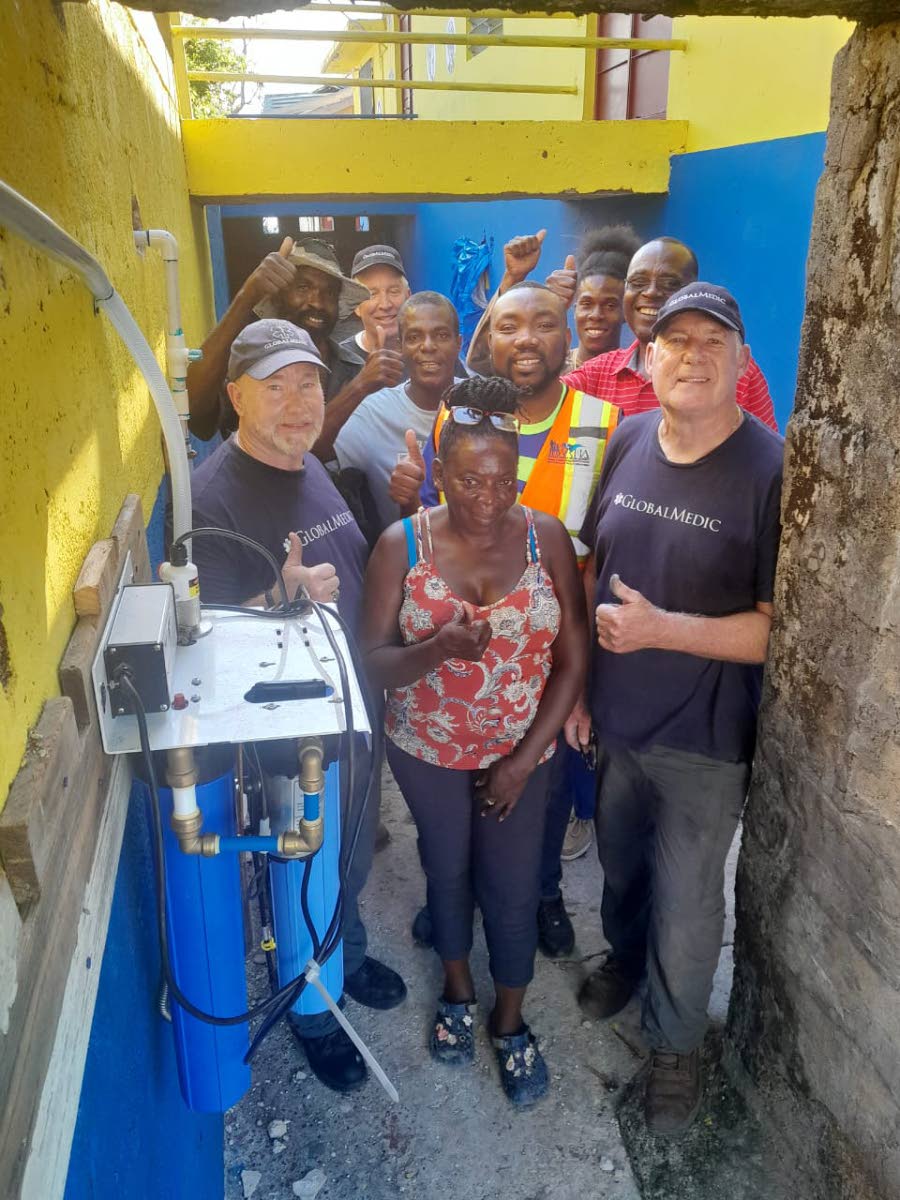 The Global Medic team, along with staff from the Blauwearie Primary and Infant School and representatives from the Westmoreland Health Department.
-
 From left: Gerald Miller, Westmoreland health promotion officer; Richard Forward, team lead for Global Medic; Tatesha Murray, principal of the Blauwearie Primary and Infant School; and Morty Bromley, Global Medic team member.
Western Bureau:
For years, students at Blauwearie Primary and Infant School relied on water from a nearby stream, rain catchment and bottled supplies, never fully certain if the water they had access to was safe to drink.
That reality has now changed following the installation of a water purification system by international humanitarian organisation Global Medic in the aftermath of Hurricane Melissa.
“We have been in Jamaica since the hurricane, and we have been providing emergency food kits, family hygiene kits and water purification units for facilities,” said Don Jorgensen, a rapid response team leader with Global Medic, in an interview with The Gleaner.
“We installed a water purification kit at the school in Blauwearie yesterday, and it will provide enough drinking water for all the students and staff and most of the houses surrounding the school for at least a year.”
The system, which uses a series of filters and ultraviolet light, can kill 99.9 per cent of all water-borne bacteria and viruses, according to Jorgensen.
He explained that the unit can produce up to six gallons of clean drinking water per minute and can operate for extended periods when needed.
“We’ve had it running 24 hours a day in some instances.”
The installation comes at a critical time for the rural Westmoreland school, which is also being used as a shelter for residents displaced by the hurricane.
Principal Tatesha Murray described the system as wonderful for both the school and the surrounding community.
“Most of the time we would have got the water from the stream or catchment,” Murray said. “So, it is really wonderful that they were able to come in and give us this filter system where we were able to get clean drinking water for the school and the community, and we’re appreciative of it.”
According to Murray, the lack of piped water has been a long-standing issue, even before the hurricane.
“We don’t get water from the NWC (National Water Commission). We get it from the stream,” she said. “We have a gentleman who pumps the water, and what we normally do is use it to wash our toilet and cook, but if they are going to drink, they would generally buy bottled water.”
Because of this, students were often warned not to drink from the school’s water supply.
“Generally (the) children … would buy bottled water from the tuckshop to drink, because we always tell them not to drink the water,” Murray said. “You have one or two of them who would probably chance it.”
Global Medic was put in contact with the school through community advocate and proprietor from Negril, Rosa Young, who has been coordinating humanitarian support across several affected areas.
“When we came to Jamaica, we made contact with a number of different local community leaders and we have followed their lead,” Jorgensen said. “They recommend areas where we will do installations or where we will do distributions. And so Rosa recommended that we do the installation at the school.”
Jorgensen noted that installations in Jamaica have been comparatively smooth due to strong local cooperation.
“In Jamaica, we have had amazing help from the Jamaican people,” he said. “They have always bent over backwards. They have really done whatever they could to help us out.”
The Blauwearie school currently shelters 12 displaced residents, down from 15 the previous week. Murray said the occupants previously relied on donated bottled water for drinking and untreated water from streams or catchment for bathing.
With the new system now operational, clean water is available to shelter occupants, even though the school is currently closed for the Christmas holidays.
“We tested it yesterday,” Murray said. “So, we have … clean water in the tank now, so the persons at the shelter can use it.”
The system does require electricity, but the school is equipped with a gas-powered generator to keep it running until regular power is restored.
“Right now, the school has a gas-powered generator, which they will use when necessary,” Jorgensen said. “Once the regular power comes on, they’ll be able to just plug it into the wall and they can use it as much as they want.”
Beyond Blauwearie, Global Medic continues to operate across western Jamaica. Jorgensen said three similar systems are currently being used at a community kitchen in Montego Bay to prepare meals for residents in affected areas, while another unit was installed in Frome last week.
“We’ve also been distributing household water purification units for people that can set up in their house,” he said. “These units do not require electricity. They’re very simple to use, and I think we’ve already distributed close to over a thousand of them so far since the hurricane.”
While the new water system addresses one major concern, Murray said the school still faces serious challenges ahead of the reopening in January. Hurricane Melissa destroyed bathroom facilities, desks and chairs, forcing students to attend shortened schooldays.
“The primary school bathroom has been blown down entirely,” she said. “We only have about two stalls at the infant that are operational.”
The school has also lost most of its furniture.
“The majority of our desks and chairs have been destroyed because of Melissa,” Murray added.
“What we have done currently is use some of the benches from the church and folding tables for some of the students.”
Despite these hardships, Murray expressed deep gratitude to those who helped make the water installation possible.
“I sincerely, really and truly want to thank Ms Rosa Young for getting Global Medics here,” she said. “And also Mr Gerald Miller [from the Westmoreland Health Department], because he said the need was there.”
She also commended school groundsman Ashley McKenzie for his hands-on assistance.
“He has been there helping the Global Medic persons to install and getting the different things that they need,” Murray said. “I really and truly appreciate him.
“We are secure in the knowledge that we can go to the pipe and get drinking water,” Murray said. “And that is no easy feat. So, we are truly and truly grateful.”
mickalia.kington@gleanerjm.com