New Cross house fire remembered 45 years on
Loading article...
-
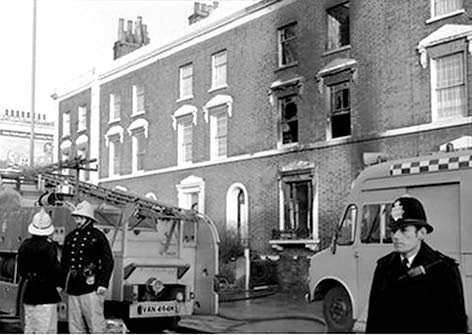 The house at 439 New Cross Road, south London in which 13 black people died in a fire on January 18, 1981.
-
 Protesters on the Black People’s Day of Action March in 1981, after the New Cross fire.
LONDON:
This week marked the 45th anniversary of the infamous New Cross fire in Lewisham, south London when 13 young black people, between the ages of 14 and 22 years old, perished in a blaze at a birthday party which many believed was an arson attack, motivated by racism.
A memorial service was held on Sunday, January 18, 45 years to the date, at St Andrews Church, Brockley Road, London SE4 when members of the community gathered to commemorate and honour those who lost their lives in the fire in 1981 and to remember their families and survivors. The service was led by Revd John Grundy and Revd Steve Lawrence.
In the early hours of January 18, 1981, the joint birthday for Yvonne Ruddock and Angela Jackson at 439 New Cross Road ended in tragedy when fire engulfed the three-floor building, killing 11 of the occupants, while two died from their injuries days later in hospital.
There was a high degree of racial tension in New Cross at the time as it was well known that the far right group, the National Front, was active in the area. It had been claimed that there were early complaints about noise from the party leading the police to deduce that the house had been bombed, either as a revenge attack or to stop the noise.
The tardy investigations by the police at the time sparked frustration and anger within the black community. The protests arising out of the fire led to a mobilisation of black political activity and the setting up of the New Cross Massacre Action Committee, led by John La Rose, Darcus Howe, Linton Kwesi Johnson, Leila Hassan and Jean Ambrose among others.
When no arrests were forthcoming and shocked by the indifference shown by the white population, the Committee accused the London Metropolitan Police of covering up the cause of the fire which they suspected was an arson attack.
Three months later in March 1981, the New Cross Massacre Action Committee organised a 25,000-strong ‘Black People’s Day of Action March’ from Lewisham to Hyde Park in protest over the police handling of the investigation into the New Cross house fire. It was the ultimate mobilisation of the black community around a grave injustice.
But despite lengthy police investigations, no one has ever been charged in relation to the blaze. Also two subsequent inquests into the deaths – one held in 1981 and a second in 2004 – both returned open verdicts despite fears from grieving relatives that it could have been a racist arson attack.
The 13 youngsters who died in the fire were: Patrick Cummings aged 16; Andrew Gooding, 14; Peter Campbell, 18; Gerry Paul Francis, 17; Steve Collins, 17; Patricia Johnson, 15; Rosaline Henry, 16; Lloyd Hall, 20; Humphrey Geoffrey Brown, 18; Owen Thompson, 16; Yvonne Ruddock, 16; Glenton Powell, 15 and Paul Ruddock, 22.
In addition to the original 13, Anthony Berbeck, 20, died two years later after falling from the balcony of a block of council flats in South London on July 9, 1983. He was at the party and became mentally disturbed following the death of his best friends.
ETCHED INTO COLLECTIVE MEMORY
Among persons who gave their thoughts on the 45th anniversary are human rights activist and advocate for racial justice Professor Gus John who in 1981 helped to organised and mobilised support for the Black Peoples Day of Action from the North of England.
In sharing his reflections on the anniversary of the tragedy, Professor John said:
“The tragedy of the New Cross Massacre on 18 January 1981 is etched into the collective memory, not only of the survivors and relatives and peers of the 14 people who lost their lives, but of black Britain.
“At the time I was living in Manchester and I helped to mobilise people from there and other areas including Preston, Leeds and Huddersfield to join the ‘Black People’s Day of Action March’ in London under the banner ’13 Dead and Nothing Said’.
“It was extraordinary for 13 young people under the age of 25 to lose their lives in such a tragedy, but the most devastating hate crime to happen in peace-time Britain was treated like a non-event in official circles.
“Prime Minister Margaret Thatcher said nothing, William Whitelaw, the Home Secretary said nothing, the Queen said nothing. Other tragedies with fewer deaths got more media coverage across the country than the New Cross fire.
“It signalled on the part of the state that the black community was so marginalised and not part of the mainstream that an incident like the New Cross fire had to do with the black community and nobody else. The whole nation didn’t need to concern itself with it. This was a profound statement that the state and the government of the day made by not reacting to the New Cross fire tragedy.
“Its historical significance is such that it should have long been a major component of the recorded history of Black post-war settlement in Britain. Yet, the generations born after the Battle of Lewisham in 1977 and the fire at 439 New Cross Road in 1981 have not been taught that history and what it says about Britain.
“History has a way of repeating itself and the lessons the society and the police failed to learn from that fire, its relevance to the Battle of Lewisham, the systemic racism of the state and the institutional racism of the police, were all in full play again with the murder of Stephen Lawrence in 1993 and the police investigation of that racist murder.
“The New Cross Fire and the state and police response to it speak to the condition of being young and black in Britain, then and now. That history continues to shape the present and the challenges young people, black and white, face in building a more equitable and non-systemically racist future Britain.
“As we remember the layers of trauma that this tragedy induced in those involved, in their communities and in the wider society, let us pay tribute to those who refused to be defeated as victims, but built movements of resistance, giving support to one another, making sure that the state and the society took accountability and did not forget.
“We remember, too, at this time, the dedicated, ongoing service given by the late departed Dr Aggrey Burke, consultant psychiatrist and Black Mental Health activist, among others, to the survivors and relatives of the deceased, to aid healing and repair and to restore strength and hope.”