‘Cuba not a threat to any country’
Loading article...
-
 Tania López Larroque, the new Cuban ambassador to Jamaica, speaking with The Sunday Gleaner last week.
-
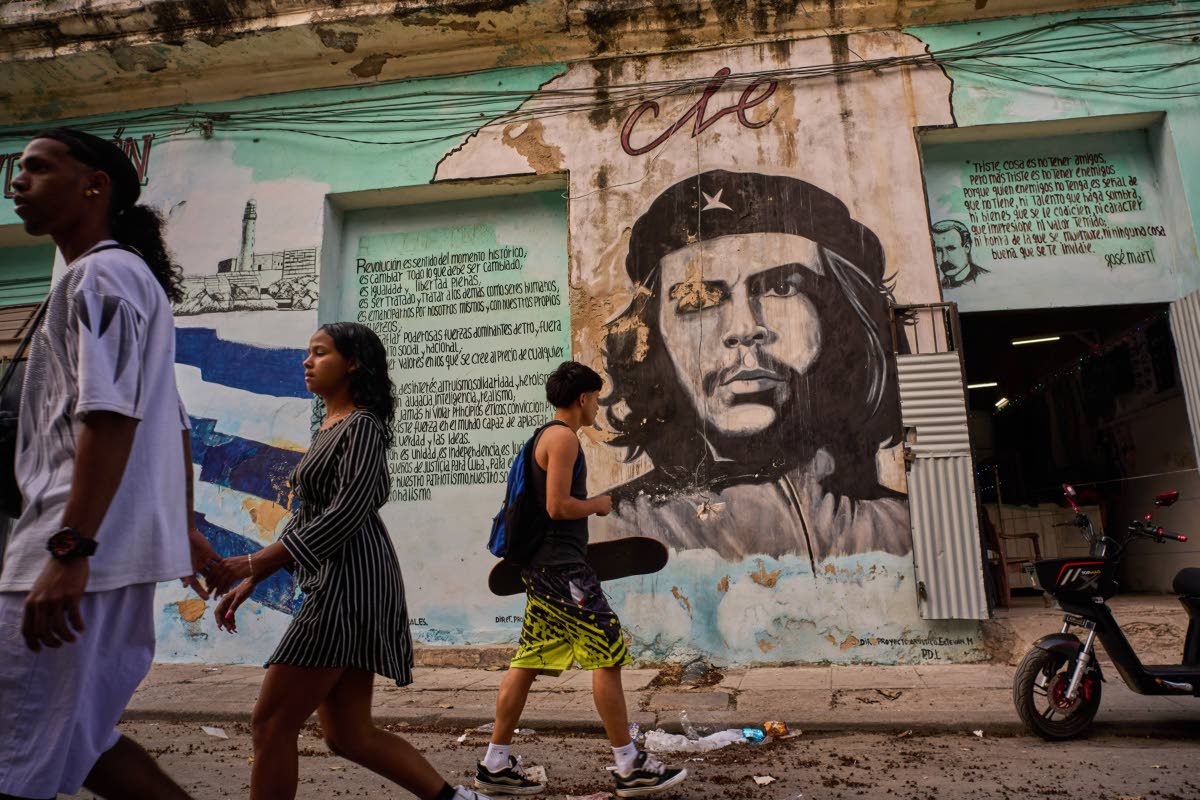 People walk past a mural of Che Guevara in Havana.
Cuba’s Ambassador to Jamaica, Tania López Larroque, had barely settled into Kingston when a new crisis erupted.
Just weeks after her arrival on December 8 last year, United States President Donald Trump signed a January 29 executive order imposing an international fuel blockade on Cuba, threatening heavy sanctions against any country that supplies the island with oil.
The consequences, she says, have been devastating.
Without fuel, Cuba cannot function. Hospitals struggle. Government services stall. Schools are disrupted. Transport falters. The blockade has rippled through every sector of national life, creating what she describes as a humanitarian emergency for the country’s 11 million people.
In her first media interview since taking up her post, López Larroque did not disguise her anguish – not for herself, but for ordinary Cubans who, she told The Sunday Gleaner, are suffering for their political choices.
“This is not an era of the emperor, where you can just invade and capture a country, place a flag there and say this country is now mine. That era is dead, and one thing is clear: All Cubans know that the problems of the country are not political problems. They are a result of the criminal economic embargo of the United States, now in effect for 67 years,” she said.
She insists the dispute is not about resources. Cuba, she notes, has neither oil nor major mineral wealth. There is nothing to seize.
“Cuba is not a threat to any country in the world. Cuba is not a threat to its citizens. Eighty-seven per cent voted for the constitution. So Cuba does not have anything that the United States wants, unlike Iraq and Venezuela. Therefore, it’s about political control, and wanting to decide the future of Cubans, which – because of our education system – we are quite capable of doing ourselves and have been doing, despite the criminal economic embargo,” she said.
QUESTION OF SOVEREIGNTY
Why has Cuba remained such a point of friction with Washington?
“Cuba has made principled decisions. There have been mistakes, and President Miguel Diaz-Canel and the government have acknowledged them. So we have recognised our own mistakes and we want to be the ones to fix those mistakes. We do not want any emperor to give an order to say this is how it must be done. Nobody tells Cubans in Cuba how it must be done. Democratic decisions are made after consultations, and where adjustments have to be made, they are made, and have been made. The idea that Cubans are under a dictatorship is just not true,” she stated.
Cuba is, however, a one-party state, with limited tolerance for organised dissent. Western media have reported the imprisonment of thousands following swift crackdowns on protests against the administration.
López Larroque counters that Cubans are deeply conscious of their history and identity.
“Our history cannot be hidden, and it is not. Our education system has produced scholars, and has trained people in disciplines all over the world. The history of the country is taught; it is part of who we are,” she explained.
REVOLUTION AND ITS AFTERMATH
Modern Cuba cannot be understood without 1959.
The Cuban Revolution overthrew the US-backed dictatorship of Fulgencio Batista. Among its leaders was a young lawyer, Fidel Castro, who, alongside his brother Raúl Castro and Argentine revolutionary Che Guevara, led a guerrilla campaign that culminated in Batista’s flight on New Year’s Eve 1958.
Castro would govern for decades, reshaping the island along socialist lines and aligning it with the Soviet Union during the Cold War.
When the USSR collapsed in 1991 – following reforms under Mikhail Gorbachev and amid geopolitical shifts influenced by leaders such as Margaret Thatcher and Ronald Reagan – Cuba lost its principal benefactor. The economic shock was severe. Subsidised oil disappeared. Trade contracted. Ageing sugar mills and declining exports of cigars and rum could not generate enough revenue to sustain the economy.
Later, oil shipments from Venezuela offered temporary relief. Tourism slowly expanded, often via third countries. But isolation persisted, compounded by tightening sanctions and shifting global alliances.
‘WHAT CUBA REALLY IS’
For López Larroque, the story of Cuba is not only one of embargoes and geopolitics, but of resilience and solidarity.
“I would like the world to know what Cuba really is despite the embargo and what Cuba has managed to do during the last 67 years. The world should know that 86 per cent of the population voted for the constitution we now have which revolutionised our social systems. We deserve to construct the society we want, and that is what we have been doing. I would like the world to know about the Cuban solidarity with our brothers and sisters in Africa. Cuban blood flowed on the continent to free people from colonisation and oppression,” said the ambassador.
She points to Cuba’s military involvement in Angola during that country’s liberation struggle, when thousands of Cuban soldiers fought against forces backed by apartheid South Africa. She also highlights medical missions – from combating Ebola in Liberia to assisting Italy during the COVID-19 pandemic.
“I want the world to know our people and to talk to them to realise and to feel these real sentiments, human people. Eighty-six per cent of our population voted for our constitution, decided for the social system we have. So I would like world to know the people, the real Cuba. And to imagine how much more we would be able to do if we haven’t such difficulties. To know about Cuba’s solidarity, which I don’t like to talk in first person because we do it humbly. Because it’s just sharing with humankind. We are just one species. That’s the way Fidel told us to do. That’s why we helped Africa. And so he said, it’s a debt we have with humankind. And we have a debt with Africa. And if you are not able to help others, you will never be able to help yourself. That’s the Cuba I would like people to know. Cuba has a debt to humankind. And that debt is to help, is to liberate from oppression.”
Over the decades, Cuba has trained thousands of professionals – doctors, teachers and engineers – including students from the United States. Cuban medical brigades have worked in remote communities across the Caribbean and beyond, often in areas underserved by local systems.
“This is not a criticism of other countries. This is a celebration of the Cuban people and what they have been able to do, and how they have survived. It is a credit to them, that there is still a country. And we still continue to survive, under great hardships. We are not sitting down and playing dead. Cubans will defend Cuba,” she said.
There have been moments of thaw. In 2016, US President Barack Obama visited Havana, meeting Raúl Castro in a historic gesture that eased remittances and visa processing. But those openings have narrowed once more.
Today, as fuel shortages bite and economic pressure intensifies, López Larroque’s message is one of unity.
Cuba, she insists, has endured worse. And Cubans, she believes, will endure again.
erica.virtue@gleanerjm.com