Yaakov Raskin | Before Purim: remembering what must be erased
Loading article...
-
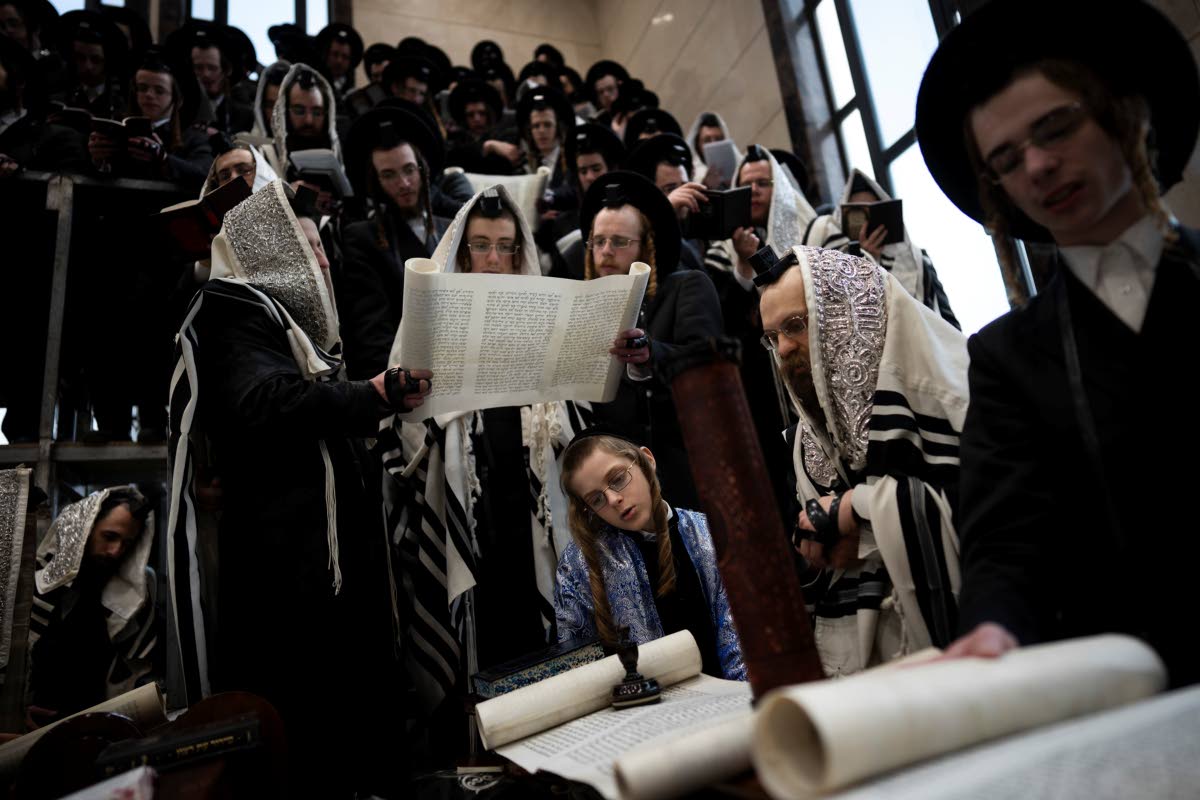 Jewish ultra-Orthodox men and children, some wearing costumes read the Book of Esther, which tells the story of the Jewish festival of Purim, at a synagogue in Bnei Brak, Israel, Friday, March 14, 2025. AP
-
Jewish ultra-Orthodox men and children, some wearing costumes read the Book of Esther, which tells the story of the Jewish festival of Purim, at a synagogue in Bnei Brak, Israel, Friday, March 14, 2025. AP
-

In the coming days, Jewish communities around the world will celebrate Purim, a festival that commemorates a dramatic moment in ancient Persia when the Jewish people were saved from destruction. The story, recorded in the Book of Esther, tells of Haman, a powerful royal adviser who plotted to annihilate the Jews, and of Queen Esther and her cousin Mordechai, whose courage and faith overturned the decree. The holiday is marked by public readings of the Megillah, gifts of food, charity to the poor, and an atmosphere of joy.
Here in Jamaica, Purim brings with it the same melodies, the same reading of Esther’s scroll, and the same sense that history and faith still speak in the present.
The week before Purim arrives, the Torah directs us to observe a special Sabbath known as Shabbat Zachor, or the Sabbath of Remembrance. On that day we read a short but powerful passage from Deuteronomy 25:17-19 commanding us to remember the evil that Amalek did to the Israelites in the desert after the Exodus from Egypt and to eradicate it from the face of the earth.
This passage is read every year before Purim because of the deep connection to the Story of Esther. Haman, the villain of the Purim story, is described as an Agagite, and a descendant of Amalek.
But who is Amalek, and why did G-d command us to wipe their memory from the face of the earth?
CONFRONTATION
In the Torah, Amalek appears at a fragile moment. The Israelites had just left slavery, crossed the sea, and narrowly escaped Pharoah’s pursuing army. In this state of vulnerability, the tribe of Amalek struck those who lagged behind: the faint and the weary. A battle ensued. Moses stood on a hilltop with raised hands while Joshua led the battle below.
After the confrontation, God declared that the Jewish people should never forget what the Amalakites did to them. At the same time, they are issued the command to erase the memory of Amalek.
The question many rabbis ask why are we commanded to both remember and erase the memory of Amalek? Many enemies confronted Israel in biblical times, so why is this nation alone marked with such language?
Several commentators have sought to answer this questions. Many note that Amalek was the first nation to wage war against Israel after its birth as a free people. Since it was at this formative moment, when the fledgling nation was learning to walk in freedom that Amalek sought to destroy them, that we are commanded to never forget.
Rashi, drawing on Midrash, offers a striking image. The nations of the world were like people standing before a scalding bath, afraid to enter. Amalek leapt in first. Though burned, they cooled the water for others. Their attack was not only military. It was an attempt to diminish the reverence that had followed the Exodus and to show that awe could be treated lightly.
Centuries later, Jamaica’s first known rabbi, Yoshiyahu ben David Pardo, reflected on this same question. Rabbi Pardo, whose teachings have recently resurfaced, asked why the Torah speaks of Amalek with such intensity.
He points to the audacity of their act. It came immediately after the great miracles of Egypt and the splitting of the sea. Amalek rose not to defend territory or seize wealth, but to challenge what the world had just witnessed. Their aggression was unprovoked. They targeted those who were exhausted on the road, those least able to defend themselves. And by striking first, they sent a message to others that reverence for the Divine and respect for the Jewish people could be dismissed.
FESTIVAL OF JOY AND GRATITUDE
However, Chassidic tradition, and most prominently the teachings of the Lubavitcher Rebbe — Rabbi Menachem Mendel Schneerson — deepen this idea further. Amalek is not only a nation of the past.
Amalek represents the inner force that cools inspiration after a breakthrough, that turns our conviction to make positive change in the world into indifference and apathy.
Understood this way, the command to remember Amalek becomes a discipline of awareness. The obligation to erase Amalek becomes the lifelong work of removing that coldness from within ourselves.
On Shabbat Zachor, these verses are read in Jamaica and in synagogues around the world. The command to remember is not abstract. It calls each of us to examine what weakens our resolve, what numbs our conscience, what causes us to overlook those who struggle at the margins.
Purim is a festival of joy and gratitude. Yet before the celebration, the Torah asks us to remember.
The teachings of Rabbi Pardo and the Rebbe remind us that memory is not meant to trap us in the past. It is meant to guard the present. As Purim approaches, we remember Amalek not simply as a figure in ancient history, but as a warning against cruelty, indifference, and spiritual coldness.