St Mary Technical steps up TVET ambition with innovation hub
Loading article...
-
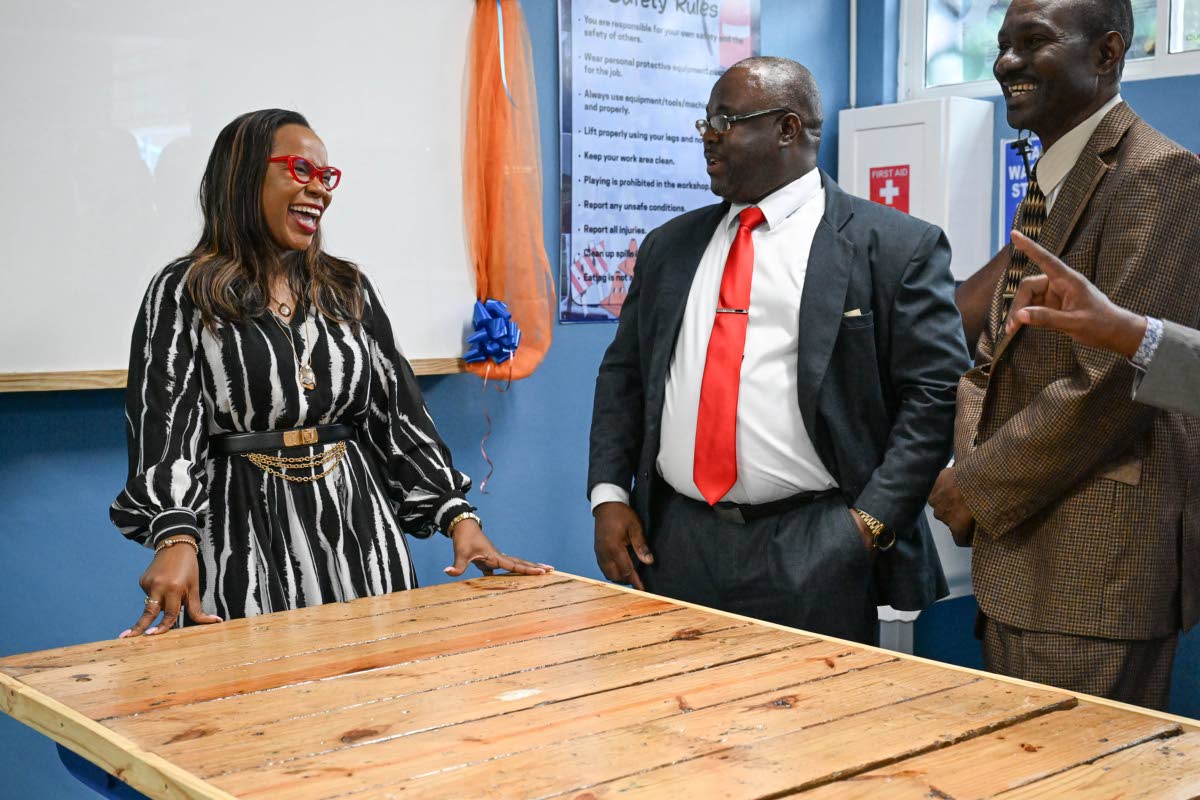 Permanent Secretary in the Ministry of Education, Skills, Youth and Information, Dr Kasan Troupe (left), shares a moment with Principal, St Mary Technical High School, Orville Richards (centre), and Board Chairman, St Mary Technical High School, Dr Isaac Brown, inside the Innovation Hub for Electrical and Renewable Energy at the St Mary Technical High School on February 6.
-
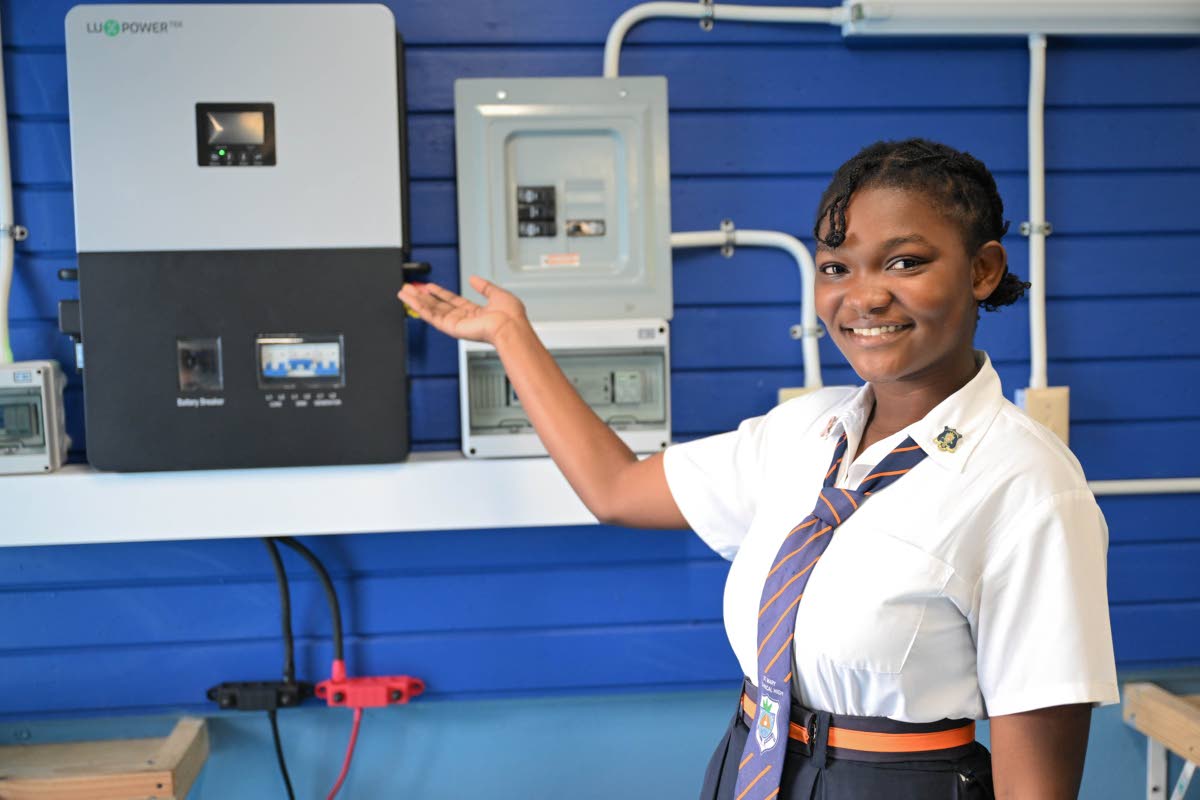 St Mary Technical High School sixth form student, Abigail Dixon inside the innovation hub.
St Mary Technical High School has begun to position itself more assertively within Jamaica’s technical-education landscape. The school’s principal, Orville Richards, has praised the Ministry of Education, Skills, Youth and Information for helping to establish a new state-of-the-art hub dedicated to electrical and renewable-energy training — an investment he sees as central to strengthening the institution’s technical credentials.
Richards describes the facility as a decisive step toward transforming the school into the country’s premier TVET institution. “This innovation hub stands at the intersection of education, innovation, sustainability, and national development,” he said. Arriving at a moment when climate resilience, digital integration and smart technologies are becoming unavoidable, the hub is intended not merely as infrastructure, but as a signal of intent. As Richards put it, the initiative is “more than an investment. It’s a statement of belief… that our students are worth investing in at the highest level.”
Completed on February 6 at a cost of $20 million under the ministry’s TVET Expansion Plan, the hub is already being woven into the school’s broader academic strategy.
The school also boasts one of Jamaica’s most promising young TVET talents, 17-year-old Abigail Dixon, who placed second in the 2025 WorldSkills Jamaica National Skills Competition at the Montego Bay Convention Centre, demonstrating strong competence in renewable energy with a focus on solar installation. Her performance earned her national recognition and selection to represent Jamaica at the WorldSkills Competition in Shanghai, scheduled for September 22-27.
Richards argues that the gains are visible in the school’s recent performance. In 2025 its overall CSEC pass rate rose to 70 per cent, up from 59 per cent the previous year. Around ten subject areas—most within the industrial arts stream —achieved perfect scores. Mechanical technology, electrical technology and technical drawing all recorded 100 per cent pass rates.
Traditional academic subjects have shown similar momentum. Geography, physics and chemistry improved by up to 40 percentage points. The Business and IT Department reported a 96 per cent success rate, while industrial arts, home economics, visual arts, physical education and sport maintained 100 per cent passes. English Language, at 79 per cent, aligns with the regional average. Richards argues that the combined effect is a graduate cohort that is “employable, ready and certified to go out there in the world of work.”
CERTIFICATION PROGRAMMES
The school’s expanding range of certification programmes reinforces this claim. Students can pursue credentials in cosmetology, IT office skills, food and beverage, renewable energy (Level 2), electrical installation, welding, general construction, housekeeping and furniture making. Hospitality and tourism management has recently been added as a dual-certification offering.
Yet Richards insists the school’s growing success cannot be attributed to equipment alone. Collaboration — rather than machinery — is the guiding principle. “What makes this moment powerful is not the equipment; it’s not the wiring or the technology. It is who we are becoming together,” he said. The school’s slogan, “One Technical,” is meant not as a motto but a cultural blueprint.
Under this approach, boundaries between disciplines are deliberately blurred. “‘One Technical’ means electricians collaborate with engineers,” Richards explained. “It means IT works alongside agriculture students on aquaponics, hydroponics, and solar systems. It means business students help commercialise innovation. It means teachers share departmental expertise and students learn that no great solution is created in isolation.”
The innovation hub, then, serves both as a physical asset and as a catalyst for institutional identity. For St Mary Technical, its value lies not only in upgrading equipment, but in reinforcing a model of education built on integration, applied learning and the quiet discipline of technical competence.