Bernard Lodge onion glut leaves farmers with millions in losses
Loading article...
-
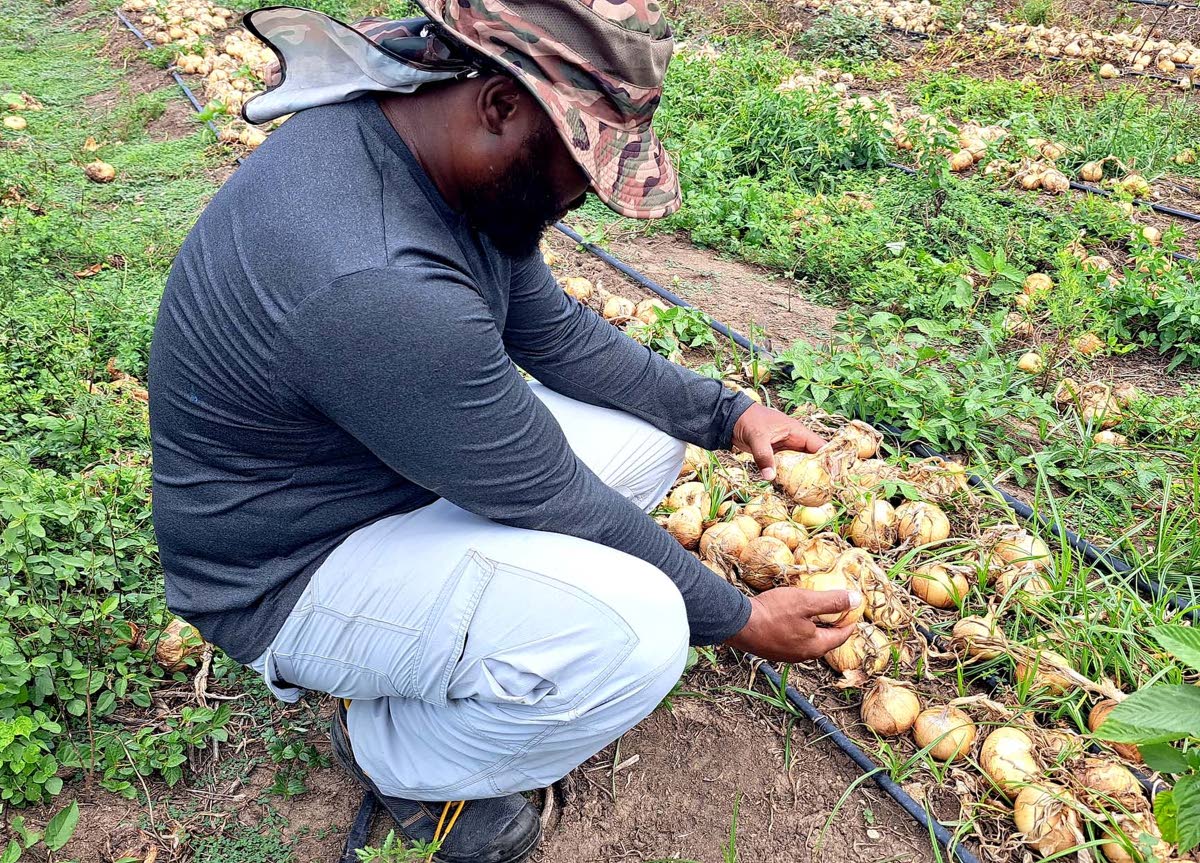
Jorn Bennett examines onions reaped from his farm in Bernard Lodge, St Catherine.
-
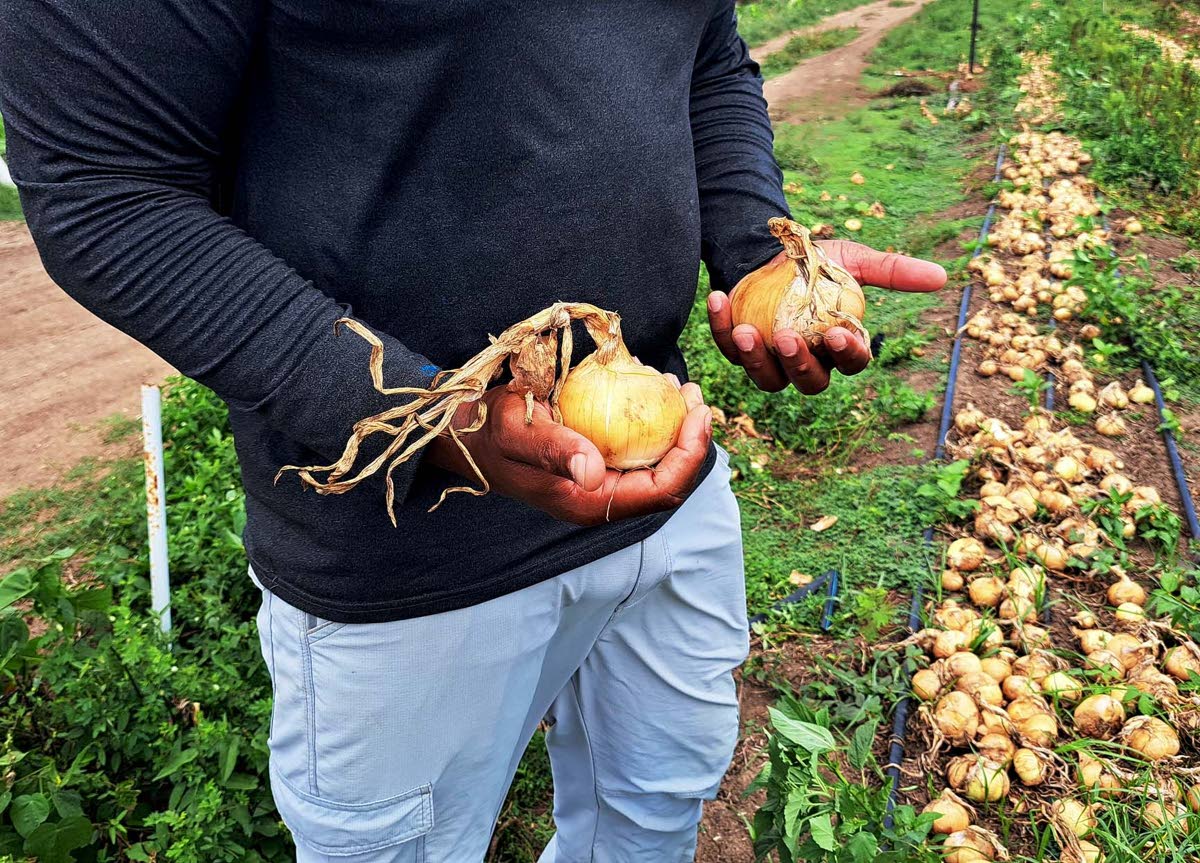
Global warming and climate change are radically altering the dynamics of agriculture.
-
 Acres of onions on Bernard Lodge farms in St Catherine await reaping.
Onion farmers in Bernard Lodge, St Catherine are facing millions of dollars in losses as a glut in local production collides with continued imports, leaving acres of mature crops at risk of spoilage.
More than 15 farmers in the area are now under pressure to slash prices in a bid to recover costs, even as they call for stronger protection for local agriculture.
Among them is Jorn Bennett, who has three of his 10 acres of onions ready for reaping. A participant in the Ministry of Agriculture’s onion farming initiative since its inception, Bennett says he has never faced such uncertainty at harvest time.
He estimates losses of just under $3 million if he is unable to secure buyers for his crop.
“We plant with the expectation of selling our produce in the local market, around about February/March, normally the imports would stop so that [the] local farmer can get a chance to sell their produce,” Bennett told The Gleaner.
He said that has not happened this year, with imported onions still flooding the market.
The pressure comes against the background of a sharp expansion in onion production nationally. Data from the Ministry of Agriculture, Fisheries and Mining show that the area reaped for onions rose from just 65 hectares in 2018 to a peak of 290 hectares in 2023, reflecting increased investment and participation in the crop. Although acreage has since eased, it remains well above pre-2019 levels, creating a structurally larger local supply that is highly sensitive to market timing.
“Normally vendors would be lined up ready to purchase our onion, but the price they are quoting is not feasible for me to sell at that price even to break even when we add all the other expenses,” he revealed.
Bennett said he invested more than $2.25 million to bring his three-acre plot to harvest. While imported onions are retailing for about $5,000 per 50 pound bag, local onions must be priced at roughly $7,500 per bag to cover production costs.
“It is a survival mode right now, my plan is to try and break even so I can go again next year, so if I have to match the imported onion price I will have to do it, better than have everything spoiling,” he conceded.
AT A DISADVANTAGE
Without mechanised equipment or the scale enjoyed by overseas producers, Bennett said local farmers are already at a disadvantage. He typically harvests about 45,000 pounds per acre and sells at $170 per pound, but may now be forced to drop prices to between $90 and $100 per pound.
The problem has been compounded, farmers say, by weaknesses in the post-harvest system.
In a recent Sunday Gleaner feature, an importer pointed to inadequate local storage capacity, arguing that imported onions are brought in to compensate for gaps when domestic supplies cannot be stored for extended periods. Farmers counter that the absence of coordinated storage and import controls leaves them exposed during peak harvest, precisely when local supply is at its strongest.
Dale Lopez, owner of Grass to Grace Farm, is also feeling the squeeze, with two acres ready for harvest from Bernard Lodge lands.
“My net profit will be far less than what is expected when I factor in production cost because I will have to match the price of the imported onion to avoid large scale spoilage,” Lopez said.
He added that imported onions can cost between US$7 and US$10 per 50 pound bag overseas, creating a price gap that local farmers cannot match.
Lopez is urging the government to put mechanisms in place to prevent imported onions from overlapping with local harvest periods. He is also recommending that the Ministry of Agriculture explore CARICOM markets as a way of absorbing surplus produce.
Just last month, the Rural Agricultural Development Authority sought to reassure the farming community and the public of its commitment to managing the current onion supply following significant production increases.
The agency said it had intensified market facilitation, technical support and storage partnerships to stabilise prices and secure fair returns, citing strong yields in major producing parishes like St Thomas and St Elizabeth as evidence that local production is meeting national demand.
Farmer Laytoya Johns is meanwhile calling for a fixed pricing regime, arguing that middlemen are worsening the crisis.
“Something need to be done about this, because the vendors will buy at the rate we are required to sell and then mark up sometime 50 to 80 per cent and blame the farmers for the high price,” she claimed.
editorial@gleanerjm.com