Elizabeth Morgan | While they stand aside and look ...
Loading article...
-
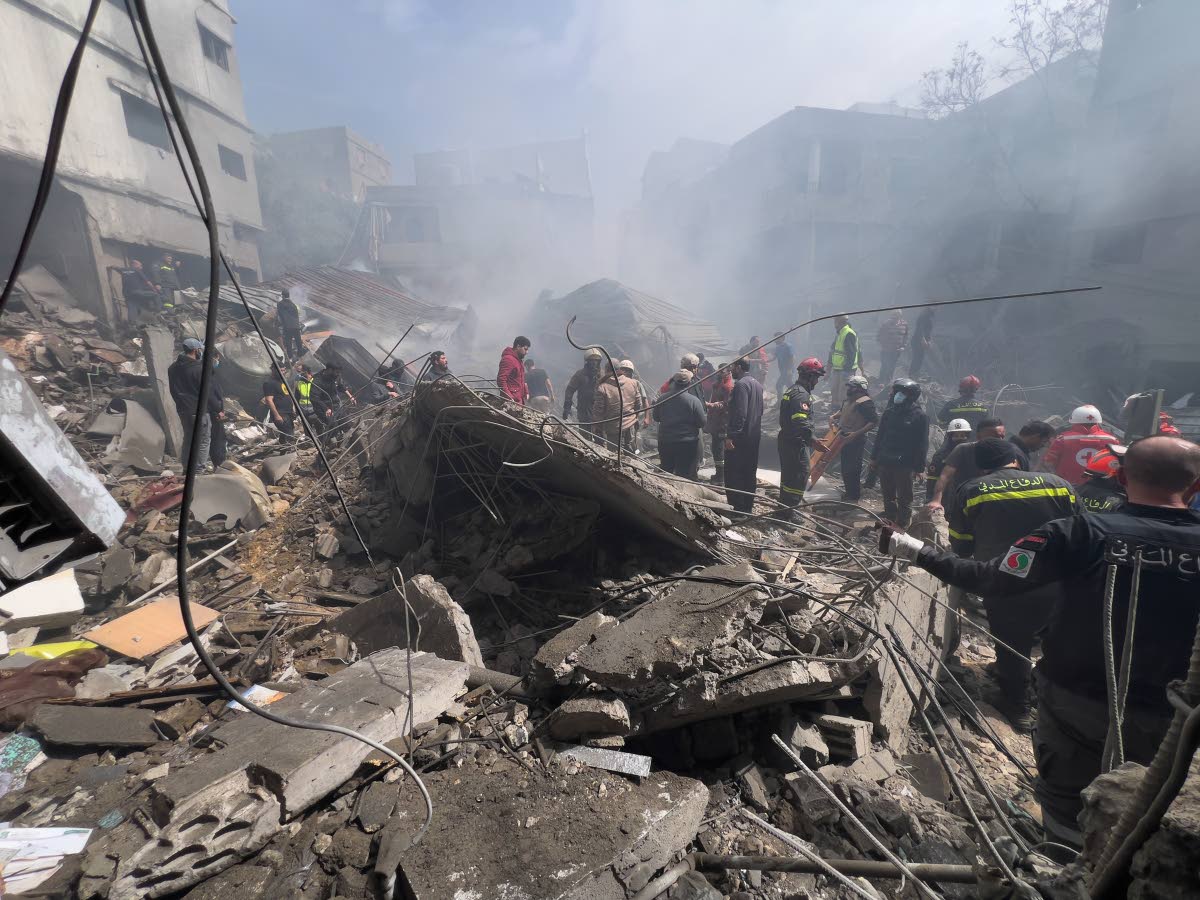 Rescue workers search for victims at the site of an Israeli airstrike that hit a crowded neighbourhood south of Beirut, Lebanon, Sunday, April 5, 2026.
-
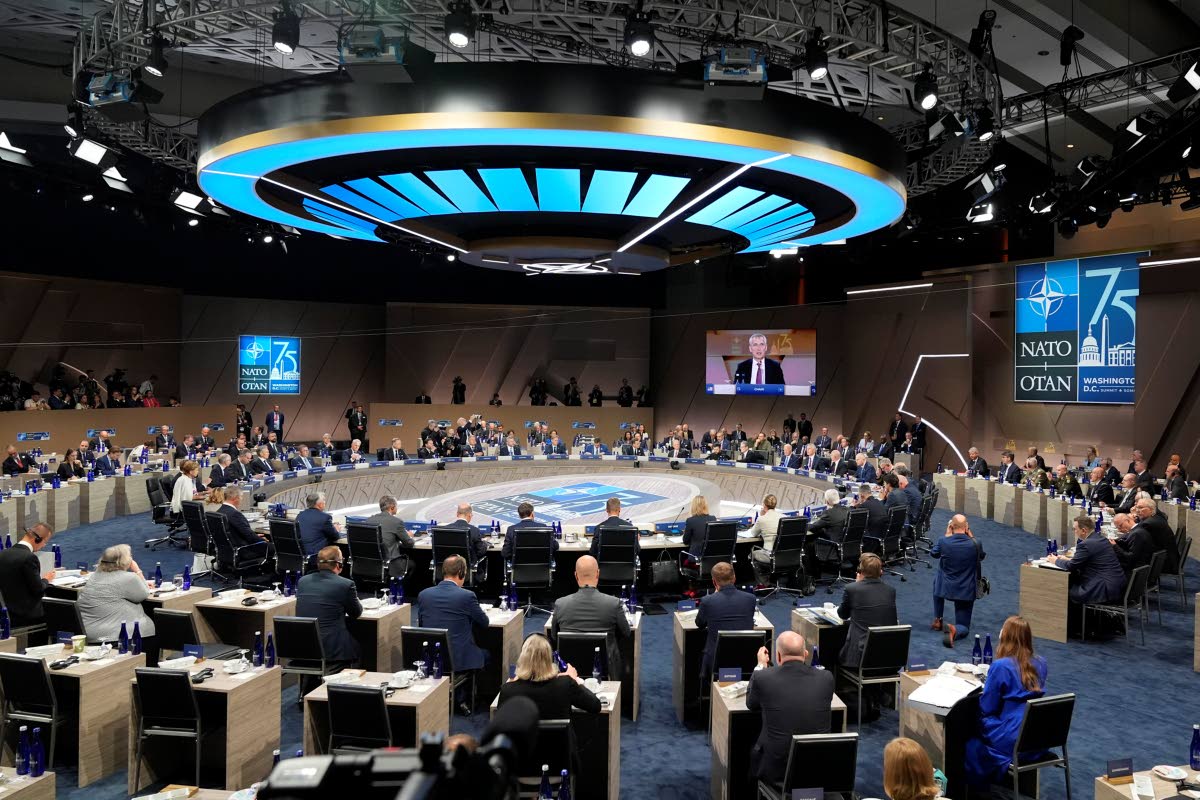 In this file photo, leaders take their seats for a meeting of the NATO-Ukraine Council during the NATO summit in Washington, July 11, 2024.
In the crisis engulfing the world with the USA as the main protagonist, the general view seems to be that leaders should not rock the boat, but should remain focused on their own concerns, staying under the radar. Nobody wants to upset the Trump administration.
WORLD WAR II COALITION
During WWII, 1939-1945, with appeasement failing, an allied coalition formed to oppose Nazi Germany and Imperial Japan. Leaders stood up in opposition, willing to take risks in support of a free world.
The United Nations (UN) was formed in 1945, supported by the USA, with the intent of maintaining global peace and security through collective action. Until now, coalitions were formed to confront rogue states and leaders.
LEADERS OF THE 1970S
In the 1970s, there were indeed leaders from developing countries, who were willing to boldly defend their right to development, and not to be oppressed, exploited and marginalised. Developing country leaders, whose voices resounded in the UN as members of the strong Group of 77 and the Non-Aligned Movement alliances, included: Julius Nyerere (Tanzania), Kenneth Kaunda (Zambia),) Samora Machel (Mozambique), Salvador Allende (Chile); Carlos Andrés Pérez (Venezuela); Fidel Castro (Cuba), Michael Manley (Jamaica), Lee Kuan Yew (Singapore), Indira Gandhi (India), and Mahathir Mohamad (Malaysia).
There were also developed country leaders, who had a more socialist approach being members of Socialist International. These included Olof Palme (Sweden) and Willy Brandt (West Germany). Pierre Trudeau (Canada) was a liberal with socialist leanings.
Like their politics or not, they were not afraid to speak, and there is no question that many paid a price. The UN General Assembly was certainly not boring.
ADVENT OF DONALD TRUMP
The unexpected happened in 2016 in the USA. A New York businessman and TV personality won the 2016 presidential elections representing the Republican Party aiming to Make America Great Again. It was an unusual presidency marked by the global pandemic, COVID-19. It was thought that this was just a fluke. Joe Biden (Democrat) won the 2020 election. There was a sigh of relief, thinking normality had returned.
How wrong many were! In 2024, US voters re-elected Donald Trump as president, and so began, in January 2025, an extraordinary US presidency marked by a slew of ‘emergency’ presidential orders, insults to world leaders, threats, tariffs as coercion tools, Truth Social rants, military action, and now a war with Iran. Members of the Republican Party, which controls Congress (House and Senate), surrendered their Constitutional powers becoming spectators and enablers in the Trump show.
APPEASEMENT
In a now globalised world where economic, financial, trade, technology and security policies are intertwined centred on the USA, most world leaders, since 2025, seem largely to be practising a strategy of avoidance and appeasement. They have been applying flattery and expensive gifts to keep on the right side of President Trump and his administration, hoping to survive his term unscathed.
For Europeans, it has been anything to avoid the USA abandoning the North Atlantic Treaty Organization (NATO) with war in Ukraine or imposing higher unilateral tariffs on their goods exports. Europe, including the UK, had a wakeup call. Trump USA actually does not think that their relationship is so special, even threatening to acquire Greenland, the territory of Denmark and annexing Canada, both NATO members. President Trump supports Hungary, a delinquent EU member, and seems to greatly admire Putin’s Russia.
Trump supported populist conservative political parties in Europe and Latin America.
There has been talk of strengthening partnerships in the global south to counter the USA. This does not look workable in Latin America and the Caribbean where there is a pro-Trump faction and fear among others. Trump has stated that the updated Monroe Doctrine will be applied in the Western Hampshire, its sphere of influence. Venezuela has been brought to heel and Cuba will be next. Do not forget Canada as the US’ 51st state. Canada has signalled recognition of a rupture in the global order and is looking to forge its own path.
Asia, including India and China, seem to be focusing on their own region and interests, seeking to increase regional integration, especially in the Association of Southeast Asian Nations (ASEAN). India is seeking to diversify its relations and strengthen its domestic economy. China is reported as looking to the future in science and technology to improve its competitiveness and to expand its economy. India and China are nuclear states.
In Oceania, Australia and New Zealand are in a security pact with the US and must now be concerned about their own exposure and vulnerabilities.
Africa seems to be accorded lesser importance by Trump, except for its resources. South Africa has faced accusations and threats, and Islamic sites were bombed in Nigeria to support Christians. With US unpredictability, concern about trade, travel bans, and security, African countries are also endeavouring to stay out of the firing line.
For the BRICS – Brazil, Russia, India, China and South Africa – expanded in 2024 to include other countries, including Iran and United Arab Emirates. It appears that with the Iran war and Iran’s retaliation into the Gulf States, relations may be strained in the BRICS.
In the Middle East, not unaccustomed to turmoil, Israel, with US support, has continued waging war in Gaza, the West Bank, and Lebanon. Now, with Israel, the Trump administration started a war in Iran without legal justification and which has serious implications for a global economy still dependent on oil for energy. This should be a call to countries to invest more in renewable energy.
OPPOSITION
So, with President Trump threatening to rain terror on Iran this week, where is the opposition to this rogue administration coming from? The NATO allies are endeavouring to avoid involvement in this war. They have been meeting with other countries to find a path to opening the important Strait of Hormuz.
One of the few voices mounting a moral opposition is the leader of the global Roman Catholic Church, Pope Leo XIV, using his homilies/messages to speak out against power dominance, violence, justifying war with Christianity, and to call for peace through dialogue.
But, who else among world leaders, with no ambiguity, is willing to fully raise their head above the parapet? Who will form the defence coalition? Not content to just stand aside and look..
Elizabeth Morgan is a specialist in international trade policy and international politics. Send feedback to columns@gleanerjm.com.