
Faith shaken, not broken
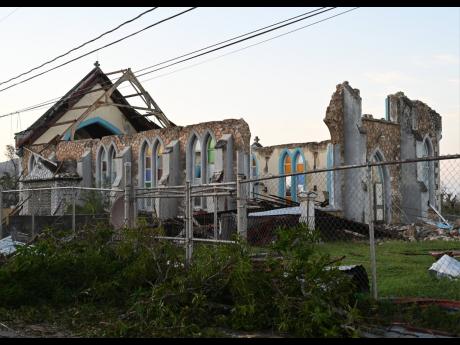
Hurricane Melissa shreds sanctuaries across Jamaica
Published:Sunday | November 2, 2025 | 12:12 AMJanet Silvera - Sunday Gleaner Writer




WESTERN BUREAU:
Hurricane Melissa has shattered hundreds of Jamaica’s churches, from wooden chapels tucked in sugar-belt villages to grand cathedrals that survived slavery and emancipation.
The storm has shaken the very heart of a nation famed for having the most churches per square mile in the world.
Jamaica’s religious landscape, boasting more than 1,600 churches, has long been intertwined with its identity. But Melissa, dubbed “the hurricane on steroids”, ripped apart that legacy in a matter of hours.
In the United Church of Jamaica and the Cayman Islands, at least 30 congregations have reported severe destruction.
“Some of these are our oldest buildings, some over 100 years old,” said Rose Wedderburn, regional deputy general secretary and general secretary designate.
“They were made from material that simply couldn’t withstand a storm like this. Some just crumbled.”
The United Church, which traces its roots to the early 1800s Presbyterian and Congregational missions, now faces the painful task of rebuilding its spiritual infrastructure. Yet Wedderburn insists that out of the wreckage comes revelation.
“This will give us more time to focus on rebuilding lives,” she told The Sunday Gleaner. “We have to ask ourselves, where are the people, and how do we reach them there?”
For Wedderburn, the storm’s destruction calls for a reimagined church, one that shares resources across denominations and ministers beyond the sanctuary walls.
“It’s an opportunity to make ministry more relevant,” she added. “We may be sentimental about our buildings, but the mission continues wherever the people are.”
She noted that some older communities have dwindled, leaving historic churches serving only a handful of worshippers.
“We might have to relocate ministries to areas of greater need,” she said. “That’s the bigger picture.”
Hardest hit were
the Baptists
Among the hardest hit were the Baptists, one of Jamaica’s oldest denominations and historically among the most community-focused. With 340 churches across the island, the denomination has about 40,000 active members and 150,000 adherents.
“We estimate that at least 10 per cent of our church roofs are gone, and many buildings are completely unusable,” reported Reverend Merlyn Hyde Riley, general secretary of the Jamaica Baptist Union. “The devastation is in the millions of dollars. There are more red dots on our damage map, representing the ones that lost total roofs.”
Hyde Riley said the western parishes of Westmoreland, Hanover, and St James were especially hard hit, with both churches and parsonages severely damaged. However, its early days and the numbers are not all in.
Beyond the loss of sanctuaries, she described a ripple effect now disrupting vital social services.
“Our churches aren’t just worship centres,” she explained to The Sunday Gleaner. “They run schools, clinics, homework programmes, and kitchens that feed the homeless. With roofs gone and equipment destroyed, those ministries are temporarily halted. It’s heartbreaking, but we don’t believe this is permanent.”
Internet and phone lines remain down in many communities, cutting off communication and forcing some congregations to suspend worship entirely. Yet Hyde Riley’s faith in recovery remains unshaken.
“We’ve never seen damage like this, not even during Hurricane Gilbert,” she admitted. “But our people are resilient. This is a setback, not a defeat.”
In Savanna-la-Mar, Westmoreland, Anglican Bishop Hartley Perrin stood before a battered but still-standing St George’s Church, its walls intact, its roof peeled away by Melissa’s winds.
“I feel confident that the church can be rebuilt,” he said calmly. “The physical structure, in terms of the walls and so on, they are still there. It’s a matter of rafters, sarking and recovering. It can be done.”
For Perrin, the moment is bittersweet. After 47 years of ministry, he is set to retire at the end of the year, leaving behind a congregation he has led through storms, droughts, and decades of change.
“I’ve done it over and over,” he reflected. “But I’m an old man now. This time, it will be up to those who come after me to rebuild.”
Even as he prepares to say goodbye, Perrin’s faith in the endurance of the Anglican community remains steadfast. His final months in ministry, he said, will be spent guiding his flock through recovery, ensuring the next generation carries the torch of faith and service.
For more than two centuries, Jamaica’s churches have anchored community life, doubling as schools, shelters, and cultural centres. They bore witness to the abolition movement, educated generations of children, and served as safe havens in times of crisis.
Now, many of those same buildings need saving. From Happy Grove United Church in St Elizabeth to small stone chapels in Trelawny and Hanover, the damage reads like an obituary of Jamaican heritage.
“These structures aren’t just places of worship,” Wedderburn reflected. “They carry our story, our culture, our resilience, our faith.”
Even amid the heartbreak, Jamaicans are holding fast to the belief that faith cannot be flattened.
“There’s always hope,” said Wedderburn. “We are a little nation, but we’re tallawah. We’ll rise again – together.”