Accolades for JN exhibition at inaugural WIFAX
Loading article...
-
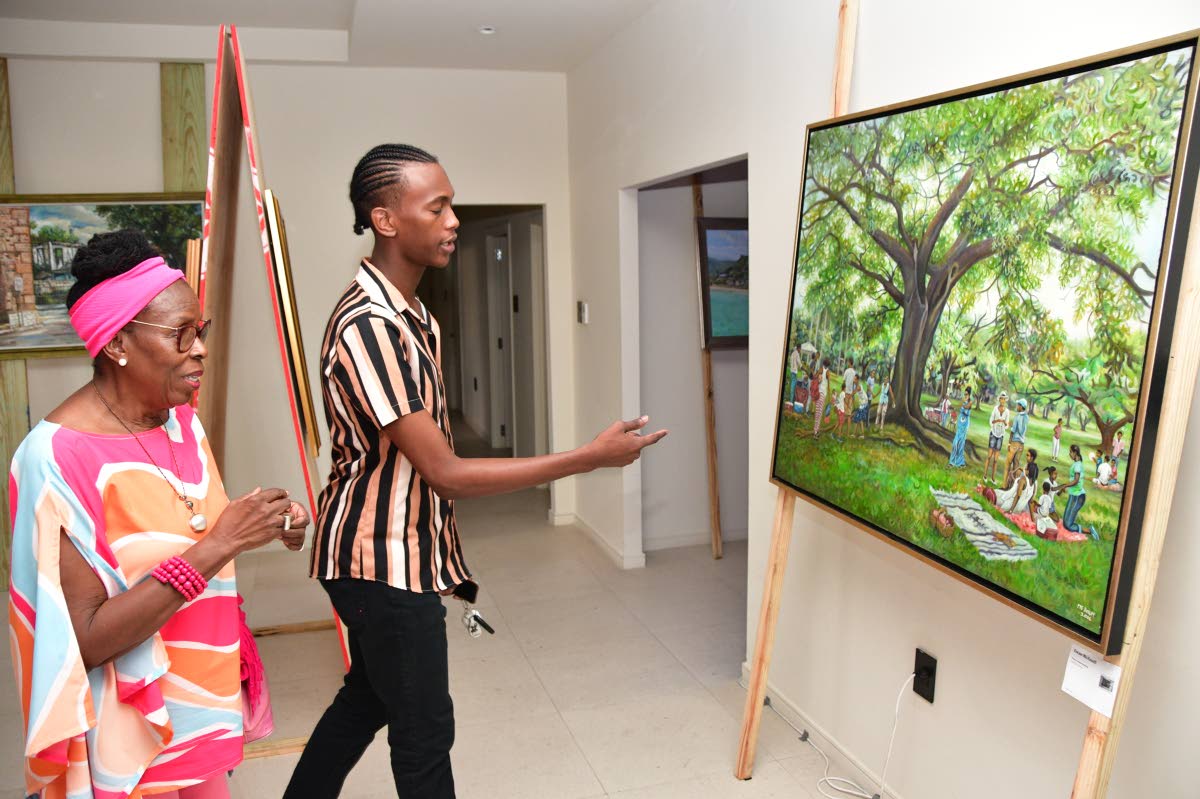 Ewan McAnuff’s Picnic in Hope Gardens caught the attention of Tyrel Creary and his grandmother, journalist, Rowena Christine King. Photo - Contributed
-
Ewan McAnuff’s Picnic in Hope Gardens caught the attention of Tyrel Creary and his grandmother, journalist, Rowena Christine King. Photo - Contributed
-
 Artist, John Campbell, describes Going to Market by renowned painter Carl Abrahams to fellow artist, Kianne Patrice Hutchinson. Photo - Contributed
From its collection of works of art showcasing some of Jamaica’s foundational figures and artists, The Jamaica National Group helped transform the Penthouse Suites at the ROK Hotel in downtown Kingston into a gallery.
This exhibition formed part of the week-long West Indies Fashion, Art and Architecture Exchange, by Saint International.
From pioneering artists such as Barrington Watson, Robert Armstrong, Carl Abrahams, Alexander Cooper and Richard Hall, to contemporary painters such as Jodi Ann McMillan, Carol Chrichton, Michele Lee Lambert and Heather Sutherland-Wade, patrons and artists had their own unique ‘exchanges’ with the works on display. Each piece selected told different stories about Jamaica’s history and its present, providing glimpses into its colonial past, rural and urban poverty, revivalism and pastimes.
INFLUENCE AND PERSPECTIVES
For artists, it was an opportunity to bask in the works of the greats who also influenced them in ways that, in some cases, not even they had yet come to realise.
The works of Carl Abrahams sent a flood of feelings rushing through John Campbell.
“Carl Abrahams is one of the artists who I saw when I was young, who I thought was just out of this world,” he said. “I’ve seen his religious works, I’ve seen his representational works and they have his language. He’s not trying to be anyone else; it’s a strong and distinct language he has developed. So, there is no doubt, when you see a Carl Abrahams piece, you see a Carl Abrahams piece.”
Although Campbell’s art is abstract, Abrahams’ pieces influenced him to create his own unique language in every work he produced and every story he told.
The viewing was a moment of discovery for Kianne Patrice Hutchinson, as she admired a piece by Alexander Cooper portraying a community where, despite poverty and crumbling infrastructure, the characters conveyed a sense of innocence and contentment. Although she had long admired Cooper’s work, it was his diversity of style that most resonated with Hutchinson, as Campbell described Cooper’s body of work.
“Along my journey, people used to say you have to just choose one style and stick to that for the rest of your life and perfect it, and that’s it. I always felt like that was an indictment, because my mind doesn’t work that way. I’m such a curious person. I read voraciously, I’m interested in everything, and so it would be so opposite to who I am as a person to stick to one thing even though every single cell in my body is telling me to go in a different direction,” she said. “So, what John says about it’s OK to be diverse, I embrace that.”
TRANSPORT VIEWERS
Romaine Lewis, a St Thomas native, said the most important characteristic shared by the pieces was their collective ability to transport viewers. As an artist who constantly seeks to transport his audiences into the fleeting moments of life he captures on canvas, Lewis found that the textures, tones and varied styles of the selected pieces offered a similar experience. But he connected most with Barrington Watson’s UWI, which captures a moment in the Chapel Gardens on the Mona campus of The University of the West Indies.
“Perhaps it’s a bias. We share a parish in a sense, but he has a particular way of capturing people that is dynamic, and sometimes it’s not always easy to get, because it’s subtle in the way that he does it. [As an artist], you want dynamism, but you don’t want it to be overdone or exaggerated. The subtlety is hard and he gets subtlety,” he explained, pointing out Watson’s ability to capture the distance between objects and subjects as an example of his mastery. It’s a skill Lewis himself continues to hone as he draws his audience into the scenes he envisions.
Artists and patrons commended the showcase, and some expressed a desire for more institutions to follow suit.
“I’d like to see more like this. I’d like to go somewhere and see a collection that tells the story of our past and present, so that the public can be aware of the historical context of our art and our narrative,” Campbell said.
“We stand on the shoulders of the past, those who came before us, but it cannot be when the person dies that you scramble to acquire their works. Institutions overseas have gone past that,” Hutchinson said.