Yaneek Page | NaRRA’s reconstruction boom must strengthen communities and small businesses too
Loading article...
-
 Yaneek Page. Photo - AG Guest Guest
-
Yaneek Page. Photo - AG Guest Guest
-
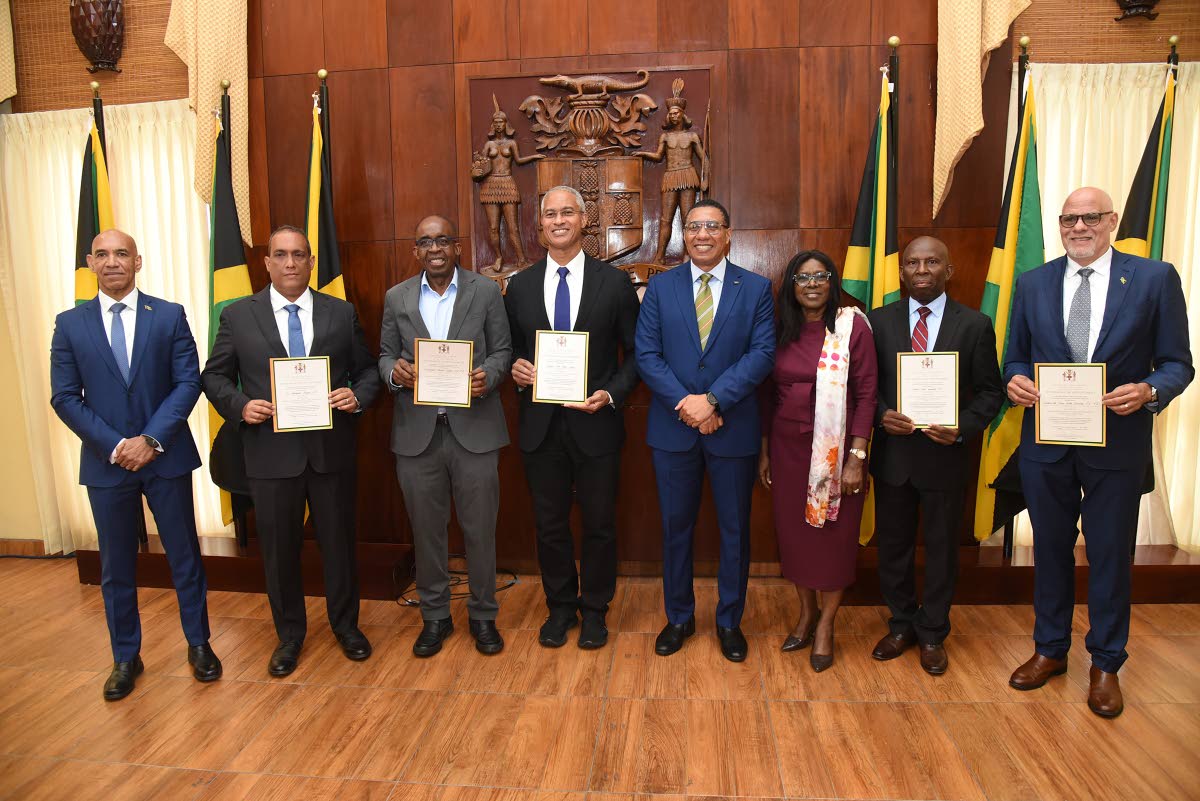 Prime Minister Dr. Andrew Holness (fourth right), Audrey Sewell (third right), Cabinet Secretary, Ambassador Antony Anderson (left), Chief Executive Officer, National Reconstruction and Resilience Authority (NARRA), share a moment with members of the Jamaica Reconstruction and Resilience Oversight Committee (JAMRROC) during it’s Official Launch in the Banquet Hall, Jamaica House on Tuesday. The members are, Dr. Christopher Burgess (second left), Patrick Hylton (third left), Professor Peter Blair Henry (fourth left), Pastor Glen Samuels 9second right). Photo - Ian Allen
Picture Western Jamaica three years from now if the National Reconstruction and Resilience Authority (NaRRA) delivers fully on the ambition outlined by Prime Minister Dr Andrew Holness in his Budget Presentation earlier this year. On March 19, 2026, he described the authority as being more than project delivery. “It is about project networking to create new economies in areas impacted by the disaster and to induce the greatest expansion of our economy in the shortest period of time in our history”, he noted in Parliament. That is a tremendous promise worth visualising, first through the eyes of people who live and do business in the areas hardest hit by Hurricane Melissa on October 28, 2025.
Understandably, it may be hard for many to see that beyond last week’s headlines, which revealed much about the operational overheads but very little in the way of output. A social media frenzy followed the revelation of NaRRA’s proposed J$115 million-a-year lease at the Digicel Building, with occupancy since scaled back to one floor, instead of two, after public outcry. Then came the uproar about the CEO’s $40 million salary plus substantial fringe benefits, including a considerable performance gratuity. Certainly, those costs deserve scrutiny. But the people whose homes, businesses, and livelihoods were upended by Melissa also need to know what all that spending will help deliver. What would the prime minister’s promise look like beyond NaRRA’s office walls, in the towns and communities waiting to recover? For small business owners, that interest is practical. They want to know that the money is being spent wisely, and equally important, where the work will be, when it will become available, and how they can get a fair chance to earn.
No Cabinet-Approved Projects Yet
It would potentially mean a complete urban transformation of Falmouth, substantial housing recovery and relocation in Parottee, coastal protection and climate-resilient redevelopment of Black River, waterfront and urban redevelopment in Montego Bay, and a complete rebuild or repair of schools and health facilities damaged by the hurricane. Possibly a transformation of roads, and drainage rebuilt to withstand torrential rains and severe weather from climate risks ahead. Bridges that cut off districts would be replaced, not simply patched. And the courthouse and other key public buildings may soon sit inland, out of the surge zone while the seafront becomes a heritage and tourism corridor. And every step would be public, allowing anyone to visit the online project register and view what is approved, with linked completion/progress timelines and contract information.
As of this writing, NaRRA’s website lists zero Cabinet-approved projects in its official register. The initial studies informing some of the possibilities are groundwork. And there are many proposed projects outside the worst-hit disaster zones. Indeed, the first statement below the project tracker reiterates that announcements are not approvals and approvals are not delivery.
Even if executed perfectly, it will not feel fast. Hospitals and new town centres take years. Additionally, the money set aside does not cover everything. Damage and losses have been put at US$12.2 billion, against an international financing package of up to US$6.7 billion over three years, much of it repayable financing. That package is not money already sitting in NaRRA’s account. So some projects may have to wait. It is also imperative to clarify the scope: NaRRA’s primary job is not to fix roofs or gates of personal properties. The law specifies that it must prepare, implement, and oversee the major reconstruction and resilience projects Cabinet approves. Its reach extends to rebuilding the public backbone of communities rather than private repairs.
Small Business Set Aside and Participation
Notwithstanding, there is one more critical piece of that picture. In the ideal version, the contractor or subcontractor who rebuilt the clinic is from Santa Cruz, and local hardware stores supplied the materials. Nearly every truck, piece of equipment, and available worker in western parishes are employed. And every entity and its workers get paid on time. Beyond a dream, this must form part of the procurement imperatives, particularly because NaRRA will largely operate under a ministerial exemption from the standard public procurement regime. Local businesses must be sensitised to the order and the rules that will replace it.
Doing otherwise would expose the west to the catastrophe of rebuilding its physical communities while leaving its people economically weaker. Residents can’t watch substantial sums being spent around them while their own businesses struggle. Without deliberate provision for such participation, larger firms with more capital equipment and bidding experience will capture most of the work. Therefore, local businesses will lose both the immediate income and experience that could qualify them for future contracts. Some employment created from temporary jobs alone will not deliver the lasting impact and growth for which such massive rebuilding provides opportunity. And the idea that inclusion is the enemy of speed is a rookie fallacy. A point I have rebutted in prior columns. New infrastructure built on a weaker economy would be a devastating man-made disaster.
It is hoped that NaRRA will, without slowing down:
Make the MSME reservation explicit in its procurement framework - explaining how it will operate across different financing arrangements.
Unbundle large contracts to allow small firms to bid, wherever technically and economically reasonable.
Pay within 30 days, with interest on unjustified late payment, and protect small subcontractors.
Publish upon award the value, method, number of bidders, winner, firm size and firm registered business address.
The project register is a starting point, however it is important to note that projects are not contracts.
What Small Businesses Should Do
To every contractor, roofer, supplier, haulage operator, caterer and engineer reading this: the reconstruction market is coming whether you are ready or not. Get ready!
Check the Public Procurement Commission’s registration requirements for your supplier category and register on GOJEP.
Get your tax compliance, applicable documentation and financials in order.
Engage 2-3 trusted businesses about bidding jointly. Together you may qualify for work none of you could win alone. Put the arrangement in writing.
See your banker about contract financing before you need it. A contract without working capital can become a liability.
Watch NaRRA’s project register and procurement notices weekly. Together, they should help you see what work is coming.
One love,
Yaneek Page is the programme lead for Market Entry USA and a certified trainer in Entrepreneurship.