
Garth Minott | Honouring a legacy through literacy
Published:Wednesday | July 30, 2025 | 8:14 AM
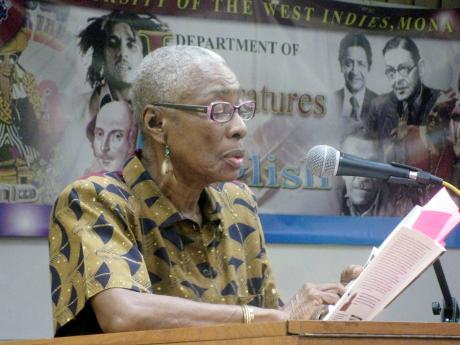

I TAKE this opportunity to salute the memory of Dr Velma Pollard, poet, scholar, author, activist, philanthropist, and a dedicated Christian. She was not one who sought publicity or acclaim but was simply someone who dedicated to her craft and focused on human development, which I can attest to as one of her former students in linguistics at The University of the West Indies (UWI). I salute her for the literacy intervention at the August Town Primary School in St Andrew.
Shortly after taking up assignment as Anglican Chaplain at the UWI, Mona Campus in 2003, I renewed my acquaintance with Dr Pollard and was given details of her work to improve not only literacy, but also school attendance at the August Town Primary School. Dr Pollard conducted a study on the state of literacy at the school and found that students were not only reading and functioning below their grade levels, there was also a standing practice that not many students would attend school on Fridays, as many parents could not afford to provide lunch for their children.
MARKED IMPROVEMENT
After sharing her findings with members of the Anglican Community which worships at the UWI Chapel, she recommended that the congregation sponsors lunch on Fridays. Soon after this was implemented, it was observed that not only was there 100 per cent attendance on Fridays, but there was also marked improvement in literacy.
Once I learnt of the success of the intervention, it was a no-brainer. Not only did I fully endorse and support the outreach, I also encouraged the expansion of the programme to provide lunch on a daily basis. Later, breakfast was added after the then principal indicated that some children were attending school without breakfast. Of course, not only was this before the National School Feeding Programme, and the addition of breakfast was phenomenal as the evidence showed a marked transformation in overall school performance.
This intervention, which I credit as an initiative of Dr Pollard, and supported by the wider Anglican community, and which the school recognised through the gift of plaques, symbols of honour as signs of respect for this outreach ministry, is a stellar indication of the commitment of the Anglican Church to education.
Indeed, with her roots in Woodside, St Mary, where she was not only educated and socialised, but also received her Christian formation, it was not surprising that Dr Pollard, a serious social activist in her own right, chose the August Town community. In fact, given its rich history rooted in the spirit of emancipation, effected on August 1, 1838, it is fitting that Dr Pollard chose this community. It was not simply because of its proximity to the UWI, but also for its rootedness in our history. Moreover, it is fitting that we are recalling this history now, as in a few days we will be celebrating Emancipation Day.
EMANCIPATION IS ONGOING
Kortright Davis, well-known Anglican priest and retired professor of Howard University, is correct when he asserts in his book, Emancipation Still Coming, that emancipation is ongoing. In this sense, I see a link with the ongoing struggle to educate the majority of Jamaican people as, despite much talk about the need to prioritise literacy (and numeracy), the excellent report done by Professor Patterson and his team, and well-intentioned attempts by the implementation task force to action the recommendations, if reports in the media recently is anything to go by, the problem of illiteracy is still a challenge. For this reason, the project led by Dr Pollard, mindful of the deep and abiding legacy of enslavement, and, the need to focus on literacy affirms one lesson taught by National Hero, Marcus Garvey that, one way to free people from poverty and other forms of oppression is through education, with literacy being a critical component.
In the final analysis, education is not just about literacy (and numeracy, but also about character formation. This is in keeping with the biblical theological view that people are made in the image and likeness of God, imbued with intelligence, the capacity to think critically and the gift of imagination to dream and bring visions to reality. To focus on literacy, therefore, is to affirm people’s dignity, worth and, what the late Rex Nettleford referred to as “smadiness”. Moreover, literacy and character formation, key roles for schools in any society, must take into account investment for the present and the future, with returns which far outweigh the capital injection. In this regard, the Government need not feel guilty about investing in children’s nutrition, as is currently done through the school nutritional programme. Instead, what is required is ongoing evaluation of the interventions, both in literacy and nutrition, to ensure value for money. By so doing, we would be honouring the life and work of Dr Velma Pollard.
Rt Rev Garth Minott is the Anglican bishop of Kingston. Send feedback to columns@gleanerjm.com.