Basil Jarrett | Opportunities in every (Middle East) crisis
Loading article...
-

-
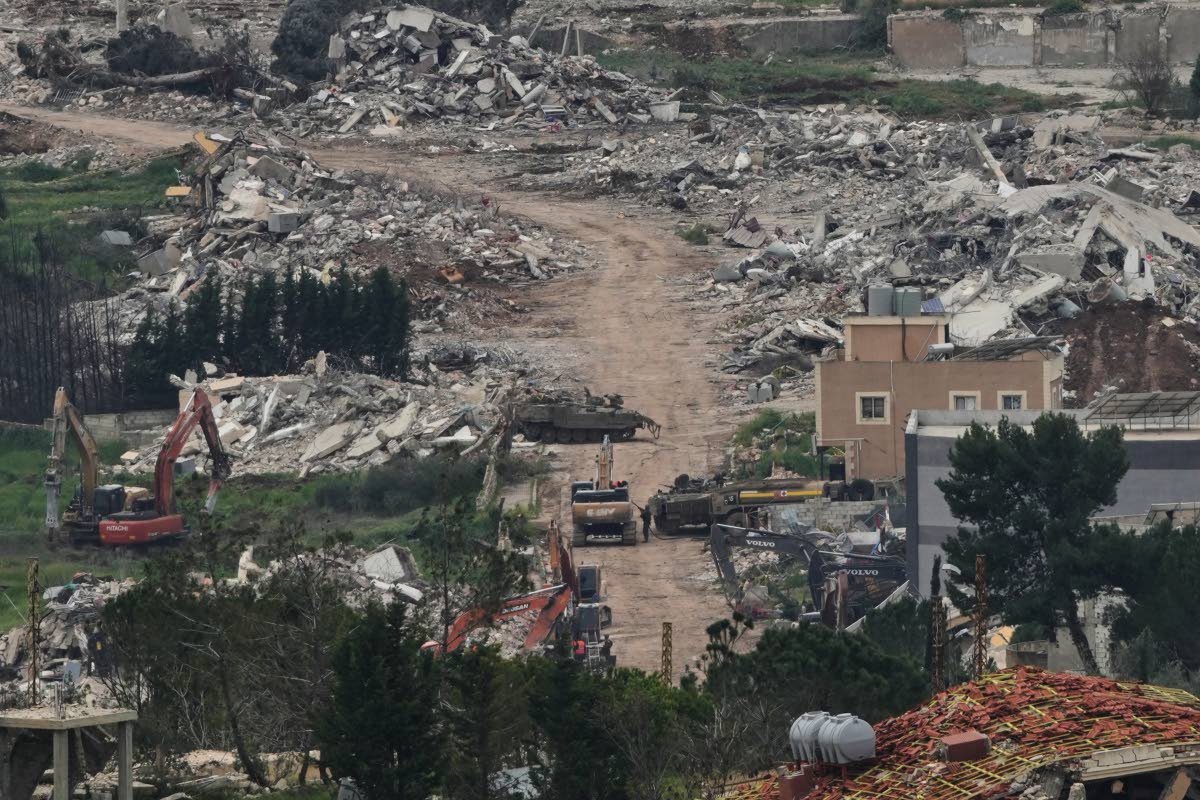 Israeli army vehicles and bulldozers operate in southern Lebanon, as seen from northern Israel, Wednesday, April 15, 2026.
Let’s get this out of the way early. What is happening in the Middle East is a sad, disheartening and completely regrettable waste of human life and property.
Over the past six weeks, the region has looked like a match dropped in a room already soaked in gasoline, after the US and Israel launched strikes on Iran on February 28. In retaliation, Iranian has attacked Israel and its Gulf neighbours sympathetic to or aligned with the US, with a mix of missile and drone technology that has surprised many for their complexity, lethality and quantity. A fragile ceasefire now exists in principle, even though bombs are still flying courtesy of an aggrieved Israel and some confusion over how far the cease fire stretches and who it applies to.
THE DAMAGE SO FAR
Reuters reported last week that the broader conflict has already led to roughly 5,000 deaths, with Iran and Lebanon among the hardest hit. In Lebanon alone, Israeli strikes since early March have killed more than 2,000 people and displaced 1.2 million, according to Lebanese officials cited by Reuters. AP, meanwhile, reported that one single day of Israeli airstrikes on Beirut on April 8 killed at least 182 people and wounded nearly 900, while another round the following day pushed the toll above 300 with more than 1,100 injured. Hezbollah has continued attacks on northern Israel, Israel has kept hammering Lebanon, and the U.S. has now gone as far as enforcing a naval blockade on Iranian ports while diplomats try to salvage something that still resembles peace. The IMF is already warning that the war is raising global financial stability risks and could trigger a much deeper economic downturn if it drags on.
It is indeed a global human and geopolitical tragedy, one which Jamaicans will soon start to feel in their wallets as the bombs in the region start echoing at the pumps in Kingston. So far, there has been a burst of weekly increases in gas prices, some as much as 20 per cent since the start of the year. In early April 2, E10-87 gasoline had moved from $148.87 on December 28 to $172.38, up 15.8%. E10-90 went from $155.49 to $179.83, up 15.7% while diesel climbed from $159.43 to $184.75, a 16% per cent hike. Kerosene has also piled on the misery, jumping 19.6% from $145.58 to $174.15. As a result of all this, every taxi fare, supermarket run and light bill payment now has one eye on Tehran. Even the Bank of Jamaica (BOJ) has issued a warning that a prolonged conflict and further energy price increases could push inflation higher in Jamaica very soon.
THE OPPORTUNITY BEFORE US
Now before anybody accuses me of trying to turn war into a business seminar, let me just say that in no way is this article meant to trivialise what is happening in the region or to downplay the devastating impact on the lives of innocent people, never mind the possibility of tipping the world toward recession. Nor is it an argument that Jamaica should seek to profit from other people’s misery. But one of the oldest principles in crisis communication and crisis management is that there is opportunity in every crisis. Not joy. Not celebration. Opportunity. The chance to rethink a weakness before it kills you. The chance to solve a problem you were perfectly happy to ignore when things were cheap and comfortable. That principle is now colliding head-on with another old truth: necessity is the mother of invention.
If a war six thousand miles away can send our transport fuels climbing by 20 per cent in a matter of weeks, then Jamaica’s over-dependence on imported fossil fuel is no longer just an environmental talking point for conferences with those God-awful brown paper bags. It is a national vulnerability. A strategic weakness. An open flank.
What we should be doing now is aggressively accelerating the move towards renewable energy, namely solar, by fast tracking policy, marketing campaigns and financing solutions right now. Not next year. Not after another round table, three pilot projects and a task force with a logo. Now!
DO IT NOW
If the average Jamaican can get a loan for a motor vehicle, furniture set, kitchen upgrade or Carnival costume, then surely we can structure sensible financing for rooftop solar, battery storage, solar water heating and other energy-saving retrofits. Government may want to seriously consider subsidies not just low or tax-free import waivers for solar panels, inverters, batteries and related equipment. If we can understand the logic of strategic tax policy for tourism and manufacturing, we can certainly understand it for energy resilience. Banks and other lending institutions should develop aggressive financing solutions for customers with repayment terms based more around your light bill payment history and less around your credit score. And JPS, for its part, needs to accelerate its thinking around how to expand its footprint in solar and other renewables, and to do so in a way that makes distributed generation feel like national policy, not boutique privilege for people with enough roof and enough money.
Electric vehicles need far heavier pricing discounts, promotions and endorsement, especially in fleets and public transport. If fuel shocks are now becoming a regular part of the global weather report, then Jamaica would be foolish not to push back with these alternatives. And what better time to grab people by the neck and force them to take action than now, when all of us are feeling it.
There is an old Jamaican proverb that says cockroach “nuh business inna fowl fight”, which is probably why the local media discourse around the conflict in Iran is so minuscule. But in 2026, it may be even wiser for said cockroach to insulate himself from the fallout. That is the real opportunity here. Not profit from pain, but protection from vulnerability.
We may not be able to stop wars in the Middle East, unblock the Strait of Hormuz, or persuade powerful countries to stop lobbing bombs at each other, but we can certainly reduce the extent to which their madness determines our monthly expenses.
That is the opportunity before us in this current crisis. But do we dare to grab it.
Major Basil Jarrett is the director of communications at the Major Organised Crime and Anti-Corruption Agency (MOCA) and crisis communications consultant. Follow him on Twitter, Instagram, Threads @IamBasilJarrett and linkedin.com/in/basiljarrett. Send feedback to columns@gleanerjm.com