Peter Espeut | PEP placement ginnalship
Loading article...
-
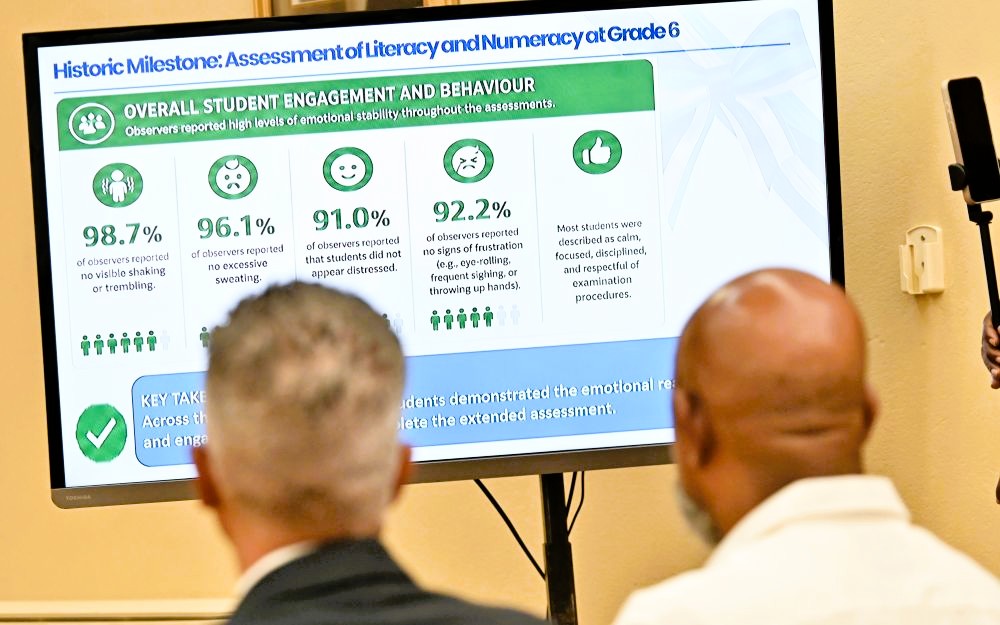 A display screen shows the breakdown of PEP results, announced during a news conference on Monday, June 22.
-
A display screen shows the breakdown of PEP results, announced during a news conference on Monday, June 22.
-
 Peter Espeut
“Ninety per cent of students who sat the 2026 Primary Exit Profile (PEP) examination have been placed in a school of their choice”. So declared the headline of a release from the government’s propaganda agency, the Jamaica Information Service (JIS) on Monday, June 22.
The job of the JIS is to make the government look good. In these modern days of information management and control, where elections are won and lost on the quality of political propaganda, the general public needs to examine carefully government messaging and search for the truth behind the words of government propaganda releases.
When I sat the Common Entrance Examination (the precursor to PEP) in 1963 I had to declare three choices of high school I wished to attend, in order of preference. The higher my score, the more likely I was to get my first choice. I am sure it is the same with PEP.
Why does Jamaica need a PEP examination at all? In some countries, students automatically attend the public high school in their neighbourhood or geographic area, so there is no need for a placement examination. In Jamaica we need a PEP because there are not enough high school places for every Jamaican child to get one. And so there is fierce competition for the few spaces.
In 1963 when I sat the exam Jamaica had only 41 traditional high schools (largely owned and operated by churches and trusts) and six technical high schools; children from about 690 primary (grades 1-6) and all-age schools (grades 1-9) competed to attend them. Not even in 2026 do Jamaican children have the right to attend high school.
But then very many children who complete grade 6 are functionally illiterate. They would drag down any high school in which they were placed. Jamaica must have a PEP to weed out those that the system has failed.
In 1963, not many children who took the Common Entrance got a space in any of their three high schools of choice; most children simply went on to Grade 7 in an all-age school.
Subsequent governments upgraded many all-age schools to secondary schools, and built new ones. Everybody knows that these new schools at the secondary level deliver a lower quality education than the traditional church and trust high schools. In the latest secondary school rankings there is only one government-owned school in the top ten, and only two min the top twenty. So you see why we must have a selection examination.
In 2026 children taking the PEP must indicate seven schools of their choice, in order of preference. No wonder 90 percent are placed in their schools of choice! They have so many choices.
Let me give the government some free advice: ask the students to list the top 30 schools of their choice. Then JIS will likely report that 100 percent of students got one of their schools of choice!
Last Monday’s JIS release gave some details:
“Twenty-four per cent of the students got their first choice, 18 per cent got their second choice, 16 per cent got their third choice. So, when you add up all of that, you’re almost at 60 per cent that got their first three choices”.
This allows better understanding of student performance, but to understand what is really going on in Jamaica’s education system, we need additional information.
Children who attend private preparatory schools (high fees) do much better than those who attend government primary schools (no school fees); traditionally, prep school children gobble up the best high school places, thus reproducing and reinforcing Jamaica’s notorious class system at taxpayers’ expense. Before we applaud the PEP results, the public must demand that the Ministry of Education break down the data to show how many of those who got their first choice were prep or primary school students.
In the past, it was so bad that the government was forced to apply affirmative action: they implemented a 70-30 system, which reserved 70 percent of high school places for students of primary schools, while restricting the number of private prep school students who could attend a government high school. As you would probably imagine, that system has long been abandoned, as the performance of primary school students has been so poor, and pressure from parents of prep school students mounted.
Do we have educational apartheid in Jamaica, where the children of the better-off have a track to quality high schools and tertiary education, while the children of the poor are pushed into lower quality institutions, only to drop out or leave school without the CXC and CAPE passes that open the door to middle class incomes?
The answer is largely yes! The work of Professor Errol Miller (Jamaican Society and High Schooling) and the late Dr. Derek Gordon (Class, Status and Social Mobility in Jamaica) in this area is well known. Our education system allows social mobility to only a few, who are then paraded before the public as evidence of how the system is working.
And our educational apartheid starts with the Common Entrance Examination, or the Grade Six Achievement Test, or the Primary Exit Profile, or whatever you choose to call it. And there is a lot of obfuscation. And there has to be, because our education system is classist and elitist.
I hope you took note that the highest primary school PEP performer has been announced, but not the top overall performer. Or the top ten overall performers. Or the top 100 overall performers.
How did primary school students do in comparison to private prep students? Why is the full picture not being presented? What is the government trying to hide?
In this government by public relations you have to read the press releases carefully, to separate the truth from the propaganda, designed to make us believe that things are better than they really are. That is what ginnalship is all about.
Peter Espeut is a sociologist and development scientist. Send feedback to columns@gleanerjm.com