Carvell McLeary | Jamaica: Land of happy uncertainty
Loading article...
-
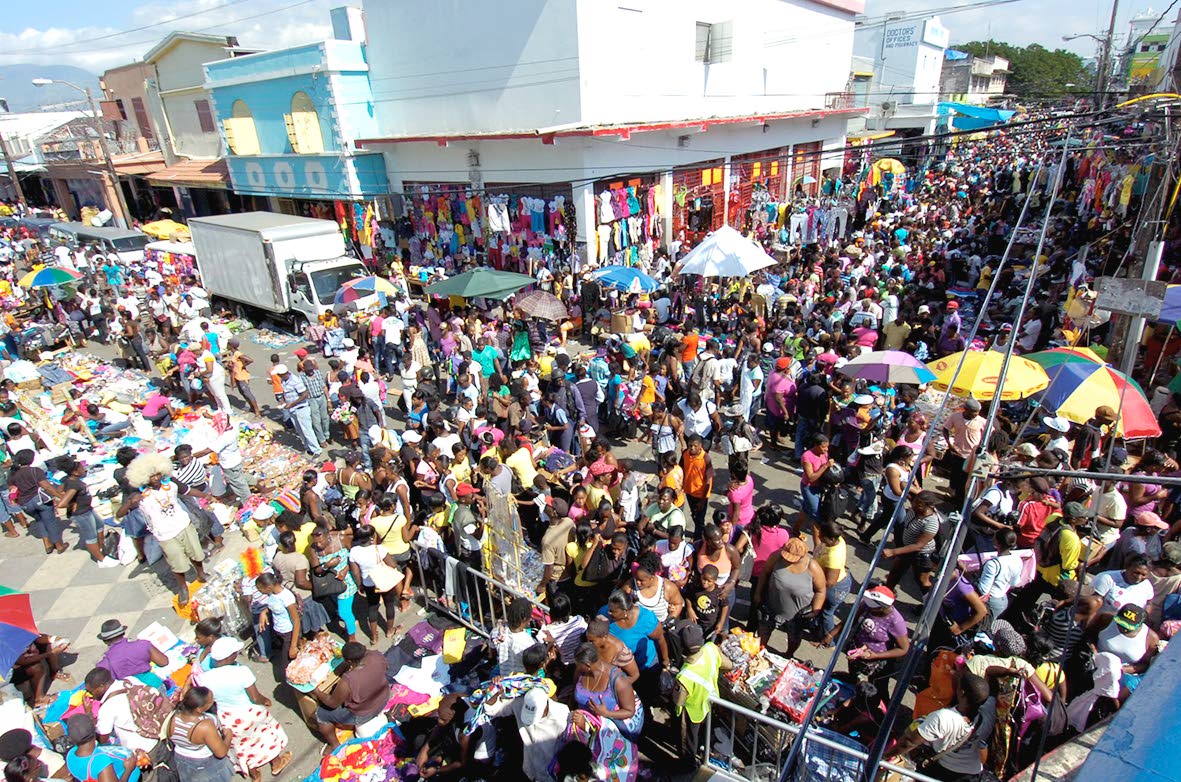 This file photo shows a buzz of activity in the downtown Kingston shopping area.
-
 Carvell McLeary
There are countries where life operates with the precision of a Swiss watch. Roads are labelled; buses stop where they should; road-construction sites are well marked on your approach; and automated banking machines give cash when instructed. Then there is Jamaica, a place where cell-phone coverage generates colourful language.
For years, I struggled with why Jamaican life embraced this uncertainty. Why are street names missing? Why do some buses treat bus stops as mere suggestions? Why do roadworks happen after you have bent your rims? Why do we watch potholes grow in stature to become craters? These are frustrating peculiarities of everyday life!
Dutch social psychologist Geert Hofstede studied national cultures and identified factors that differentiated societies. One is uncertainty avoidance, the degree to which people feel uncomfortable with uncertainty, the unknown, and unpredictability. Countries having high uncertainty avoidance want rules, structure, planning, and predictability. Citizens must know what is coming next. Procedures are valued, and systems are worshipped. No surprises!
UNCERTAINTY
In Hofstede’s 1980s studies, Jamaica recorded one of the lowest uncertainty-avoidance scores in the world, 13 out of 100. We embrace uncertainty with enthusiasm! Our transportation system, as a prime example, has long displayed a healthy disregard for rigid predictability. Signs have faded letters and are often blocked by bushes, making road trips problem-solving exercises of intuition, prayer and Google Maps.
With non-existent or poorly maintained sidewalks, roads and pedestrian tracks merge dangerously. Today’s ‘barbagreen’ is tomorrow’s obstacle course, and Jamaican drivers need to be adaptable to the elements of discovery characterising every journey.
AGILITY AND RESILIENCE
Most people navigate uncertainties with remarkable skill and composure. While visitors experience stress, we experience adaptation. We adjust, improvise and find a way. The refrain, ‘no problem, man!’, is our anthem for low uncertainty avoidance. This characteristic has strengths and weaknesses. For sure, Jamaicans are exceptionally resilient. We adapt quickly when circumstances change, and function in environments where plans unexpectedly collapse and systems fail.
When disaster strikes and resources become scarce, people show an extraordinary capacity to innovate and survive. Under oppressive food deprivation, from our plantation experience, we developed a love for ‘cowfoot and beans’, ‘tripe and beans’, and ‘curry chicken foot, back, and neck’ as traditional foods that are trademark delicacies today.
A culture accepting uncertainty can, unfortunately, become too comfortable with it. There is an important distinction between being adaptable and accepting avoidable chaos. Our challenge is not to become a society obsessed with rules and bureaucracy. While these are important, we don’t need to transform into anxious planners carrying clipboards and measuring tapes everywhere.
Properly marked roadworks save lives. Reliable transportation improves economic productivity. Good infrastructure reduces stress. Indeed, forms of certainty make life safer, more efficient, and more productive. The goal must be to combine adaptability with stronger systems and better planning, while not abandoning our cultural strength of flexibility. In other words, continue being the people who can handle uncertainty while reducing the uncertainty that is not required in the first place.
WORKPLACE
The workplace is another place where comfort with uncertainty deserves examination. Walk into some organisations and you encounter the corporate version of the unmarked road. Policies exist, but nobody knows which version is current. Procedures are written, but how things are done is passed orally like ancient tribal knowledge from veteran employee to newcomer. Job descriptions state one thing, employees do another, and everybody understands that the real organisational chart is not the one hanging on the wall but the invisible network of who ‘run tings’.
Deadlines possess elasticity. Meetings scheduled for 10 o’clock begin at 10:30 a.m., with everyone behaving as if this was the original plan. A project deadline can approach like an out-of-control truck, yet the organisation remains calm until someone shouts, “Board a chaw fire! We must deal wid dis now!” Suddenly, the organisation springs into action.
Our comfort with uncertainty sometimes becomes an excuse for creating it. An organisation should not congratulate itself for heroically solving crises that its poor planning created. If the same emergency occurs every month, it is a management system! When roles are unclear, procedures outdated, and responsibilities ambiguous, managers may describe themselves as being “flexible”. Employees, however, experience dissonance, frustration and low trust.
Our affirmation, “we’ll work it out”, is admirable when facing sudden equipment failure or an unforeseen event. It’s unnecessary when applied to budgeting, succession planning, employee performance management or a project deadline known since last year. There is an important distinction between resilience and disorder.
HIGH RELIABILITY ORGANISATIONS
Nowhere is that distinction more important than in High Reliability Organizations (HROs). They operate in environments where failure can have severe consequences. Aviation, air traffic management, healthcare, chemical, oil and gas plants, nuclear power generation, and other safety-critical industries cannot depend on goodwill, improvisation, or somebody “working it out”. HROs recognise that uncertainty cannot be eliminated, but it can be anticipated, detected and managed.
HROs develop what researchers call a preoccupation with failure. Small errors are not dismissed, because today’s irregularity may become tomorrow’s major incident. They resist simplifying problems, build redundancies and resilience and, in a crisis, transfer decision-making to those with the greatest relevant knowledge rather than someone with the largest office. HROs manage uncertainty.
Yet, the comfort with uncertainty gives us some advantage in high-reliability environments, where adaptation is important. We respond creatively to unexpected events and aren’t paralysed because the original plan failed. Of course, adaptability without disciplined systems can become dangerous.
The HRO approach counterbalances the excessive acceptance of uncertainty. It disciplines, but does not destroy flexibility, and combines adaptability with vigilance, resilience with procedure, and human judgement with reliable systems.
Our cultural flexibility and improvisation under pressure are valuable. But we must stop confusing our ability to survive disorder with a justification for maintaining it.
Hofstede’s research allows us to understand an important societal norm. Let’s use this framework to help us become better.
Carvell N. McLeary, PhD, is a Kingston-based people leader and culture engineer working to improve workplace culture and productivity. Send feedback to carvell.mcleary@protonmail.com or columns@gleanerjm.com.