Peter Champagnie | Justice demands a review of the Firearms Act
Loading article...
-
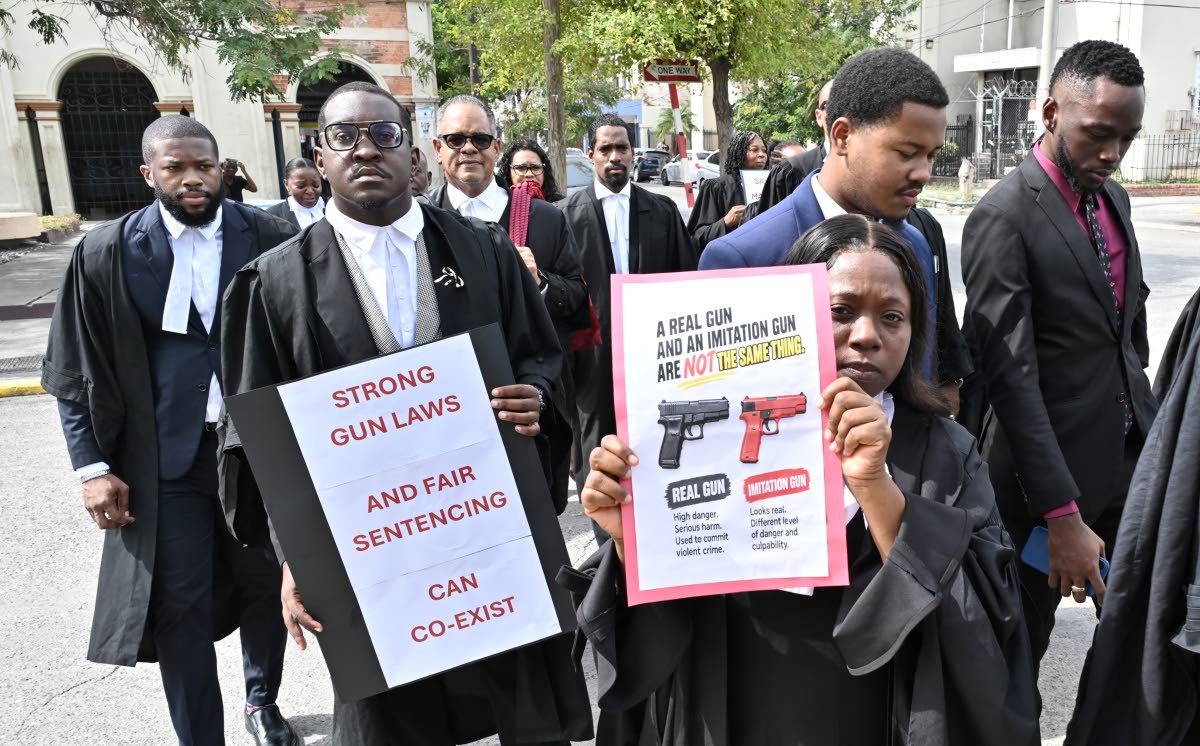 Defence lawyers across Jamaica withdrawing their services from the country’s criminal courts, escalating their dispute with the Government over mandatory minimum sentences under the Firearms Act. Photo - Rudolph Brown
-
Defence lawyers across Jamaica withdrawing their services from the country’s criminal courts, escalating their dispute with the Government over mandatory minimum sentences under the Firearms Act. Photo - Rudolph Brown
-
 Peter Champagnie. Photo - File
The disagreement over aspects of the Firearms (Prohibition, Restriction and Regulation) Act, 2022, which recently resulted in members of the Jamaican Bar Association and the Advocates Association taking to the streets in protest, is significant. The significance is in the fact that some of the concerns articulated by these professional bodies are shared by the Office of the Director of Public Prosecutions and the chief justice. These concerns relate to the treatment of imitation firearms and the removal of any incentive for persons charged under the act to plead guilty.
The concerns expressed by the legal profession have not garnered widespread sympathy among the Jamaican public. Historically, matters concerning the rights of persons before the criminal courts have never commanded the same public attention as issues which have a tangible impact on daily life.
At a time when there has been a downward trend in the murder rate, any call for a review of the Firearms Act runs the risk of being perceived by some as unpatriotic and even downright blasphemous. It has drawn the ire of a few who, having no alternatives, must at all times sing for their supper at the feet of their political masters.
That there must be stringent penalties for persons convicted of gun offences is axiomatic. Candidly, a statutory mandatory minimum sentence of 15 years is not unreasonable. Before the passage of the act in 2022, a sentence of three years’ imprisonment would often be derisively described by the recipient as “cowboy lunchtime”. A sentence of such brevity understandably called into question whether the criminal justice system was adequately responding to the prevalence of firearms and the serious crimes committed with them
Parliament was therefore right to act in seeking to go tough on gun offences.
The difficulty lies not in the decision to strengthen the law, but in the manner and extent to which that objective has been pursued. As is often the case, when haste takes precedence over careful and measured consideration, legislation intended to remedy one problem creates others.
Under the new Firearms Act, an incentive by way of a reduced sentence for pleading guilty is omitted. The sentence is 15 years whether an accused person pleads guilty or proceeds to trial and is convicted. The resultant effect is that a significant number of persons charged under the act are now electing to take their chances at trial, notwithstanding the possibility of conviction. This is in the context that the rate of acquittals is higher than the rate of convictions.
This results in a considerable expenditure of judicial time in circumstances where accused persons might otherwise be willing to plead guilty but are not afforded a meaningful opportunity to obtain a reduction in sentence. The safety valve provided by Section 42(k) of the Criminal Justice (Administration) Act, which affords an opportunity for a person to have his or her sentence reviewed by the Court of Appeal, is of little comfort. It only becomes viable after a trial has commenced and not before.
Equally concerning are issues relating to imitation firearms. Where the facts reveal that an imitation firearm was never used to commit a crime, the act nevertheless mandates a term of 15 years’ imprisonment. This was demonstrated recently in R v Ewayne Pryce (2026) and R v Nickrane Mighty (2026).
What has now been advanced by some commentators who appear more committed to a political cause than to an objective consideration of justice is the suggestion that data demonstrate a downward trend in the number of gun cases coming before the Gun Court, since the inception of the act.
In making that argument, however, the fact that there was already a downward trend in the number of new cases being registered before the central court, for gun matters in Kingston immediately preceding the act, appears to have been overlooked or suffered a deliberate detour in this regard.
In 2019, that court registered 508 new cases. By 2021, the number had decreased to 403. 2022 saw 363 new Gun Court cases. However, last year saw an increase to 389 cases.
In essence, these figures do not, without more, establish a correlation between the act and any perceived reduction in the number of cases coming before the courts. Indeed, to suggest otherwise is to disregard other factors which may have contributed to the reduction, including improvements in police operations.
In retrospect, the firearms legislation which existed prior to 2022 could simply have been amended to introduce a statutory mandatory minimum period of imprisonment of 15 years, subject to an exception for special cases. Such an approach obtains in other jurisdictions, such as Ireland in its Firearms Act 1964, as amended by its Criminal Justice Act 2006.
Arguably there was no need for a complete overhaul of the legislation in the manner in which it was undertaken. The question to ponder, therefore, is, how did we arrive at this position given the fact that it is said that there exists, a Legal Reform Department within the relevant ministry responsible for legislation of this nature? Of what effect and how regular are there reviews of legislation involving all stakeholders?
Until that question is answered, we are left to grapple with issues such as those now emerging from this legislation — issues which have become infected by irrational opinions entirely divorced from any meaningful concept of fairness and justice.
What is needed now is a shift away from rhetoric and towards a mature, informed and reasoned discussion about the operation and consequences of the legislation.
Peter Champagnie is an attorney-at-law. Send feedback to columns@gleanerjm.com.