Editorial | One step in jury matter
Loading article...
-
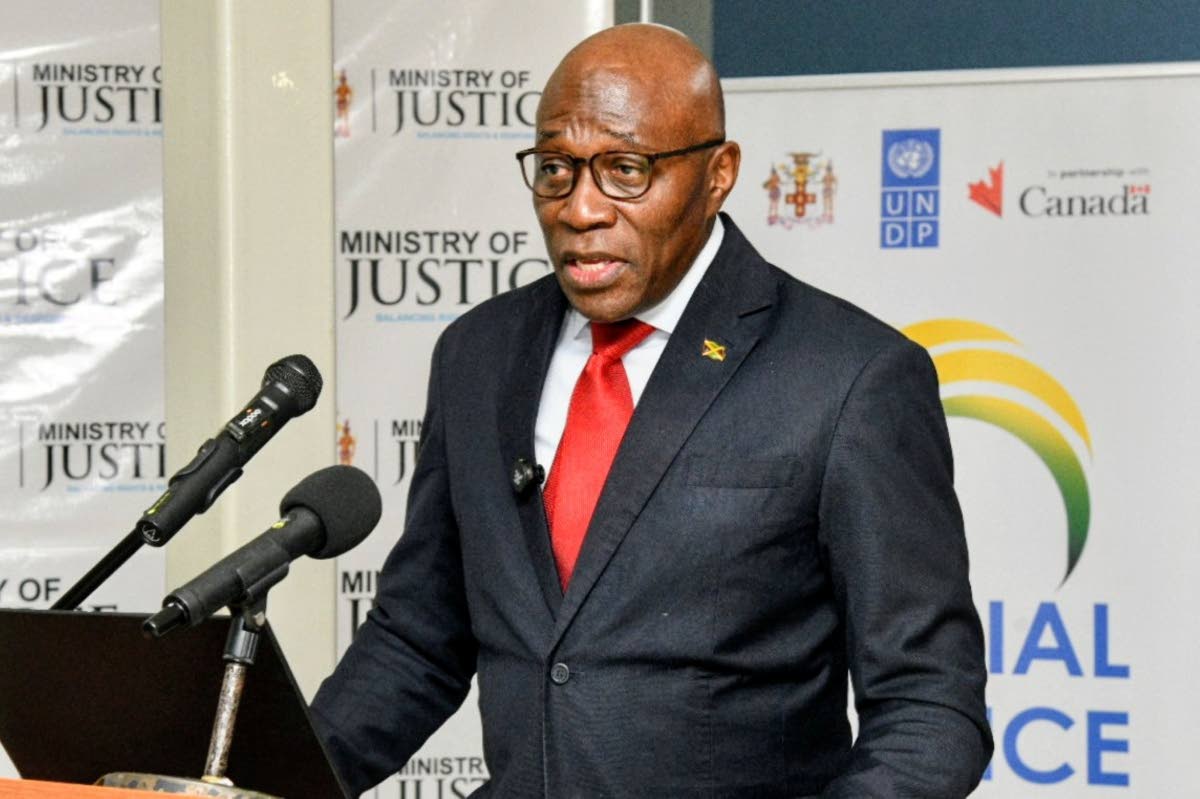 Chief Justice Bryan Sykes
-
Chief Justice Bryan Sykes
-
 Delroy Chuck (right), minister of justice and constitutional affairs, chats with Justice Bryan Sykes, chief justice of Jamaica, during the Judiciary’s Strategic Management Retreat at the AC Hotel in Kingston on Monday. Photo - Rudolph Brown
The Government’s decision to proceed with the Kartel amendment on jury tampering, ahead of a broader overhaul of the Jury Act, is a rational move in the face of last month’s latest collapse of a trial when a judge was forced to dismiss a sitting jury late in the case.
While this move is welcomed, Delroy Chuck must now move with greater urgency to fix the flaws in the bill he presented to Parliament in January and engage in a structured dialogue on how criminal cases in Jamaica are heard, including whether the default for trials should be by judge only, effectively abolishing juries.
The Gleaner’s Editorial Board is broadly sympathetic to the bench-trial proposal as a way to get around a dysfunctional jury system and improve efficiency in the courts. However, given the philosophical foundations upon which the jury system sits and how deeply invested in the arrangement many Jamaicans appear to be, the board endorses Mr Chuck’s intention to send the matter to a joint select committee of both Houses of Parliament for review.
CRITICAL gaps
The amendment to the Jury Act now before Parliament is informally named for the acclaimed Jamaican dancehall artiste Vybz Kartel (Adidja Palmer) because it was during his 2014 trial for murder that critical gaps in the law regarding what judges can, or can’t, do if juries become compromised first received significant public attention.
Kartel and four lesser-known colleagues were accused of killing one of the entertainer’s dogsbodies, Clive ‘Lizard’ Williams, who allegedly couldn’t account for guns given to him for safekeeping. One of the accused killers was acquitted, but Kartel and three others were convicted.
However, fairly early in the 64-day trial, one of 12 jurors was released from the trial, having expressed to the presiding judge her fear for the safety of her son at a detention facility after coming across one of the accused when she visited the lock-up. Then, on the final day of trial arguments, the jury foreman reported to the judge that a member of the panel had offered her money to influence a not-guilty verdict. Other jurors confirmed that they, too, had been offered bribes.
Discharging the accused juror would have meant the panel falling below the allowable number for the case to continue. A long and complex hearing would have had to start from scratch again.
At a conference between the judges and lawyers, the defence argued for the trial to be scrapped. Prosecutors, on the other hand, were willing to take their chances with the tainted juror. In the end, the judge decided to continue the case. Kartel and three others were convicted and given long jail sentences.
However, in 2024, although sympathetic to the dilemma faced by the Jamaican presiding judge, the Judicial Committee of the Privy Council (JCPC) ruled that the convictions of Kartel and his colleagues were unsafe. It was possible, for instance, that jurors who turned down the bribe could have overcompensated by opting for guilty verdicts. If the trial had taken place in England, the Privy Council panel noted, the judge would have had the authority to dismiss the jury and proceed on his own.
NO constitutional obligationOne of the suite of amendments to the Jury Act that Mr Chuck took to Parliament in January was intended to give Jamaican judges that power. He was, however, forced to withdraw the bill at the start of the debate when the opposition leader highlighted the raft of flaws and logical inconsistencies in the proposed law generally, as well as the tainted-jury provision.
Nonetheless, the urgency for judges to continue cases on their own in circumstances where judicially warranted was spotlighted recently by Chief Justice Bryan Sykes referencing a case in the St James Circuit Court.
“After four weeks of trial, that was it,” the chief justice said in September. “It was just waiting for addresses and the summation to be done, [but] the jury had to be discharged.”
He added: “One of the most intriguing things to me is that the Privy Council has pointed to a solution for nearly four years now since the Adidja Palmer case went there.”
Happily, the amendment tabled by Mr Chuck on Tuesday will address this matter. Hopefully, it will get the same scrutiny from the Opposition as the larger bill received in January, to ensure that what is passed is appropriate for the situation.
If jury trials are to remain the standard in Jamaica, the Government will have to find a solution to the problem of too few jurors, especially middle-class professionals, turning up for court duty. Increasing the stipend paid to jurors is unlikely to be sufficient.
Moreover, as Justice Sykes, a proponent of bench trials, is wont to point out, there is no constitutional obligation in Jamaica for trials by jury. What is required are trials conducted within a reasonable time by properly constituted and fair courts.
The debate on the merits of the various positions must get under way now.