Christopher Burgess | Drought resilience: Store more, move more, lose less
Loading article...
-
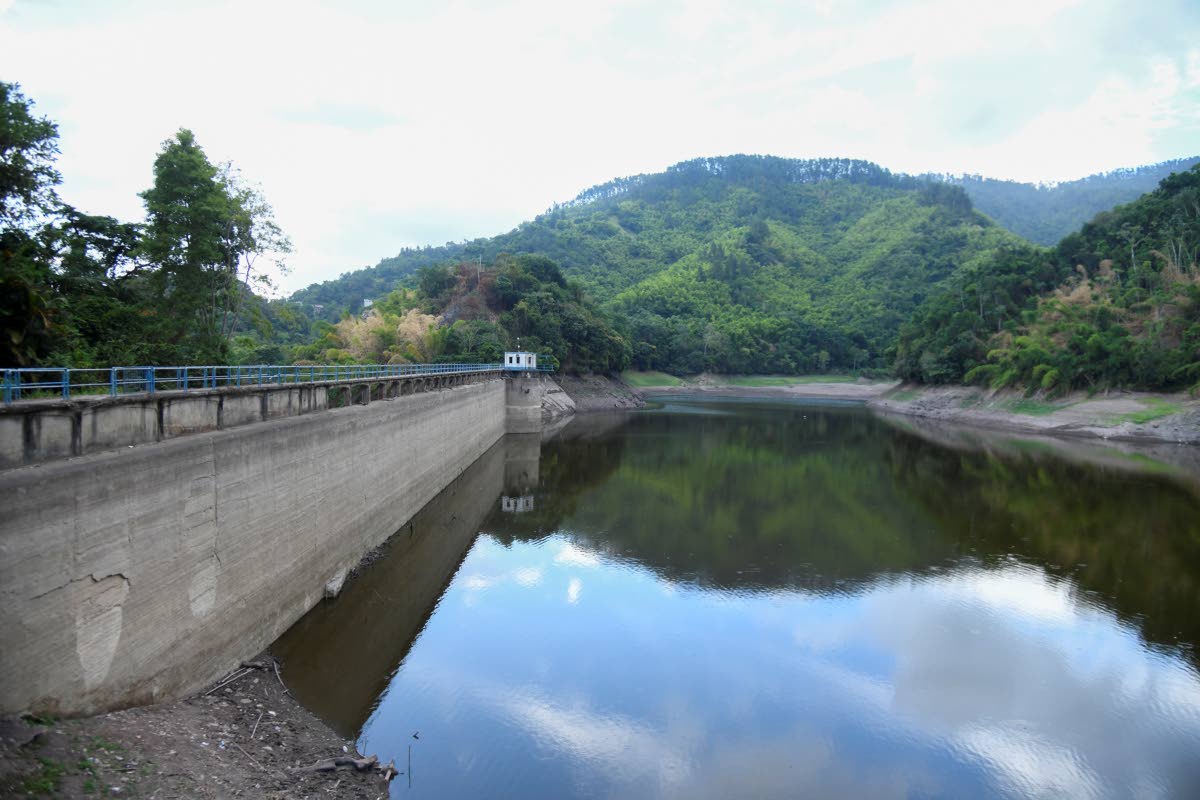 Photo of Hermitage Dam taken on August 24 when the water level stood little over 31 per cent. Photo - Antoine Lodge
-
Photo of Hermitage Dam taken on August 24 when the water level stood little over 31 per cent. Photo - Antoine Lodge
-
 Christopher Burgess. Photo - Contributed
Jamaica is not short of water resources, nor are we short of plans. Yet, when drought comes, taps in homes and schools still run dry. The problem is that we store too little, move too little to where it is needed, and lose too much.
The current strong El Niño-related drought exposes the weaknesses. The National Water Commission (NWC) reported 73 drought-affected systems by late July. By the end of September, that number had jumped to 107 systems, while Mona and Hermitage levels were below 40 per cent capacity. With El Niño forecast to remain strong and increasing uncertainties surrounding the October-November rainy season, Minister Matthew Samuda has warned of tighter restrictions and enforcement.
But, for households and schools, drought is not measured in percentages at Hermitage Dam. It is measured in empty tanks and buckets, missed NWC supply schedules, and money spent buying trucked water. Complaints tell a story of frequent missed schedules, leaking water mains, and communities without water for weeks. Predictable rationing can be manageable, but unpredictable supply and very low pressures turn scarcity into a crisis.
None of this should surprise us. The 2009 Water Sector Plan and 2022 Water Resources Master Plan identified substantial exploitable water, but inadequate storage, high non-revenue water and the mismatch between water resources and major demand centres.
The question is not whether Jamaica has enough water, but whether we can complete the investments needed to keep it flowing when the rains stop.
WATER-RICH
The water challenge is more about where water occurs and the need to transfer it to where it is needed than how much exists. Jamaica has approximately 5,872 MCM/year (million cubic metres per year) of exploitable water, mostly groundwater. This is more than 20 times NWC’s current public-water production, although not all of that exploitable resource is practically available for potable supply. The scale demonstrates that the challenge is not scarcity, but how to move the water.
The availability-demand imbalance is clearest in Kingston and St Andrew (KSA). The Kingston/Hope River Water Management Unit (WMU) has about 77 million gallons per day (MGD) of safe yield, mostly groundwater. But nitrate contamination and saline intrusion restrict the use of parts of the aquifer. More than 13 wells have been closed since the 1980s. Consequently, a KSA water-supply system that requires roughly 50 MGD must import water from adjacent catchments.
From the east, the Yallahs pipeline transfers 12-16 MGD from the Yallahs and Negro rivers to Mona Reservoir. These sources are very sensitive to rainfall patterns, and flows can fall sharply during drought.
From the west, St Catherine’s Rio Cobre system provides more than 13.5 MGD. The Rio Cobre WMU has a much larger safe yield of about 472 MGD than the Kingston/Hope River WMU.
KSA also depends on the Wag Water River system feeding Hermitage Dam and Constant Spring, which has historically provided 18 MGD in wet conditions. This source is also highly rainfall-sensitive.
The historical weakness is that KSA lacks adequate storage. Mona Reservoir and Hermitage Dam together hold only about 1.2 billion gallons. That is only around 24 days of KSA demand before losses. This is why a water-rich country can still experience severe water restrictions during long droughts that can persist for six to 18 months.
The solution lies in increasing transfers from water-rich regions to demand centres and substantially increasing storage to address deficits during droughts, particularly during strong El Niño events.
STRONG EL NIÑOS
There has perhaps been too much emphasis on El Niño to explain the current crisis. It explains the drought, but it does not explain why drought quickly translates into prohibition orders and restrictions for paying customers.
Strong El Niño events are not a new threat to Jamaica. They typically result in below-normal rainfall and severe drought. The current developing El Niño event reached a Pacific Ocean temperature anomaly of about +1.9°C in August and is forecast to strengthen into a very strong El Niño, increasing concerns about the lack of rainfall.
Jamaica has experienced strong El Niño events alongside drought at least five times in the last five decades. During the 1982-83, 1997-98 and 2014-16 events, drought conditions lasted 12 to 24 months. The current conditions reinforce the need for more storage beyond the usual six-month dry season.
Water Resources Authority flow records illustrate what this means for Hermitage Dam. Severe low flows coincided with strong El Niño events. For example, annual inflows fell to approximately 12.0 MCM in 1983, 13.0 MCM in 1998 and only 10.0 MCM in 2015, compared with average annual inflows of about 54 MCM. During some of the strongest El Niño-related droughts, Hermitage received only around 20 to 30 per cent of average inflows and substantially less than NWC’s usual requirement of about 25 MCM. That is fundamentally a lack-of-storage problem.
We can improve drought resilience by capturing more water when flows are abundant.
PLANS AND PROGRESS MADE
Jamaica understands the problem and NWC has made progress. The 2009 Water Sector Plan identified high non-revenue water (NRW), inadequate storage, inefficient transmission and drought vulnerability. Thirteen years later, the 2022 Water Resources Master Plan again emphasised storage, distribution efficiency and transfers from water-rich to water-deficient areas. The problem is not a shortage of plans; implementation has simply not reached the required scale.
Between 2013 and 2016, the Robert Pickersgill-led ministry advanced major water-supply infrastructure. Building on the earlier Rio Cobre pipeline replacement from Bog Walk to Flat Bridge, the programme replaced approximately 14 km of large-diameter pipeline from Content to Ferry between 2013 and 2015, reducing physical water losses by an estimated 2 MGD.
The ministry also launched the KSA NRW programme in 2016, using audits, mains replacement, leak reduction and improved network management. Minister Samuda noted in 2023 that the programme had reduced losses from 71 per cent to less than 38 per cent. Water previously lost in the ground is now available to customers. But NRW alone cannot solve a prolonged drought when rivers provide less water.
The next phase must extend NRW improvements nationally. The NWC’s announcement of an 11-year programme is therefore welcomed. But major reservoirs and water-transfer projects can take a decade to plan, finance and construct. So they must be advanced simultaneously.
The task for the next decade should be to continue building drought resilience: store more, move more, and lose less water. Jamaica has the water; we now need the infrastructure to build resilience and to continue strengthening NWC. A programme combining national NRW reduction, strategic storage and stronger inter-basin transfers may well be the kind of national resilience investment the NaRRA should advance.
Dr Christopher Burgess is a member of JAMRROC. He is a registered civil engineer, vice-president of the Jamaica Institution of Engineers, climate scientist, land developer and managing director of CEAC Solutions. Send feedback to columns@gleanerjm.com