Byron Blake | Mired in confusion - Emergency relief, recovery support, and investment for reconstruction and redevelopment
Loading article...
-
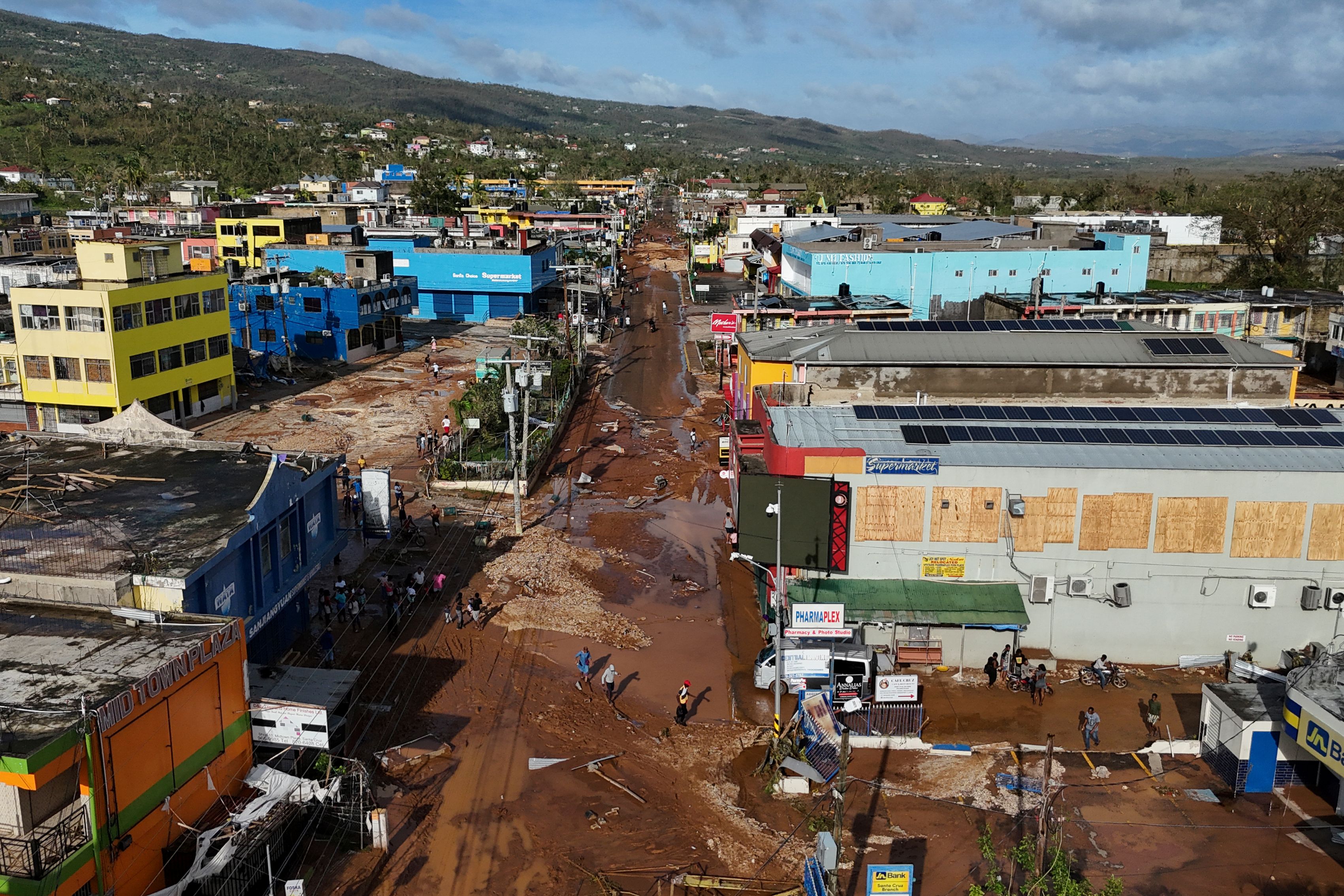
In this aerial shot taken on October 29, 2025, residents are seen walking through Santa Cruz after Hurricane Melissa passed. (AP Photo)
-
Byron Blake
Major disasters, natural or man-made, trigger a range of emotions. The first concerns the human condition of victims. A government's declaration of an emergency is an SOS for help. Help to save lives and preserve basic human needs: food, including clean water, clothing, and shelter from the elements.
Prime Minister Dr Andrew Holness’ government might have had something different in mind when it declared the emergency after the devastation to lives and livelihoods caused by the monstrous Hurricane Melissa, but we can be assured that was what individuals and organisations in Jamaica and abroad heard and responded to. That is what they heard and responded to up to Hurricane Beryl under an Andrew Holness administration. It was the same in the many other countries in the Caribbean and the world that have made emergency declarations.
The response to the Hurricane Melissa SOS matched the speed and magnitude of the storm. Individuals and organisations abroad, and even locally, sent money to the account designated by the government. They saw it as a safe and speedy way to get help to victims.
They were aware that the government of Jamaica had responded to several disastrous situations in recent years, including Hurricane Beryl the year before, and assumed that they must have developed protocols and organisational arrangements to deal expeditiously with such situations, allowing for differences in physical and infrastructural situations.
The Government’s statement would have boosted their confidence when, in boasting about the package it secured from the multilateral financial institutions, it asserted that “Jamaica’s robust disaster risk financing framework enabled a rapid flow of funds to meet urgent response needs”.
The Gillings Papers, upon reviewing the recent findings by the Auditor General concerning ODPEM, Hurricane Beryl balances, Hurricane Melissa recovery funds, inventory controls, procurement concerns, and reconciliation processes would have been taken aback. But it might not have been fully surprised. It recalled a recommendation made to the diaspora to “stop giving diaspora funds to government: when diaspora money enters government it stops belonging to the people”.
That very strong recommendation was based on what seemed like administrative and systemic inefficiencies, and a lack of procedures for accountability, leading to a lack of trust. In its view, trust was “one of the most valuable assets within any relationship between institutions and the people they serve”.
If such “administrative and process issues” matters that can be rectified with resources and will horrified the author of the Gillings Papers, the policy statement proudly made by Prime Minister Dr Holness, at the Lewis Town Early Childhood Institution, Brompton, St Elizabeth on May 25, should send shivers down the spine of every living Jamaican, at home and in the diaspora.
Addressing persons at the National Labour Day Project to help replace the roof of the institution, the prime minister, with a beaming smile, announced that the failure to spend 98.2 per cent of the money donated for emergency assistance to the people affected by Hurricane Melissa was not an accident; it was strategic, that is, government strategy. That was said to an audience which, in all probability, included persons still without shelter or who have friends and relatives without shelter or under tarpaulins and without means of livelihood.
We have no reason to doubt the prime minister. Seven months after Hurricane Melissa, that level of under-expenditure, no expenditure plans, and no disciplinary action, could not have been an administrative failure. The prime minister’s explanation is the only logical one. But it begs two questions. What could justify a government allowing such a large part of its population to suffer such hardships for so long? And, what is the strategy, and to whose advantage?
The prime minister needs to answer those questions urgently and transparently. The answers are very important to us in Jamaica, and particularly to individuals and communities in western Jamaica who have been suffering for these seven long months. Equally important, they matter to Jamaicans in the diaspora and others who sacrificed to make those donations to relieve suffering.
The contributions were voluntarily given, but there was a request, and a certain understanding, about their use. If those are breached, the donations could be recalled. Alternatively, donors could decide against donating to Jamaica in the future. Either way, the people of Jamaica will pay the price. Jamaica, as a country, could pay a price. Its reputation could be at risk. And, as is clear from the Gillings Papers, once reputation and trust are destroyed, they are difficult to regain.
There is another potential adverse effect implicit in the arguments of the author of the Gillings Papers. The diaspora not only contributes to Jamaica in times of disasters, but they also support a range of social and community-based programmes. More importantly, they are an untapped source of investment for a country constantly in search of foreign capital. A loss of trust in policymakers and administrators could lead to reluctance to act in these other areas.
The prime minister and others have been speaking about the acquisition of container houses. There is a hint that the process could explain the delay in addressing the immediate shelter needs after Melissa. The container housing business is competitive. Our research suggests that container houses, of varying sizes and quality, could have been delivered in Jamaica in one to two months at prices ranging from US2,000 to US$12,000.
We have not heard of any discussions with communities in the west about container homes or whether they wish to have them. Will the NaRRA law force acceptance? We have argued elsewhere that planning for reconstruction after Melissa cannot occur outside of Western Jamaica. Planning must involve residents of affected communities.
Time is of the essence after seven months, and the onset of another hurricane season. But that cannot be a screen for top-down, opaque action.
Ambassador Byron Blake is the former deputy permanent representative to the United Nations and former assistant secretary general of CARICOM.