
... Leadership should come from within
Published:Monday | May 26, 2025 | 12:06 AM

WESTERN BUREAU:
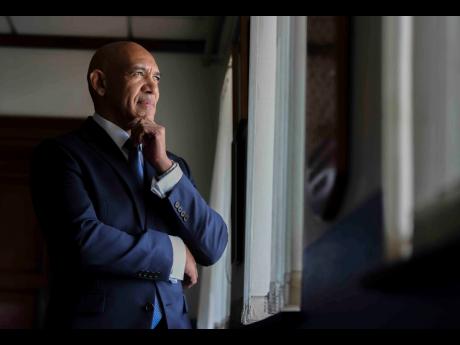
“I would have considered it (his tenure) a failure if I had to go outside of the JCF (Jamaica Constabulary Force) to get another commissioner of police,” said Major General (Ret’d) Antony Anderson.
It wasn’t just a passing remark, it was the capstone of a six-year mission that redefined the JCF. Now Jamaica’s ambassador to the United States, Anderson leaves behind a legacy of transformation anchored in structure, standards, and succession.
When Anderson took command of the JCF in 2018, Jamaica was on track to record its highest-ever number of murders. However, the former army chief, who had already modernised the Jamaica Defence Force (JDF) and set up the Office of the National Security Adviser, had no interest in patchwork solutions.
“You use what you have to get the result,” he said. By the end of my first year, murders dropped by 22 per cent nationally, and a staggering 72 per cent in St James.”
But, for Anderson, success was never only about statistics.
His blueprint for change rested on five pillars, including people.
“You have no organisation without the people. You have to engage them, get their buy-in.”
Another pillar, he said, is structure, which he explains was how he rebuilt the JCF’s outdated hierarchy to better support modern policing.
Also, there is the infrastructure of the crumbling police stations, some of which were repaired while others were completely overhauled.
PUBLIC CONFIDENCE EARNED
The fourth pillar, he noted, is equipment and technology, where smart policing replaced improvisation. Finally, there is stakeholder engagement, which saw public confidence earned, and was mirrored internally.
In his first 100 days, he created the Welfare Department, ensuring that injured officers and their families were no longer left waiting on the federation for basic medical support.
“I visited a shot officer in KPH (Kingston Public Hospital). He needed external fixations. He said he was waiting on someone from the federation. That wasn’t just wrong, it was unthinkable. So we fixed it,” Anderson shared with The Gleaner.
Recognising a national traffic crisis unfolding in real time, Anderson said he fast-tracked the launch of the Public Safety and Traffic Enforcement Branch (PSTEB) during massive 2018 roadworks.
“We had no major new equipment. We took what we had, some bikes, some visibility, and built structure around it. We planned for what would go wrong. And it worked.”
He also took on the Mobile Reserve, a unit steeped in tradition but out of step with contemporary needs.
“It had to change. It wasn’t fit for purpose. It took courage, and I knew it would create resentment. But the motive was to make us first-world.”
In a profession built on chain of command, Anderson brought personal accountability.
“When officers were under fire, I didn’t just call. I went,” he said. “That mattered. They believed someone had their back.”
This built what he calls “a force of believers”, officers who once kept their brightest children away from the police force, now encouraging them to join.
Reflecting on the shift, he told The Gleaner, “We knew we were making progress when members of the JCF who would never have encouraged their children to become police officers began to see the force as a place of pride and opportunity. That’s when you know the culture is changing.
“You see the pride in their uniforms again. That’s not random. That’s culture shift.”
ENDURING PRINCIPLE
Yet, Anderson’s most enduring principle is that reform must outlive its reformer.
“There was no Commissioner of Police Instagram or Twitter (X) handle. It was always about the JCF. That’s what must continue.”
He intentionally created a leadership pipeline within the force.
“Part of your duty is to create successors. That’s how you keep moving in the right direction.”
Now ready to take up his post in Washington, DC, Anderson carries with him the discipline of a soldier, the rigour of a strategist, and the quiet resolve of a man who knows his real legacy is the system he left behind.
“It’s not about me. It’s about the JCF and the fact that it must never again have to look outside to find a leader.”
He intentionally created a leadership pipeline within the force, he says.
“Part of your duty is to create successors, to make sure that you have somebody who can take over from you. That has to happen again. Then, there’s no turning back, no limit to what we can achieve.”
Anderson acknowledged that the commissioner’s role demands more than operational expertise, it requires the acumen of a CEO managing a complex organisation.
“By the time I left, the JCF had between 17,000 and 18,000 members, over 200 outlets, and delivered more than 20 services to the public. You’re dealing with life and death, and leading a national institution.”
He believes future leaders of the JCF must be trained not only in law enforcement, but in managing massive budgets, logistics, and human capital.
“If you’re not prepared for that, you’ll end up doing what your subordinates should be doing. That’s not leadership.”
Despite coming from the military, Anderson refused to import personnel into the JCF leadership. “Why would I bring people from the JDF when you’re already here? You know policing. My job was to align our approach. We rise or fall together. You have to put your name and reputation on the line to get the reward. And I believe we got it. We now have police officers who believe in what they do, who wear the uniform with pride. And proud officers are critical.”
Anderson’s successor is Dr Kevin Blake, who has served the JCF for 23 years and was the commander for Force Development and Logistics at the time of his appointment as commissioner of police.