Jeremiah Knight turns global culinary journey into memoir
Loading article...
-
 Jeremiah Knight, author of the cookbook and memoir ‘Diplomat in the Kitchen’. Photo - Contributed
-
Jeremiah Knight, author of the cookbook and memoir ‘Diplomat in the Kitchen’. Photo - Contributed
-
 Knight, in the process of making tostones, also known as pressed plantains, during his book tour in Montana. Photo - Contributed
-
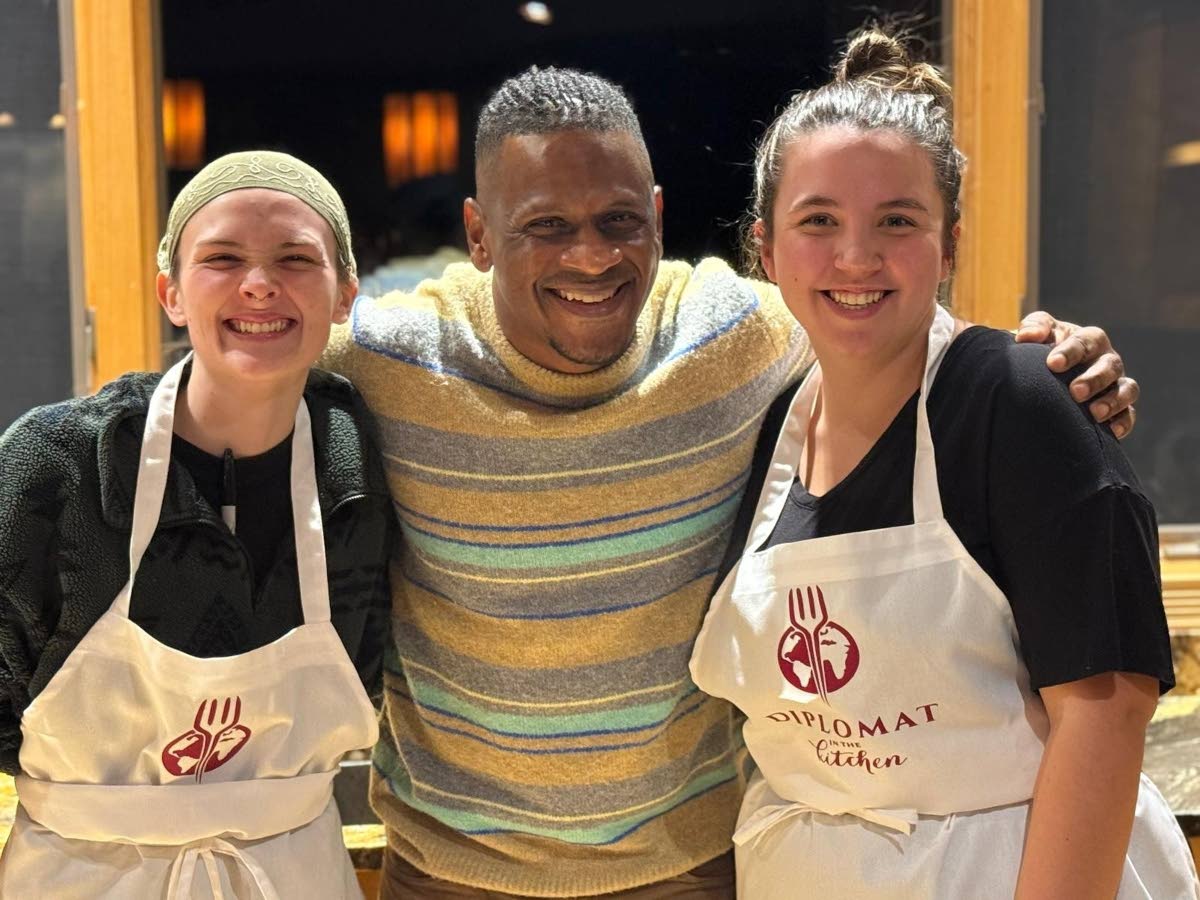 Knight is flanked by culinary arts students, Bee Depuy (left) and Gracie Keller from Missoula during a global culinary adventure in the city, part of a four-city book tour across Montana. Photo - Contributed
-
 The cover of ‘Diplomat in the Kitchen’ by Jeremiah Knight launched last October. Photo - Contributed
WESTERN BUREAU:
For years, Jeremiah Knight cooked quietly for colleagues, journalists, diplomats, and friends, using food as a way to open conversations that formal diplomacy often could not. Now, those meals have been gathered into a book that is as much about memory, culture, and connection as they are about recipes. Knight, a career United States diplomat with deep Caribbean roots, has released Diplomat in the Kitchen, a gastronomic memoir shaped by more than two decades of global postings and a lifelong relationship with food. The book brings together personal essays, globally inspired dishes, and stories that travel far beyond the kitchen.
Readers of The Gleaner may remember Knight from a 2018 Food section feature that revealed the then–US Embassy public affairs consular as a serious culinary talent, nurtured from childhood and influenced by family members whose lives revolved around food. That early glimpse has now evolved into a full-length work that places storytelling at its core.
Knight said the decision to frame the book as a memoir rather than a traditional cookbook was intentional.
“Food captures your mind and brings you back to places and people,” he explained to Sunday Lifestyle in a recent interview. “When you eat one particular dish, you can remember exactly who you were with, what was happening in your life. That is way more important to me than just having recipes in a book.”
The idea began nearly a decade ago while Knight was writing a column on culinary travel for a Dominican food magazine. Editors often trimmed his submissions to focus on recipes and photographs, leaving out the stories he felt mattered most. Instead of abandoning them, he began saving the original essays.
“I said, let me write how I want to write,” he recalled. “I’ll submit what they can edit, and I’ll keep my stories. That’s how the book was born.”
CARIBBEAN INFLUENCE
Beyond its content, Diplomat in the Kitchen is also notable for how it was produced. From design to editing, the book is the result of pan-Caribbean collaboration. Jamaicans were involved in the branding and editing process, the principal editor is Trinidadian, the designers Dominican, and the food styling and photography were handled by Venezuelans.
“This book highlights not only the power of the Caribbean,” Knight said, adding, “But the professionalism of Caribbean people.”
The Caribbean influence is not limited to production. Knight traces his approach to cooking to family members who believed in feeding generously and without restraint, including his Jamaican uncle David, a towering presence, whose cooking left lasting impressions.
“He would cook the spiciest food you ever had,” Knight said with a laugh. “And he wasn’t happy until you were uncomfortable, belt buckle undone, buttons popped. That’s how I am.”
Knight has spent 20 years in diplomacy, with eight overseas postings, including Jamaica, Chile, Tunisia, South Sudan, Pakistan, and the Marshall Islands. Each assignment, he said, reshaped not only his palate but also his understanding of how food functions across cultures.
“Flavour doesn’t always have to mean spice,” he noted, recalling his exposure to Scandinavian cuisine. “Freshness, simplicity, organic flavours, those are things I had to learn to appreciate.”
In some of the most challenging postings, food became a source of connection and survival. Knight admitted that he hesitated before including a chapter on South Sudan, wary of misrepresentation.
Ultimately, he decided it was essential.
“I remember inviting South Sudanese women into my living quarters and cooking together,” he said. “That engagement through food was one of the main ways I was able to cope and connect while I was there.”
While posted in Jamaica as consul for public affairs, Knight turned his home into an informal diplomatic space through weekly Sunday dinners.
There were no televisions, no rush, and, by design, no Jamaican staples on the menu.
“I wanted Jamaicans to experience the world through my kitchen,” he said. “One week it was French food, the next Chilean. It’s different inviting someone to a restaurant than inviting them into your home and feeding them food prepared by your hands.”
Those dinners, he believes, helped ease difficult conversations and build trust across professional lines, including with journalists and cultural figures.
“After your belly is full and you’re sitting and talking, that’s when the real work in diplomacy happens,” he said.
The book also opens space for others to share their own food memories. Friends and fellow diplomats contributed stories tied not to their homelands but to moments when food marked a meaningful experience – a Jamaican woman discovering schnitzel in Austria, or a diplomat reflecting on a posting through a single meal.
“It’s not about where you’re from,” Knight explained. “It’s about where food took you.”
Launched at the end of October 2025, Diplomat in the Kitchen is priced at US$45 and has already sold more than 600 copies. The book is also available on Amazon.
Knight has completed a small US book tour, including stops in places like Montana, an experience that reinforced his belief that global cuisine need not be intimidating.
“We went into a grocery store and found everything we needed,” he said. “That was important to me.”
Although now back in the United States, Knight says Jamaica remains central to the book’s journey. The Gleaner was the first publication to write about his cooking, and he has expressed interest in returning to the island for a local launch.
If Diplomat in the Kitchen were a dinner party, Knight imagines a long wooden table by the sea, candlelit, unhurried. At its centre would be his grandmother, Gussie Knight, the woman who first allowed him to experiment in the kitchen and to whom the book is dedicated.
“There’s no rush,” he said. “You’re not just eating. You’re dining.”
And that, ultimately, is the point of Diplomat in the Kitchen – not to impress, but to invite into a space where stories are shared, cultures respected, and understanding quietly grows, one meal at a time.
janet.silvera@gleanerjm.com