
Including people with disabilities in the workforce and higher education benefits everyone
Published:Tuesday | March 25, 2025 | 12:08 AMLauren Shallish/Contributor
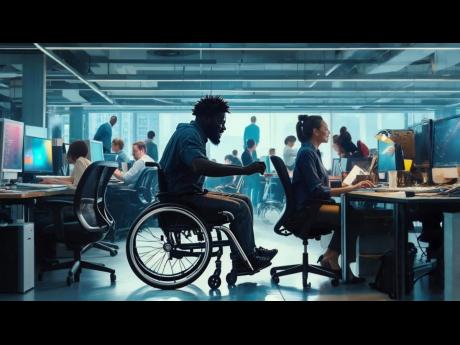
Whether it’s declaring that blindness prevents employees from doing their jobs or suggesting that hiring workers with intellectual disabilities contribute to safety lapses, the powers-that-be have repeatedly questioned whether people with disabilities belong in the workplace.
This stance reflects widespread stigma and misconceptions about what people with disabilities can and do accomplish, which has been a part of the administration of United States President Donald Trump.
Negative stereotypes and exclusionary practices persist despite the fact that people with disabilities are the largest minority group in the United States, representing nearly 30 per cent of the population.
Whether or not you identify as disabled, most people live or work in close proximity to others with a disability.
For years I have researched how people with disabilities have been kept out of efforts to guarantee equal access for everybody, particularly in higher education. This exclusion is often due to unfounded beliefs about capacity, intellect and merit, and the false premise that disability inclusion requires lowering standards.
However, studies demonstrate that including people with disabilities is good for everyone, not just disabled people. Schools and workplaces are more collaborative and responsive when people with disabilities are included at all levels of the organisation. In other words, disability inclusion isn’t about charity; it’s about making organisations work better.
ROLLING BACK PROTECTIONS
President Donald Trump issued executive orders the day he took office for a second time that aimed at ending government and private-sector efforts to make US workplaces and schools more diverse, equitable and inclusive. In addition to affecting LGBTQ+ communities and people of colour, these measures could erode years of progress toward protecting the rights of people with disabilities to earn a living.
Between 40 million and 80 million Americans identify as disabled. Even the higher end of this range underestimates the actual number of people with disabilities, because some individuals choose not to identify that way or even realise they qualify as such. That includes people with impairments from chemical and pesticide exposure, as well as many older people and those who are living with HIV and AIDS, to name some examples.
Only 15 per cent of people with disabilities are born with their impairment, so most individuals become disabled over their lifetime.
TRACING HISTORICAL PRECEDENTS
Blaming failures on people with disabilities and people of colour echoes the harms embedded in eugenics, an attempt to scientifically prove genetic inferiority of disabled, LGBTQ+, Indigenous and Black people.
Eugenics led to the institutionalisation and forced sterilisation of, and the coercive experimentation on, people with disabilities, immigrants and people of colour across the US. Even the Supreme Court endorsed the concept in the early 20th century.
These studies began to fade after World War II, but their legacy persists. Even today, forced sterilisation continues to be lawful in US jurisdictions in 31 states and in Washington.
Due to widespread activism and the advent of new legal protections, many states finally dismantled their eugenic policies in the late 1970s. But eugenics-era experiments provided foundations for contemporary medical research, standardised testing and segregated school placements.
People with disabilities have far-reaching legal guarantees of civil rights and access today due to the Americans with Disabilities Act. The statute, which was enacted in 1990 and strengthened in 2008, provided protections in the workplace, educational settings, transportation and places of recreation and commerce, among others. It also guarded against negative perceptions of disability.
For example, if an employer perceived someone as disabled and denied them consideration in the hiring process because of that, the candidate would be protected from discrimination under the ADA – whether or not they had a disability.
While these advances are significant, many people with disabilities still do not have access to their basic civil rights. This is particularly true of Black people with disabilities, as they are disproportionately pushed out of school, disciplined more harshly, targeted for incarceration and marginalised in disability representation and research.
GAINING WORKPLACE ACCOMMODATIONS
Critics of inclusion efforts sometimes wrongly argue that employing people with disabilities is too costly due to the accommodations they may require. But the Job Accommodation Network in the Department of Labor’s Office of Disability Employment Policy found in 2023 that nearly 60 per cent of these accommodations cost nothing.
What’s more, many tax incentives are available to cover these costs.
Disability civil rights law does not mandate hiring people who are not qualified or lowering standards to include the disabled. The law requires that candidates meet the “essential functions” of the job in order to be hired.
According to a 2024 Labor Department report, the employment rate for working-age people with disabilities was 38 per cent compared with 75 per cent for nondisabled people. Though there are countless reasons for this disparity, many people with disabilities can and want to work, but employers don’t give them the opportunity.
PROVIDING BENEFITS FOR EVERYONE
Many accommodations designed for people with disabilities also benefit others.
Captioning on videos and movies was originally meant to benefit the deaf community, but it also helps multilingual speakers and people who simply are trying to follow the dialogue.
Similarly, visual or written instructions assist people with depression, Down syndrome or attention-deficit/hyperactivity disorder, but they can also make tasks more accessible for everyone, along with breaking assignments into smaller components.
Sensory break rooms benefit people with autism and post-traumatic stress disorder, while also providing a reprieve in a noisy work environment and minimising distractions. Remote work options can make it easier for people with chronic illnesses to be employed, and they similarly benefit others who may have caregiving responsibilities – helping attract and retain talented employees. Text-to-speech software provides people with cerebral palsy and nonspeaking individuals with options for communication, similar to options that many people already use on their phones.
A large body of research demonstrates the broad benefits of making jobs and schools more accessible to people with disabilities, which is ultimately an advantage for everyone.
Studies on diversity in educational and workplace settings also demonstrate positive outcomes. In a study of 10 public universities, researchers found that students who reported positive, informal interactions with diverse peers had higher scores on measures of more complex thinking, a concern for the public good and an interest in poverty issues, and were more likely to vote and develop strong leadership skills.
In a national survey of human resources managers conducted in 2019, 92 per cent of the respondents who were aware that one or more of their employees had a disability said those individuals performed the same or better than their peers who did not.
Research published by the Harvard Business Review found many advantages to hiring people with disabilities.
For one thing, people with disabilities can have unique insights that contribute to the workplace culture. The presence of employees with disabilities can make the environment of entire companies and organisations more collaborative. Earning a reputation for inclusiveness and social responsibility can improve customer relations and can give businesses an edge when they seek funding and recruit talented new employees.
Ultimately, I believe it’s important to create conditions where anyone can thrive, including people with disabilities. Doing so benefits everyone.
- Lauren Shallish is an Associate Professor of Disability Studies in Education at the Rutgers University, Newark, and writer for The Conversation.
• People with disabilities can have unique insights that contribute to the workplace culture.
• The presence of employees with disabilities can make the environment of entire companies and organisations more collaborative.
• Earning a reputation for inclusiveness and social responsibility can improve customer relations and give businesses an edge when they seek funding and recruit talented new employees.