Dinthill Technical plans US$1.4m investment in commercial farming
Loading article...
-
 Anthony Garwood, principal of Dinthill Technical High School, checks on the school’s poultry operation. Photo - Ian Allen
-
Anthony Garwood, principal of Dinthill Technical High School, checks on the school’s poultry operation. Photo - Ian Allen
-
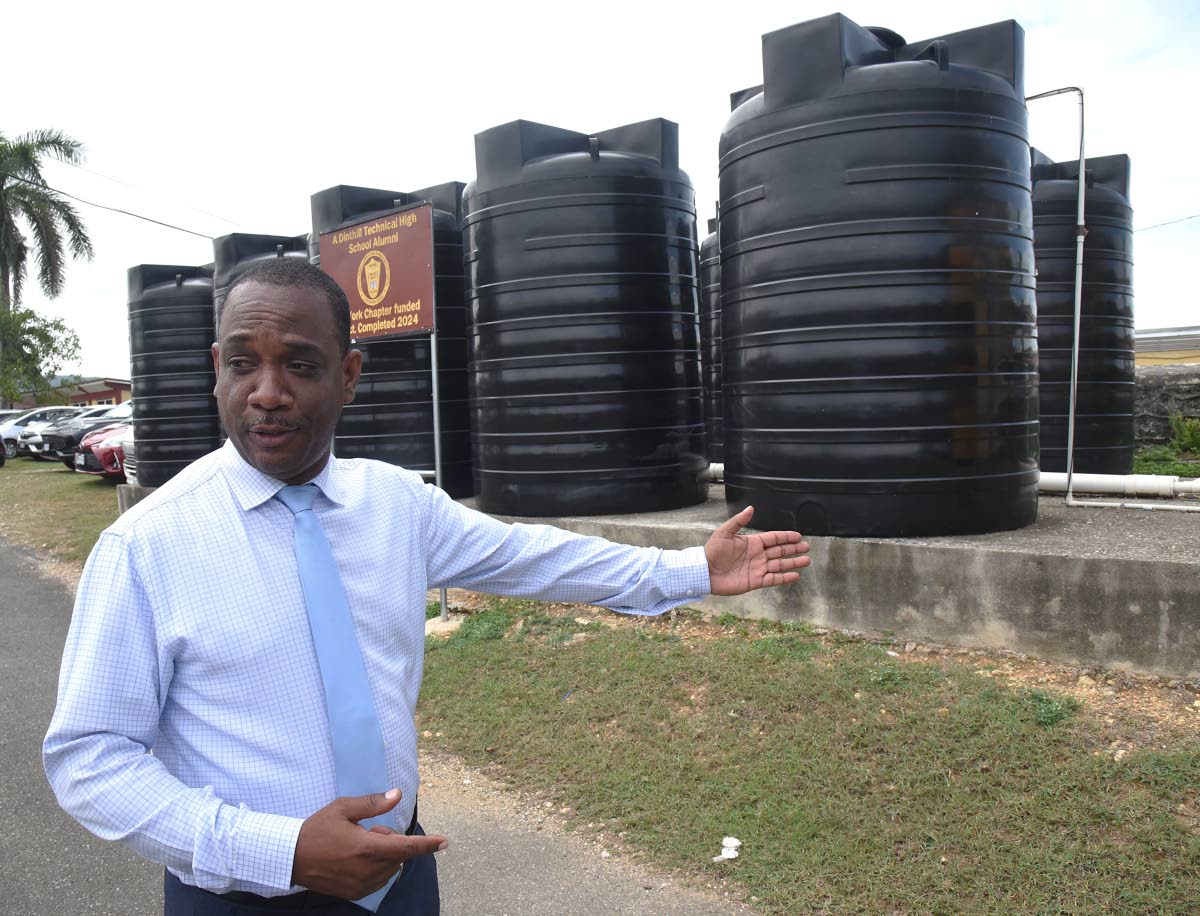 Anthony Garwood, principal of Dinthill Technical High School, displays water tanks donated by the school's past-student association. Photo - Ian Allen
Dinthill Technical High School is seeking to turn agriculture into a significant source of income, targeting US$6.6 million in gross returns and US$2.5 million in net profit from a planned US$1.4-million investment over the next five years.
The institution hopes to transform 20 acres of its property into a commercially viable farming enterprise through the Tutorial Commercial Agricultural Project, an initiative designed to boost self-sufficiency, supply produce for the school’s breakfast programme, and provide practical agricultural training for students.
The project, which has been submitted to the Ministry of Agriculture for approval, will combine the commercial cultivation of fruits, vegetables, and condiments with livestock and other agricultural enterprises.
Principal Anthony Garwood said the five-year plan emerged from discussions with the school’s 1972 graduating class in 2022, leading to the development of a comprehensive farm plan.
According to Garwood, the initiative is intended to reduce the school’s dependence on external sources while building an agricultural operation capable of supporting the institution financially.
“The initiative was established to make us self-sufficient in the next five years after expending US$1.4 million in capital expenditure, with an expected gross return of US$6.6 million and a net profit of US$2.5 million when fully implemented.”
The venture extends well beyond crop production. Garwood said the farm will include tree and vine fruits, root and tuber crops, condiments, honey, beef, mutton, dairy products, broiler chickens, and eggs.
The farm is also expected to serve an educational purpose, providing a platform for School-Based Assessments for Dinthill’s Agricultural Science students and pupils from neighbouring schools sitting external examinations. The facility will give them access to practical agricultural production on a commercial scale.
First crops
The school has already begun laying the foundation for the project.
As part of the initial rollout, it has planted 30 avocado trees, 30 breadfruit trees and 120 coconut trees on the ABC plot.
The first plantings represent the start of a broader vision that Dinthill hopes will eventually combine food production, student training, and commercial enterprise on its own property.
A reliable water supply is central to the project’s success.
Garwood said the school’s past students, particularly its New York chapter, began financing an irrigation project in 2024. The work is being carried out in two phases.
“As part of the initiative [in] 2024, our past students’ association, New York chapter in particular, embarked on an irrigation project, which we did in two phases: one is water to the school campus and another section an irrigation system to the farm area,” he explained.
The New York chapter has financed ten 1,000-gallon tanks, which Garwood said can supply the school for up to four days.
The National Irrigation Commission has also assisted with plans for an irrigation system that will draw water from a tributary of the Rio Cobre, which runs alongside the school.
“This system is 90 per cent completed and is expected to supply 10,000 gallons per day when completed,” Garwood noted.
The irrigation network is expected to underpin the farm’s commercial expansion, allowing production to continue during periods of drought and low rainfall.
Despite the early progress, Garwood acknowledged that securing the remaining funding remains one of the project’s biggest challenges.
He hopes continued support from the school’s diaspora-based past-student chapters, together with assistance from the Ministry of Agriculture, will help finance the initiative as it moves towards full implementation.
Once fully developed, the school expects the 20-acre farm to become a significant source of food and income while giving students practical exposure to modern commercial agriculture.
ruddy.mathison@gleanerjm.com