Kristen Gyles | Who should be held accountable for crime?
Loading article...
-
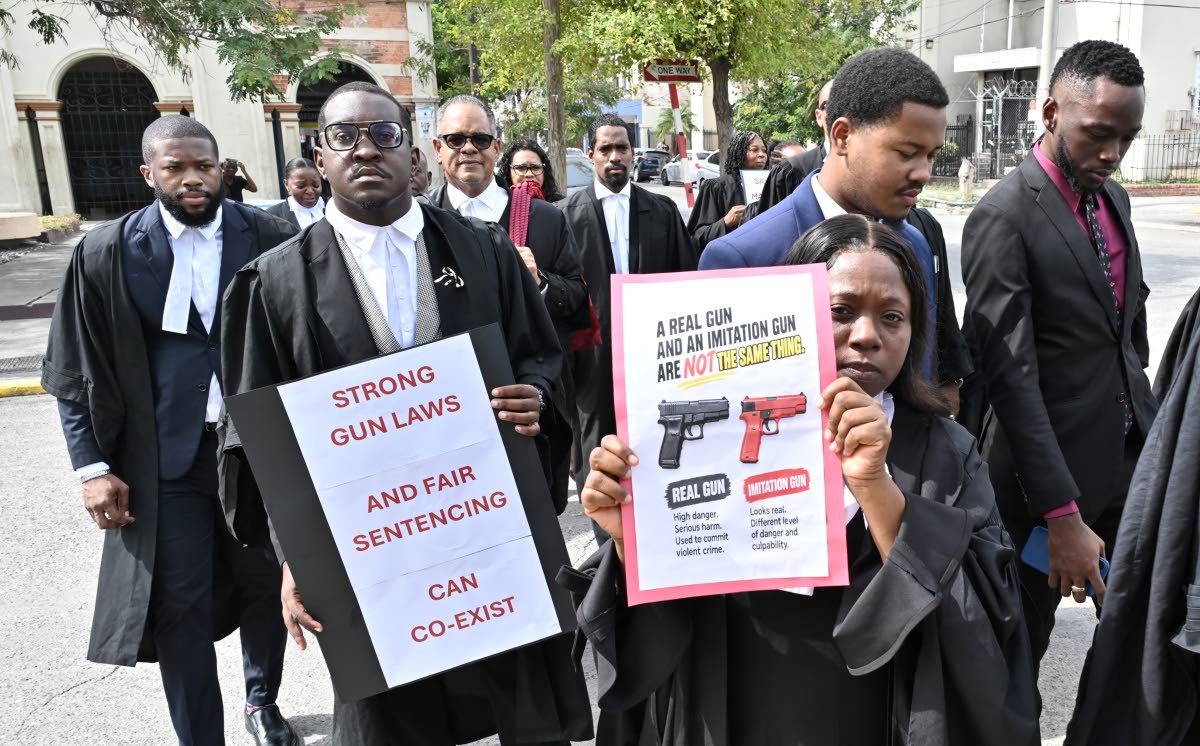 Defence lawyers across Jamaica withdrawing their services from the country’s criminal courts, escalating their dispute with the Government over mandatory minimum sentences under the Firearms Act. Photo - Rudolph Brown
-
Defence lawyers across Jamaica withdrawing their services from the country’s criminal courts, escalating their dispute with the Government over mandatory minimum sentences under the Firearms Act. Photo - Rudolph Brown
-
 Kristen Gyles. Photo - File
Recently, the prime minister and members of his Cabinet met with the Jamaican Bar Association and the Advocates’ Association of Jamaica after a silent protest by members of the legal fraternity demanding a review of the Firearms Act. One of the pain points seemed to be the minimum 15-year sentence stipulated in the act for possession of an illegal firearm. At a point in the discussion, the prime minister seemed to query where all the protests were in relation to criminals who take innocent lives.
This is a question Jamaica has heard several times by now.
At a groundbreaking ceremony in St Elizabeth last month, for example, the prime minister was quoted as saying, “I don’t see people demonstrating for the murders of innocent people in Jamaica as how there are demonstrations for persons who the police have implicated … .”
On another occasion, while speaking with the mother of a woman who was killed by gunmen in Olympic Gardens, he is quoted as asking, “Where is the protest in Jamaica about the people who have illegal guns who are killing your daughter …?” He went on to say that there is a kind of hypocrisy in the society or ambivalence about crime that must not be tolerated.
Again, these sentiments have been expressed a few times now, in various settings. The question might have at first been rhetorical but, since it has been repeated so many times, it is worth answering.
When citizens protest violent crimes, they are protesting the actions of wicked and morally bankrupt people whose hearts have gone cold. Protesting does not do much to deter these depraved individuals. Criminals know they are criminals and have already figured out that their victims and society at large don’t like them. They don’t care. Protesting a crime helps to bring awareness to the type of crime committed and helps to give support to the family members and friends of the victims of crime. But protesting probably isn’t going to be the tool that dismantles a criminal gang.
We all know this. This is probably why most people, though very concerned about the effects of crime, will probably never take to the streets to join a protest “against crime”.
In early 2017, after a spate of abductions and violent attacks on women, I remember being notified of an initiative to “wear black” on a specified date to show solidarity against gender-based violence. When the day came, I left home fully clad in black only to realise many people were wearing what looked to me like Joseph’s coat of many colours. I was disappointed at what seemed like nonchalance and sheer ambivalence. One person expressed the view to me that wearing black does nothing to reduce crime and won’t bring the victims back. I thought he was callous. But he wasn’t wrong.
Those who wore black had taken a unified, public stance against violence towards women. However, the protest was useful mostly for what it symbolised and not what it practically achieved. The violence producers already knew that their behaviour was both criminal and detestable. That was partly why they did their dirty deeds in secret.
On the other hand, when citizens protest police brutality or violations of constitutional rights, the assumption is that the government actually cares, unlike the criminals. And they should care. They should care about being right, fair, balanced and equitable. An organised protest proves that people believe in the ability of state actors to think, reflect and make conscientious adjustments based on these attributes.
Also, people do not necessarily protest social problems in proportion to their statistical prevalence. Quite the opposite. Sadly, crime is so rampant that we celebrate when an entire day passes and no murders are recorded.
While it is great to see crime trending down, we are not yet at the point where it feels strange to any Jamaican to hear about “another murder”. On the flip side, while it is unfortunate that police fatal shootings are trending up, we are not at the point where it feels ‘normal’ to hear about police fatal shootings.
It should go without saying but, while we can hold the Jamaica Constabulary Force (JCF) accountable for police brutality or unwarranted police fatal shootings, who do we hold accountable for crime? Crime is decentralised and diffused. There is no single institution or individual the public can hold accountable for crime as a whole. An old lady who has been robbed cannot march to the headquarters of “crime” and demand that the thief be held accountable. Accountability is not something we expect from criminals. So, in such a case, what use would it do for her to stand on the roadside with a placard marked “End crime now”?
The other issue that we conveniently ignore is the fact that police brutality and police fatal shootings are probably most frequently alleged in inner-city and rural communities by family members, neighbours and friends of individuals killed in police confrontations. They protest because the level of trust they once had in the systems in place to protect them and their loved ones has suffered a breach.
On the other hand, let’s say the same victims are murdered by known criminals. What exactly do we expect the community to do? Call the media? Stand on the side of the road with placards? In several instances, they know that would only mean certain death. The same criminals that murdered their family members can murder them too. And they know that.
Protection from unreasonable state action and limitations on governmental power are not privileges that become irrelevant whenever politicians invoke public safety. Governments have legitimate responsibilities to enforce criminal laws and protect victims, but the government must fight crime without becoming unaccountable in the process.
That is not a contradiction. It is one of the foundational principles of constitutional democracy.
Kristen Gyles is a free-thinking public affairs opinionator. Send feedback to kristengyles@gmail.com and columns@gleanerjm.com