
Lisa Vasciannie | Case for election observers
Published:Sunday | April 20, 2025 | 12:11 AM
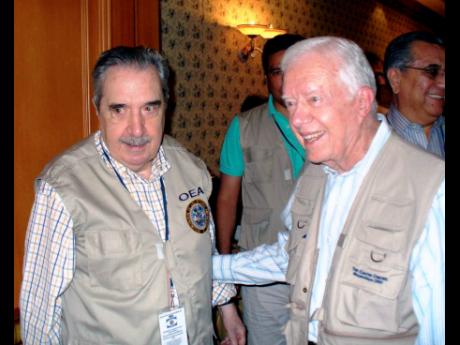

As we anticipate the next general election in Jamaica this year, the question of whether international observers will be invited arises. In this local observer groups such as Citizens Action for Free and Fair Elections (CAFFE) play a crucial role during elections.
Their familiarity with local customs and knowledge of the political system give them an advantage in this regard. However, as noted recently by The Gleaner, they often have funding challenges. International observer groups often have more financial, technical and professional resources and provide more legitimacy at the international level. Both local and international observers offer different benefits and it is optimal that both types complement each other.
Since 1997, Jamaica has had observers in almost every general election; the notable exception being in 2020 during the COVID-19 pandemic. Why have we found it necessary to ask teams of foreigners to tell us whether our elections are “free and fair” or meet international standards? Up until the late 1990s the presence of election observers in countries that were considered democratic was relatively taboo and an affront to national pride. However, in the post-cold war environment, developing countries such as Jamaica were increasingly called upon to prove their commitment to democracy. One way to signal this commitment to strengthening democracy was to invite international observers
FUNCTIONS
What, though, are observers and what functions do they carry out? Are they spies, glorified vacation seekers or superficial window dressings? Election observation is actually real work carried out by specialists in the areas of election administration, human rights, gender, political polling, disability rights and electoral law; sometimes in volatile and dangerous environments. Election observation teams are often headed by former heads of government. For example, former US President , Jimmy Carter headed the Carter Center team in Jamaica in 1997, former Nigerian President Goodluck Jonathan was head of the Commonwealth mission to Tanzania in 2015 and former Jamaican Prime Minister Bruce Golding headed the Organization of American States’ missions in Guyana in 2020 and for the Commonwealth in The Bahamas in 2021.
Observers operate under strict guidelines and codes of conduct and may only operate when expressly invited by a country’s electoral authority. The main role of observers to is to watch an election process, either exclusively on election day, or for the entire range of proceedings including the pre-election activities of administration, campaigning, or voter education; and activities after the actual polling such as ballot counting and the announcement of results. Observers conclude their functions by making an assessment of what they have witnessed – usually logistical issues such as whether the polling stations opened on time, if lines moved quickly, if campaigning was fair, if women and persons with disabilities were given equal chances to participate through representation or voting. They also make the general assessment of whether an election has been held according to the electoral laws of the country. Observers have no official function in an election. It is the clear recognition of this limited and restricted mandate of election observation that usually provides the green light for its acceptance in countries such as Jamaica. These conditions paved the way for the invitation of observers in 1997.
PURPOSE OF OBSERVERS
The main role of observers is to legitimise an election or electoral process – both nationally and internationally. The decision to invite observers and their positive verdict on the conduct of the poll is a clear indication to the rest of the world that a party has won the election and is legitimately in power. Observers therefore lend credibility to the electoral process often raising the international profile of the country. The presence of observers in an election may also provide well-needed psychological support for various actors in the process reassuring voters and other stakeholders of the secrecy of the ballot and the efficacy of the entire process. The presence of observers may also be a deterrent for electoral violence, voter intimidation and fraud.
Jamaica has invited observer teams from the Carter Center, the OAS and CARICOM and had local observers from CAFFE. The Carter Center played a pivotal role in mediating tensions between political stakeholders in the pre-election period of 1997 and ultimately observed these elections. Their subsequent involvement in 2002 reinforced the positive elements from 1997. By 2007, although the country had invited five observer teams, only the OAS and CARICOM observed the elections. This time the Carter Center stated that due to the “tremendous progress” Jamaica had made in improving the various elements of the electoral system it “did not deem” their participation necessary. It is not unusual for international teams to collaborate and make a decision that only one organization will observe elections as electoral observer missions are costly.
OFFER ADVICE
In their written reports, observer teams may sometimes offer advice and strategies for improvement in areas in which they have identified weaknesses. These reports are arguably the most useful and underrated aspect of election observation. Reports often hold several recommendations on aspects of an election and democratic process that may be improved and often serve as blueprints for a plan of action for governments to accomplish before a subsequent election. This practice has been useful for Jamaica. So, for example, the OAS and CARICOM observed the 2016 general elections and the OAS commended the Electoral Commission of Jamaica (ECJ) for implementing many of the recommendations made in 2007 as these contributed to improvements in the process. The OAS also highlighted elements of campaign financing, gender inclusion, and low voter turnout as areas that could be improved. The overall assessment was positive and consistent with CARICOM’s view that “voters were able to cast their ballots without intimidation or harassment, and … (the results) reflected the will of the people of Jamaica and reinforced their commitment to the democratic process”. Observers have also made recommendations and noted initiatives in Jamaica related to social media and campaigning, establishing an election media centre, the office of the ombudsman, engaging the diaspora and focusing on inclusion and improving women’s political participation. These observations and specific recommendations help keep successive administrations accountable to their own commitments, Jamaican electoral laws and generally to upholding democratic institutions.
We can expect the upcoming general election to be hotly contested. It is unclear whether election observation holds the same relevance in the current uncertain global environment and whether Jamaica will feel compelled to signal its commitment to preserve its longstanding democratic traditions by inviting election observers, or if the budgets and other voluntary sources of funding election observer missions will be diverted to other foreign policy priorities. Nonetheless, the United Nations and OAS have recently recognised election observers as “human rights defenders” and Jamaica’s democratic legacy is certainly worth defending.
Lisa Vasciannie lectures in international relations in the department of government and is associate dean of partnerships and resource mobilisation in the Faculty of Social Sciences at the UWI, Mona. She has observed elections with the Commonwealth in the Maldives and Tanzania and with the Organization of American States in Honduras. Send feedback to columns@gleanerjm.com