
Peter Espeut | An advantage of colonialism
Published:Friday | July 11, 2025 | 12:08 AM
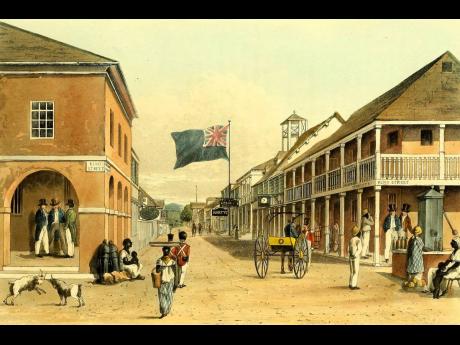
In my old age I have taken an interest in history. I studied West Indian history in high school, and at UWI we Natural Science students were required to do a “survey course” (today it would be called a ‘foundation course’) in the History of the Caribbean. Not now having to follow a syllabus, there is a refreshing freedom to pursue what interests me, and with so much primary (and secondary) material on the internet, I realise there were big gaps in what I was taught.
The Emancipendence season is approaching, which always forces me to reflect on the events of almost 200 years ago, I want to share some of the new things I have come to realise about that period.
The British parliament passed the Act to abolish slavery in July 1833, and the Jamaica House of Assembly (JHA) – composed almost exclusively of slave-owners – was required to pass local legislation to give effect to the UK Act. They did so in December 1833, and forwarded it to the Colonial Office (CO) in London, which disallowed it, because it was found to be “extremely deficient”.
In response to the demands of the CO the JHA amended the Act on July 4, 1834, but it was still deficient, and the CO again disallowed the amended Act. Emancipation came on August 1, 1834 under the disallowed Act.
On December 22, 1834 (five months into apprenticeship) the JHA amended the Act a second time, but totally ignored the CO’s wishes, deepening its control. For a third time the CO disallowed the self-serving Act of the JHA, and the British parliament passed an Act giving Jamaica’s Governor the power to unilaterally amend the Jamaican Emancipation Act by proclamation to ensure the welfare of the apprentices.
The JHA would have to be forced, kicking and screaming, to do what was right. During this period the CO played an important role in protecting the apprentices from the planters who wished to continue to exploit them.
One good thing about colonialism: when elected legislators acted in a self-serving way, the colonial power could step in and take over. There is nobody to do that in Independent Jamaica.
It became clear to Sir Henry Taylor, head of the WI Department in the CO, that the JHA was totally prejudiced against the formerly enslaved, and were not disposed to assist them to transition into free citizens with full civil rights. In a “Memorandum on the Course to be taken with the West Indian Assemblies” (Jan 19, 1839) Taylor wrote that given their character, West Indian planters were “eminently disqualified for the great task of educating and improving a people newly born into freedom as it were”.
Taylor was quite right! In the 1830s Jamaican politicians were not capable of running the colony in the best interests of the majority of the people. Taylor recommended in 1839 that the JHA be abolished and Jamaica be administered by the Governor with an appointed Legislative Council (Crown Colony government), but his superiors were too indecisive to carry out his recommendation.
Taylor would recommend this again in 1865 after the Morant Bay Rebellion, and this time see it implemented.
For some reason I was not taught this interesting historical fact.
In 1865 during the last session of the JHA before it was abolished, the Assembly passed eight Acts connected with the Morant Bay events:
1. On November 9, 1865 the JHA passed “An Act to Indemnify the Governor and all other officers and persons concerned in suppressing the late rebellion in this Island”.
It was this indemnity which, in the end, allowed Governor Eyre and his posse to escape culpability for the execution of George William Gordon, Paul Bogle, and hundreds more, as well as indiscriminate flogging, torture, and burning of homes. The CO could have disallowed this Act, but did not.
2. Same day, the JHA passed “An Act to enable the Governor to detain Persons arrested during the prevalence of Martial Law” for such time as necessary to dispose of their case.
The CO disallowed this one, because it “is objectionable, as it purports to give the Governor the power of detention without any specified limit of time, and without any provision for bringing the accused to trial”. Shades of SOEs!
3. On November 10, the JHA passed an Act to enable the Governor to declare Martial Law with the advice of his Privy Council. (Previously it required a Council of War).
The CO disallowed this one also. Martial Law must not be so easy to declare.
5. On November 16 the JHA passed “An Act to provide for the Forfeiture of the real and personal Estates of Persons guilty of Treason or Felony in the late Rebellion.
The CO declared that this “is an Act which appears to be open to very great objection. I shall feel bound to advise Her Majesty that the Act be disallowed”.
6. The JHA passed a bill to “Regulate Places of Meeting for Religious Worship, and other Purposes”.
The CO disallowed this one because they wished not to restrict religious freedom.
7. The JHA passed “An Act to provide for the trial and punishment for offences committed during martial law, and within a limited period thereafter”.
The CO advised that “I gather that its object is to continue the operation of martial law in Jamaica, in respect to the trial of offenders, for a period of six months. … I cannot anticipate that it will be in my power to advise the Queen to give her sanction to it”.
The Colonial Office was able to protect the Jamaican people from abuse by their elected representatives. Can you imagine what suffering would have resulted if those laws had not been disallowed?
No such mechanism is available today. To get an unjust law disallowed one has to challenge it in court.
Isn’t it uncanny how history can seem to repeat itself?
Peter Espeut is a sociologist and development scientist. Send feedback to columns@gleanerjm.com