Jalil Dabdoub | Caribbean leaders ...
Loading article...
-
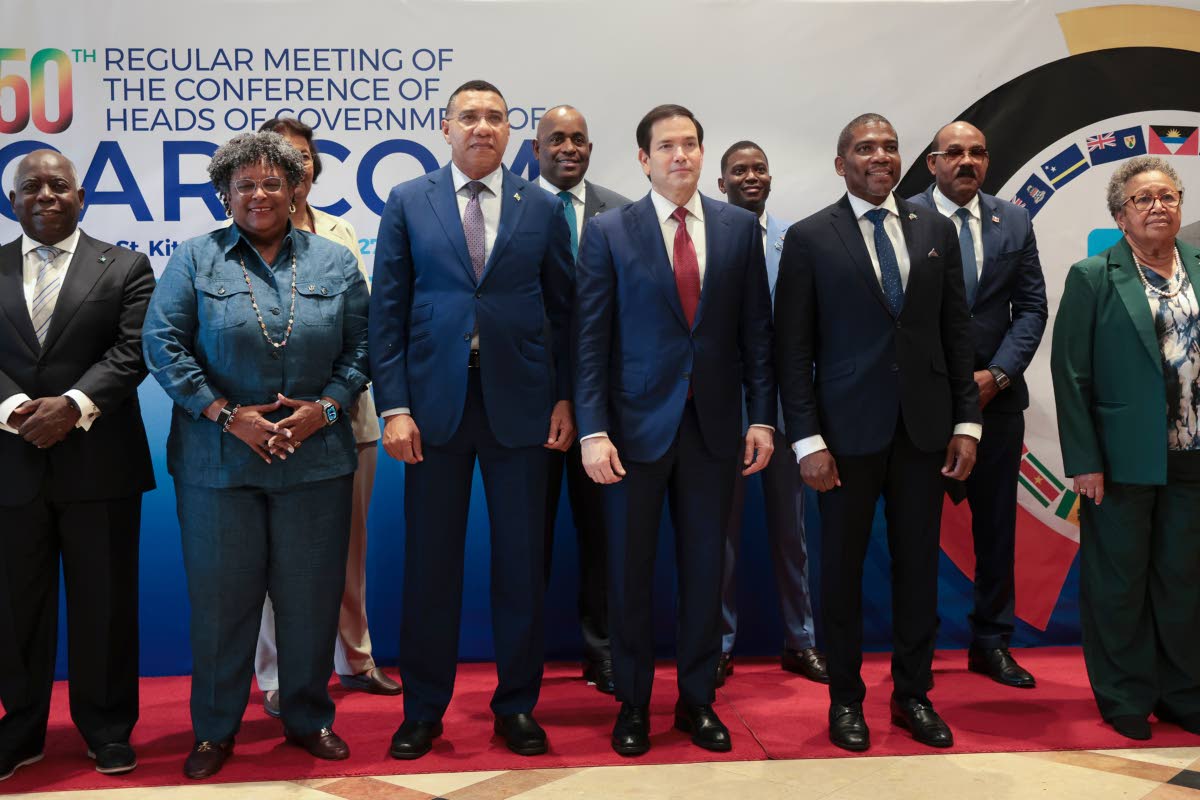 US Secretary of State Marco Rubio, centre front in red tie, poses for a group photo with other government officials attending CARICOM meeting in Basseterre, Saint Kitts and Nevis, in February. Pictured are, Bahamas’ Prime Minister Philip Edward Davis, left; Grenada’s Prime Minister Dickon Mitchell, fourth from right; Antigua and Barbuda’s Prime Minister Gaston Browne, second from right; Barbados’ Prime Minister Mia Amor Mottley, second from left; Jamaica’s Prime Minister Andrew Holness, front row third from left; and St. Kitts and Nevis Prime Minister Terrance Drew, third from right. Photo - AP
-
US Secretary of State Marco Rubio, centre front in red tie, poses for a group photo with other government officials attending CARICOM meeting in Basseterre, Saint Kitts and Nevis, in February. Pictured are, Bahamas’ Prime Minister Philip Edward Davis, left; Grenada’s Prime Minister Dickon Mitchell, fourth from right; Antigua and Barbuda’s Prime Minister Gaston Browne, second from right; Barbados’ Prime Minister Mia Amor Mottley, second from left; Jamaica’s Prime Minister Andrew Holness, front row third from left; and St. Kitts and Nevis Prime Minister Terrance Drew, third from right. Photo - AP
-
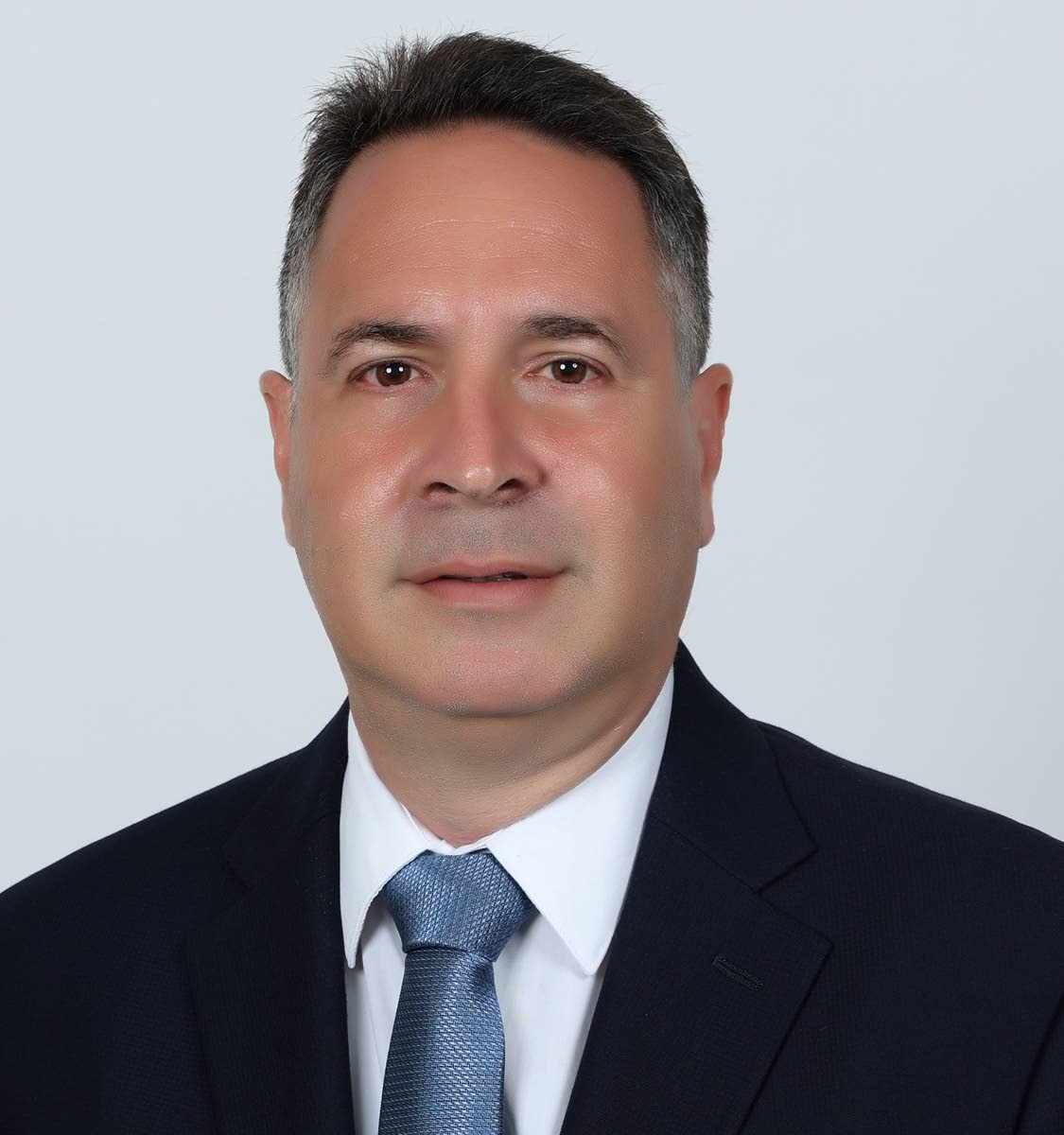 Jalil Dabdoub. Photo - Contributed
The recent commentary by former Prime Minister (PM) P.J. Patterson on the deepening crisis in Cuba is as morally resonant as it is politically uncomfortable for current Caribbean leaders, including PM Andrew Holness. It is not often that a retired Caribbean statesman speaks with such visible anguish.
Rarer still is the spectacle of a former leader implicitly challenging the resolve of those who now occupy the seats of power. It’s a reminder that Caribbean leaders once possessed the backbone to defy pressure from external forces when principle demanded it.
Today, that backbone appears non-existent at worse and dangerously flexible at best.
Let’s be clear, Patterson’s domestic record was far from perfect. His administration struggled with fiscal discipline, rising debt, and entrenched social problems that haunt Jamaica to this day. He is not above criticism. But, on matters of sovereignty, regional solidarity, and resistance to collective punishment of small states, he did not bend.
Leadership, though, must also be judged by constancy of principle. On questions of Caribbean sovereignty and resistance to what he regarded as unjust external pressure, Patterson remained steadfast. He was part of a political generation shaped by the Cold War, one who lived the injustice of colonialism and one that believed small nations had both the right and the obligation to assert their independent voice in global affairs.
His call now is not for confrontation but for clarity. He urges Caribbean leaders, through the framework of Caribbean Community, to articulate solidarity with the Cuban people amid what he characterises as a looming humanitarian catastrophe. He points to repeated votes at the UNGA condemning the embargo and questions whether collective punishment of civilians can ever be morally defensible.
DELICATE REALITY
Whether one agrees with his framing or not, Patterson’s intervention exposes a delicate reality for Jamaica’s current leadership. For any sitting prime minister to be compared, even implicitly against the moral audacity of the Manley era is politically awkward. To be exposed in this way by a predecessor, on an issue tied so closely to Caribbean identity and sovereignty, is a difficult and most embarrassing moment.
It is no small thing for a former prime minister to publicly signal that today’s response lacks the courage of yesterday’s. One cannot escape the uncomfortable optics of former leaders, long out of office, sounding more resolute than those currently entrusted with power. That is not merely awkward for today’s prime ministers, it is humiliating.
Patterson, for all his economic missteps at home, never wavered on the principle that small states have agency, that they are not pawns to be instructed into compliance. His generation understood that independence meant something more than a flag, a passport and an anthem. It meant the willingness to withstand pressure and above all to make our own decisions.
History is unforgiving. The Manley era was messy, turbulent, economically painful, but never spineless. If this generation wishes to chart a different course, fine. But let it not be a course defined by fear or evasion of principle and law.
Perhaps this discomfort is not entirely negative. Democracies benefit when elder statesmen speak, when history is recalled not as nostalgia but as a benchmark. The question is not whether 1972 can be recreated in 2026; today’s geopolitical landscape is different. The United States remains a critical economic partner. Caribbean economies are fragile. Retaliatory measures, including visa restrictions and economic pressure, are real concerns. But ‘sovereignty’ that survives only when convenient is not sovereignty at all. That is conditional permission.
The question is whether principle and rule of law still have a place in policy under this government.
Patterson’s critics will say he governed in easier times, that moral positions taken cost less when one is no longer responsible for balancing budgets or managing diplomatic fallout. Supporters will counter that precisely because he no longer wields power, his words carry a different kind of legitimacy, unencumbered by electoral pressures.
What cannot be denied is the symbolism. A former prime minister, flawed in governance yet firm in conviction, reminding the region of a moment when Caribbean leaders stood on principle and on law.
STARK CONTRAST
It is a shame, not because debate is unwelcome, but because the contrast appears so stark. When retired leaders must step forward to articulate what they see as foundational Caribbean principles, it invites uncomfortable reflection about the present state of regional leadership.
In the Jamaica Observer, under the title ‘Things Fall Apart’, former PM Bruce Golding warned that eroding institutional clarity and drifting from constitutional and regional coherence risk marginalising small states. His concern mirrors that of Patterson, that disorder in principle leads to disorder in governance. Together, their warnings signal a broader anxiety that the region is losing its moral and diplomatic centre of gravity.
Yet, even Patterson and Golding must concede Patterson’s defence of Cuba sits uneasily beside their relative quiet on CARICOM’s stance toward Palestine. Principle cannot be selective. If collective punishment is wrong in Havana, it is wrong in Gaza. If sovereignty matters in the Caribbean, it matters in Palestine while speaking loudly on Cuba exposes a dangerous asymmetry. The Palestinian question was never recently pursued with the sustained urgency that true universality demands. Principle cannot be selective; it must stand everywhere.
For now, Patterson and Golding have forced a conversation that this government has constantly preferred to avoid.
One cannot escape the uncomfortable optics, a former leader, long out of office, sounding more resolute than those currently entrusted with power. That is not merely awkward for today’s prime ministers. It is humiliating. Being well-dressed and articulate, as PM Holness often is, does not equate to leadership. Style without principle is merely being:
“inna a 3-piece suit and ting,
being like a puppet on a string.”
Jalil Dabdboub is an attorney-at-law. Send feedback to columns@gleanerjm.com