Bug Art lends his signature touch to Buju Banton’s ‘Too Too Bad’
Loading article...
-
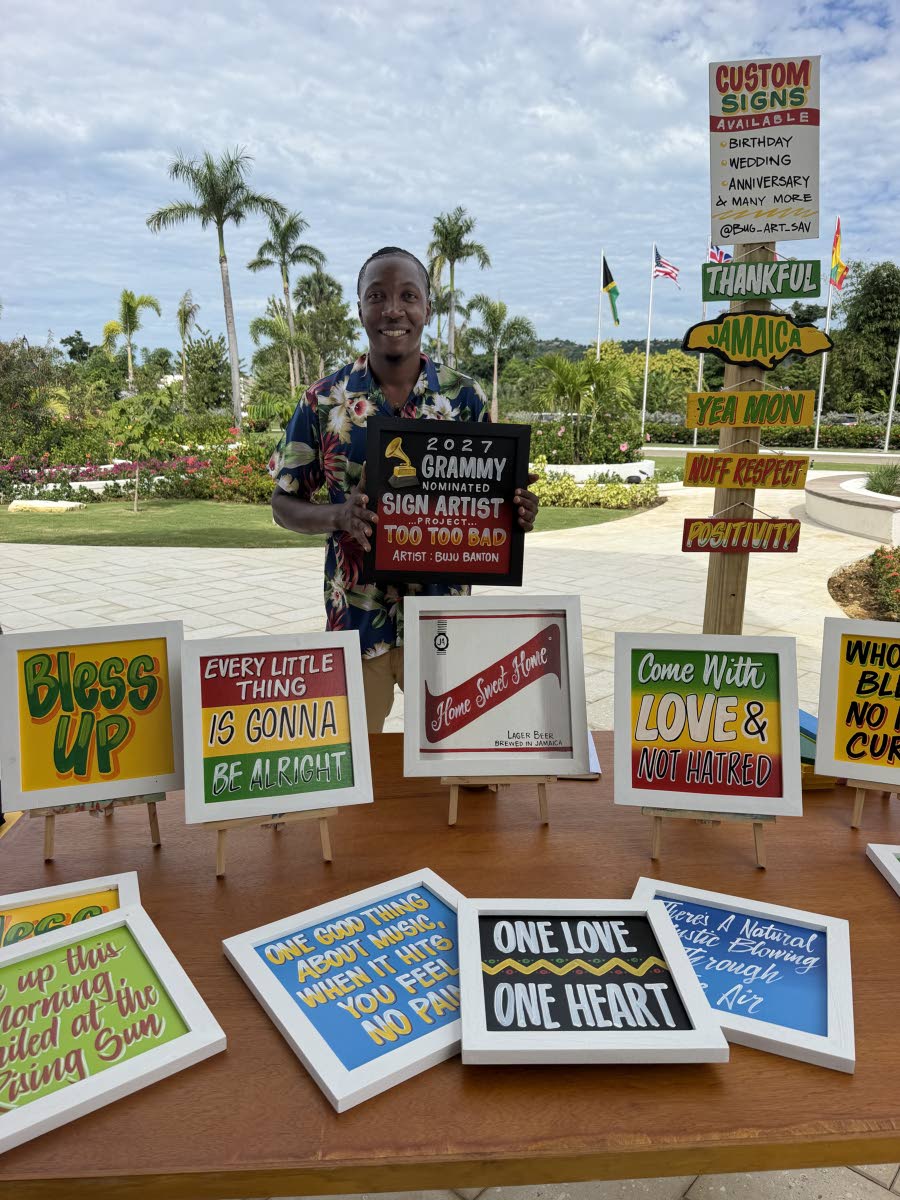 Westmoreland-based fine artist Rushane ‘Bug Art’ Drummond has built a vast clientele through his distinctive hand-painted lettering and traditional sign-painting techniques. Photo - Contributed
-
Westmoreland-based fine artist Rushane ‘Bug Art’ Drummond has built a vast clientele through his distinctive hand-painted lettering and traditional sign-painting techniques. Photo - Contributed
-
 The artwork done on the cover of recording superstar Buju Banton’s Grammy-nominated album ‘Too Too Bad’, by Rushane ‘Bug Art’ Drummond. Photo - Contributed
WESTERN BUREAU:
In an age when artificial intelligence can generate artwork in seconds, Westmoreland fine artist Rushane Drummond is making an international impression with something decidedly more personal – his handwriting. The 33-year-old, popularly known as Bug Art, is the creative hand behind the distinctive lettering featured on the cover of reggae superstar Buju Banton’s album Too Too Bad, which earned a Grammy nomination for Best Reggae Album.
For Drummond, who has spent nearly two decades perfecting his craft, seeing his hand-painted work adorn a Grammy-nominated recording represents a significant milestone in his artistic journey.
Perhaps even more gratifying was the reaction from those who had followed his career. Long before he shared photographs and videos documenting his involvement in the project, some had already identified his work.
“Without knowing, they mentioned, ‘Oh, this is your handwriting. We’ve been following you for years,’” Drummond told Sunday Lifestyle.
Like a signature, his lettering has become unmistakably his own.
The team behind Banton’s album wanted an authentic Jamaican dancehall aesthetic, reminiscent of the hand-painted signs that have long formed part of the island’s streetscape. They supplied the wording, leaving Drummond to interpret it through his distinctive artistic style.
“Every album has a face,” he explained. His assignment was to help give Too Too Bad that face.
According to Drummond, Banton’s team accepted his first submission because it captured exactly what they were looking for.
A native of Westmoreland, Drummond began taking art seriously at age 14 while attending Frome Technical High School. Before then, his creativity found expression in drawings at the back of his schoolbooks.
His journey into professional artistry was hardly straightforward. After leaving school, he took on odd jobs, including construction work, to support himself, all while continuing to draw and paint whenever opportunities arose.
Interestingly, the temporary absence of an art teacher during his high-school years exposed him to another vocational discipline, woodworking – a skill that would later become integral to his business.
During the COVID-19 pandemic, Drummond rediscovered woodworking, gradually acquiring tools and incorporating the discipline into his artistic repertoire. Today, he creates pieces from scratch, cutting wood, constructing frames, and painstakingly applying each brushstroke by hand.
His creations now find their way into gift shops locally and overseas, while his portfolio boasts an impressive clientele spanning hospitality, philanthropy and entertainment.
Among those for whom he has undertaken assignments are the Sandals Foundation, Rockhouse and Negril Treehouse Resort. He has also created logos for international recording artistes and undertaken work connected to American singer-songwriter Leon Bridges.
In Montego Bay, his artistry is on public display at the Scotiabank building in historic Sam Sharpe Square, where he painted a mural.
His talent has also taken him beyond Jamaica’s shores, representing the country at the New Orleans Jazz & Heritage Festival and earning him a feature in the international publication BLAG Magazine.
For Drummond, however, some of the most meaningful recognition has come from older practitioners of the craft, who have expressed appreciation for a younger artist keeping traditional sign painting alive at a time when technology is transforming the creative industries.
The irony is not lost on him that, amid the proliferation of digitally generated images, the very thing that attracted the attention of Banton’s team was the authenticity of his handwriting.
Drummond believes artificial intelligence has its place in the creative process, but should not replace human ingenuity.
“It should have been a tool for assistance,” he said. “It should never have been the final product.”
He also encourages fellow artists to diversify their skills, comparing art to a tree whose extensive network of roots and branches represents the countless possibilities available to creative individuals.
At its root, he said, is creativity, from which disciplines such as fine art, graphic design, architecture and other forms of artistic expression emerge.
He points to the intricate designs on banknotes, the architecture of cities, and even the construction of homes as examples of how deeply artistry is woven into everyday life.
For a man who turns 34 in December, Drummond has already built a career that demonstrates how a traditional Jamaican craft can find relevance in contemporary international markets without sacrificing its cultural identity.
And while the Grammy nomination belongs to Banton’s musical recording, Drummond takes considerable pride in knowing that his artistry forms part of the visual identity of the celebrated project.
“Wonderful, wonderful,” he said of the nomination. “I can add that to my accolades.”
For Drummond, art is much more than the application of paint to a surface. It is the foundation upon which much of human civilisation has been built.
“The world around us is shaped by artists,” he added.
janet.silvera@gleanerjm.com