
THE STORY OF JAMAICA’S NATIONAL EMBLEMS – Part II
The national bird, tree and fruit
Published:Wednesday | August 6, 2025 | 12:55 PMPaul H. Williams/Gleaner Writer


THE RECOMMENDATION of the Jamaica Horticultural Society that the lignum vitae should be the floral emblem of Jamaica was adopted by the select committee in the House of Representatives after due consideration, and it went on to suggest that the blue mahoe should be the national tree; the ackee, the national fruit, and the national bird, the doctor bird, or the swallowtail humming bird.
“This paper is laid for the information of honourable members of the House. It is necessary to do so in order to ensure the widest possible circulation among our people and that all may be aware of the progress being made towards a final settlement of these important matters,” Premier Norman Manley said in a ministry paper read in the House of Representatives on Wednesday, March 28, 1962.
The paper says the blue mahoe is a lovely and outstanding tree, easily propagated, and for over a century has been regarded as one of Jamaica’s primary economic timbers. It was much used for re-afforestation and was a valuable source of “cabinet timber”. “It has an attractive blue-green colour with variegated yellow intrusions, and it is capable of taking a high polish, showing to advantage the variety of grain and colour tones,” the paper further says.
“The trade, local and foreign, consumes annually many thousands of feet of this beautiful timber. The conservator of forests has given an assurance that there will be large numbers available for tree planting at the forthcoming Independence celebrations, and it is also considered suitable for introduction into gardens, both in the plains and on higher grounds.”
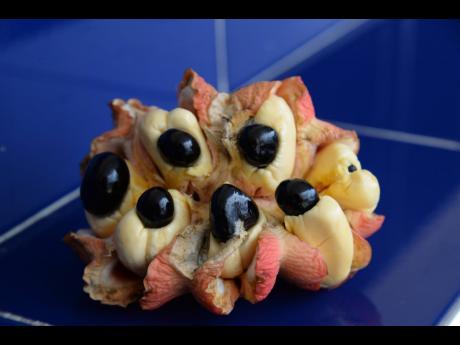
The select committee said the ackee ( Blighia sapida) selected itself, as while it was not indigenous to Jamaica, it had historic values. It was originally imported from West Africa, probably brought here on a slavery-day trade ship.The tree was unknown to science and plants were taken from Jamaica to England in 1793 by Captain Bligh, thus the botanical name.
Only place in
the world
One of the earliest local propagators of the tree was Dr Thomas Clarke, who introduced it to the eastern parishes in 1778. Jamaica was perhaps the only place in the world where the fruit was generally recognised as an edible crop at the time, although the plant had been introduced into most of the other Caribbean islands, including Trinidad, Grenada, Antigua and Barbados; Central America; and even in Florida, where it was known by different names and was not grown commercially.
Thriving enterprise
The ackee has a rich, flavourful yellow fruit, attached to a shiny black seed, enclosed by a red, segmented pod, which opens itself when the fruit is mature. The fruit itself is called an aril, and at the time of the selection its export in cans to Jamaican people in the UK, USA, Canada and Panama was a thriving enterprise.
The blue mahoe is related to the hibiscus and the sorrel, and has heart-shaped leaves that create a broad-based foliage. The fast-growing, straight trunk can reach up to 20 metres. The flowers change as they mature from bright yellow to orange-red to deep red. The versatile hardwood consists of bluish streaks when polished. Mahoe is derived from maho, so called by the Tainos, the people living in Jamaica before the arrival of the Europeans.
The ministry paper says, “This a lovely and outstanding tree, easily propagated, and for over a century has been regarded as one of our primary economic timbers. It is currently much used for re-afforestation and is a valuable source of cabinet timber. Of an attractive blue-green colour with variegated yellow intrusions, it is capable of taking a high polish showing to advantage the variety of grain and colour tones.
“The trade, local and foreign, consumes annually many thousands of feet of this beautiful timber. The conservator of forests has given an assurance that there will be large numbers available for tree planting at the forthcoming Independence celebrations, and it is also considered suitable for introduction into gardens both in the plain and on higher grounds.”
The doctor bird, or swallowtail hummingbird ( Trochilus polytmus), is endemic to Jamaica, and is one of the most outstanding of the 320 species of hummingbirds. The beautiful feathers of these birds have no equal in the world. The feathers produce an iridescent hue characteristic only of that family. The doctor bird has been the subject of many Jamaican folklore and folk songs.