More than a PM
Loading article...
-
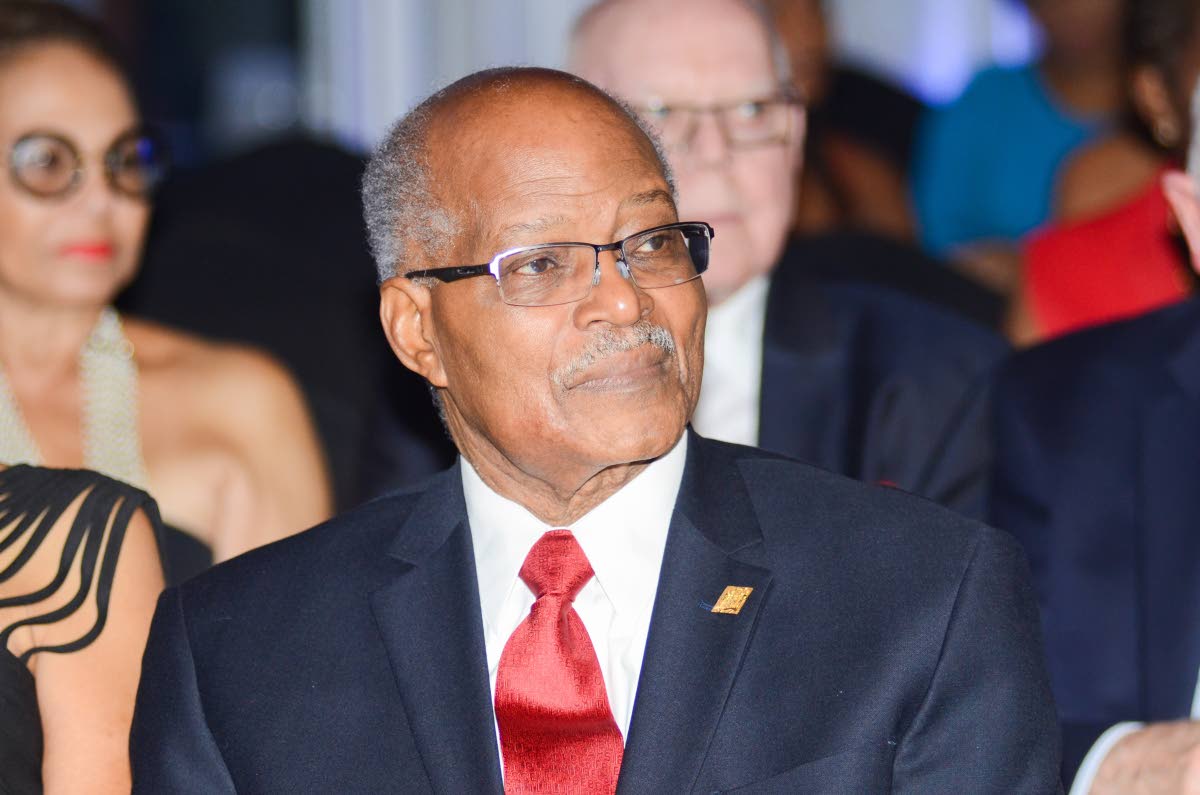 Sir Kenneth Hall, former governor general and author.
-
Sir Kenneth Hall, former governor general and author.
-
 Photo - Gladstone Taylor
Former Governor-General Sir Kenneth Hall says Jamaica’s longest-serving prime minister, P.J. Patterson, was substantially more than the country’s most successful political leader, describing him as one of the Caribbean Community’s (CARICOM) chief philosophical drivers and a monumental contributor to regional development.
In his new book, Caribbean Integration: The Patterson Doctrine — Governance, Transformation and the Future of the Caribbean Community, Sir Kenneth portrays Patterson as an unapologetic regionalist who believes deeply in the aspirations of small nation states in the Caribbean, Africa and the Pacific, and has devoted his life to advancing their unity.
“The focus on him is that he’s the longest-serving prime minister, but he’s also one of the few prime ministers - as I will say in another space - that was a witness and a participant in three of the major steps in the development of regional integration. The first is that he was there as minister of trade when there were only nine men to do. Four prime ministers, four ministers and the secretary general when they recognised Cuba. He was also there when they signed the Treaty of Chaguaramas. And, to the best of my knowledge, he is the only surviving minister who was in that room...,” Sir Kenneth told The Sunday Gleaner.
The 380-page book, comprising 13 chapters, an epilogue and a documentary appendix, opens with a bold assessment of Patterson’s statesmanship as “one of the most significant contributions to the evolution of Caribbean regional thought since the emergence of the modern integration movement”.
It traces the region’s integration journey, from the collapse of the West Indies Federation and the signing of the Treaty of Chaguaramas to the development of the Single Market, the Caribbean Court of Justice and decades of collective diplomacy.
A witness with credentials
Sir Kenneth credits Patterson with playing a pivotal role in the Lomé Convention, the landmark trade and aid agreement signed in 1975 between the European Economic Community and African, Caribbean and Pacific (ACP) countries, which provided preferential access to European markets for their exports.
He recalls that Patterson, alongside Sir Alister McIntyre and Sir Shridath ‘Sonny’ Ramphal, helped persuade Europe and the Pacific to join the Caribbean in a unified negotiating delegation when Britain’s entry into the European common market threatened traditional exports such as sugar and bananas.
“When Britain went into the common market where some of our products, sugar and bananas in particular, were heavily impacted, a small group of leaders - as they are called the triumvirate – Sir Alistair McIntyre, Sir Shridath ‘Sonny’ Ramphal and Patterson - they are the ones who also persuaded Europe and the Pacific to join with them so that they formed one delegation. So from that perspective, Patterson is the only survivor of those major events to the best of my knowledge. But it is not only about survival, it is about contribution. And this is what this book is about,” he told The Sunday Gleaner.
Sir Kenneth is himself well placed to assess Patterson’s regional contribution. A historian, he served as CARICOM deputy secretary-general from 1994 to 1996, principal of The University of the West Indies’ Mona campus from 1996 to 2006, and governor-general from 2006 to 2009. He therefore observed regional integration from the secretariat, the university and the vice-regal residence.
His assessment of Patterson is grounded in that experience and in his understanding of the institutions that have shaped the Caribbean integration movement.
In July 2003, at Rose Hall, St James, CARICOM heads of government, under Patterson’s chairmanship, acknowledged that the international circumstances in which the regional body was established in 1973 had fundamentally changed. Their declaration called for “mature regionalism”, stronger implementation mechanisms and a shift from building institutions to making them work.
More than two decades later, Sir Kenneth has identified what he calls the Patterson Doctrine: a consistent philosophy of regional integration that Patterson developed from the 1970s and refined during his political career.
“First of all, it is that small states are never powerless when they refuse to stand alone. Integration must be felt by the ordinary people in their jobs, their journeys, their classrooms, and their dignity, and that the Caribbean will take its place at the world’s tables as one region, or it will not get a place at all. But in light of the changed international environment, existentialist threats such as climate change, technological developments, which threaten to change how people work, that is artificial intelligence (AI) if CARICOM is to meet the goals that were set forth in 1973, it has to adapt...,” he stated, invoking the Forbes Burnham maxim, ‘Integrate or perish’.
Sir Kenneth argues that CARICOM must renew and transform its institutions without abandoning the objectives on which the Community was founded.
“And that, in essence, I think is what I have documented as a Patterson doctrine,” he told The Sunday Gleaner.
From building to delivering
Sir Kenneth contrasts Patterson’s approach with that of the founding generation, including Norman Manley, Grantley Adams, Eric Williams, Errol Barrow and Forbes Burnham, who established the foundations of regional integration.
When Patterson inherited the regional project in 1992, the Cold War had ended and globalisation was accelerating. The challenge, Sir Kenneth argues, was no longer simply to establish institutions but to determine whether they were transforming Caribbean society.
He describes Patterson as “Not the man who invented the Caribbean project, but the statesman who turned it from a monument into a machine”.
Among the doctrine’s central principles are the idea that small states strengthen rather than surrender their sovereignty through collective action; that implementation matters more than declarations; and that economic integration must improve human development rather than remain confined to trade.
Sir Kenneth also highlights the importance Patterson placed on knowledge, stronger diplomatic relationships with Africa, Latin America and Asia, and a regional citizenship that embraces the diaspora.
He acknowledges that the Patterson Doctrine is his own analytical description of a consistent body of ideas rather than a formal manifesto.
The doctrine in motion
The unfinished Caribbean Single Market and Economy (CSME) remains a significant test of regional integration. Meanwhile, climate change, global economic upheaval and shifting international alliances continue to expose the vulnerability of small states acting individually.
Against that background, Sir Kenneth argues that Patterson’s philosophy remains relevant: act collectively, deliver results, broaden international partnerships and invest in knowledge.
He points to several milestones during Patterson’s political career as evidence of the doctrine in practice. These include the formal launch of the CSME at The UWI Mona campus in January 2006; Patterson’s questioning of the circumstances surrounding Jean-Bertrand Aristide’s departure from Haiti in 2004; and his advocacy for reparations at a CARICOM meeting in Antigua in 2014, when he symbolically passed the reparations “torch” to a younger generation of regional leaders.
In 2009, CARICOM conferred its highest honour, the Order of the Caribbean Community, on Patterson, recognising his contribution to external trade and the ACP group.
For Sir Kenneth, these moments collectively demonstrate that Patterson’s legacy extends beyond political longevity to a coherent philosophy of regional development.
Mia Mottley
The book’s argument also invites consideration of the next generation of regional leadership, particularly Barbados Prime Minister Mia Mottley, who has emerged as a prominent international advocate for climate finance and global economic fairness.
Sir Kenneth views Mottley as a committed regionalist who, like Patterson, has built an influential global platform.
He describes her as “widely acknowledged as the one person, right now, who has a vision, has articulated a set of policies, and stands firm on the principles that should guide the current and the future”.
If, as Sir Kenneth suggests, regional integration is a continuing relay in which each generation inherits an unfinished project, Mottley’s leadership may represent another stage in the effort to turn the Caribbean’s collective aspirations into tangible results.
erica.virtue@gleanerjm.com