3-year high in police fatal shootings this month
Loading article...
-
 Geo mapping 1: Six hundred and fifty five killed by police over threee years. Map shows the hotspots, weapons seized, etc. Photo - Contributed
-
Geo mapping 1: Six hundred and fifty five killed by police over threee years. Map shows the hotspots, weapons seized, etc. Photo - Contributed
-
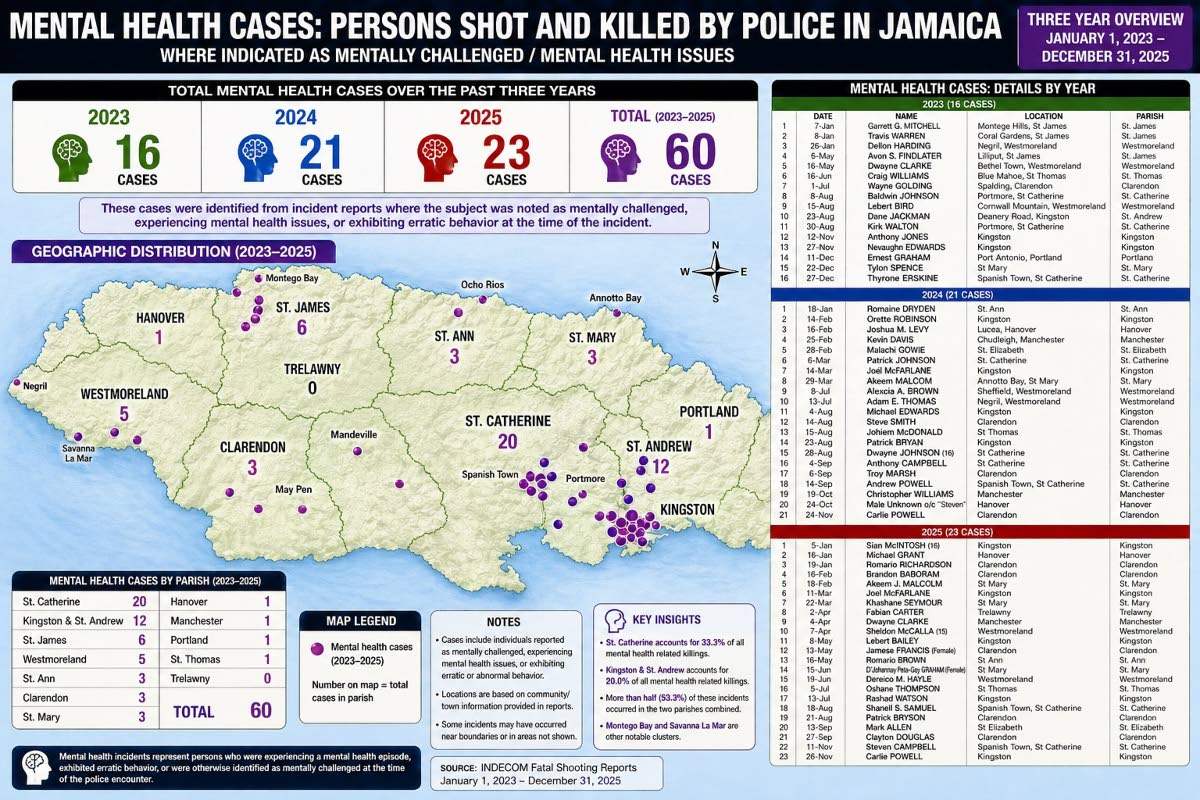 Geo mapping 2: Focused on mental health challenged, 60 killed by the police in three years. The names and parish spots included. Photo - Contributed
Jamaica is on track to record its deadliest month of fatal shootings by the security forces in more than three years, with 36 people killed up to April 27, the highest monthly tally recorded over the past 40 months.
Some 112 people were killed by state agents as at the aforementioned date.
Six people, including a man said to be of unsound mind, have been killed by state agents in the 48 hours between Saturday and Monday.
In the latest incident, a mentally challenged man, an out patient, was shot and killed by a Jamaica Defence Force soldier on Bryce Hill Road in August Town on Monday, while two men, one said to be recently deported, were also killed in 5 West, Greater Portmore, yesterday.
Also on Monday, a man was fatally shot in Wheelerfield, St Thomas.
One man was killed on Job Lane in Spanish Town on Sunday; and another man was killed in Southborough, Portmore, also on Sunday.
The police said that in each incident firearms were recovered, except in the case involving the mentally challenged man, where he allegedly breached the security checkpoint and attacked a soldier with a knife and attempted to disarm another.
Data compiled from the Independent Commission of Investigations (INDECOM) shows that no single month between 2023 and 2025, and so far this year, surpassed 36 fatal shootings.
The previous high was 31 killings in December 2025, during a year that itself set a grim record of 311 fatal shootings, the highest annual total on record.
The surge this month has been sharp and sustained.
From early on in the month of April, INDECOM had expressed as “grave and escalating” its concern in relation to investigations into 11 fatal shootings over four days, April 3-6.
INDECOM said it responded to and commenced investigations into the circumstances of five separate police incidents during the four days.
These five incidents included three triple fatal shootings and two single fatal shootings, resulting in the deaths of 11 males, including a 17-year-old.
At that juncture, it represented the ninth triple fatal shooting incident investigated by the commission since the start of 2026.
The latest figures reinforce a troubling trend, a steady escalation in fatal police encounters over recent years.
In 2023, there were 155 fatal shootings.
That number rose to 189 in 2024 before surging dramatically by 64 per cent in 2025.
Equally concerning is the growing number of persons identified as mentally ill or in crisis who are among those killed.
Over the three-year period, from 2023 to 2025, at least 60 such individuals were fatally shot by the security forces — 16 in 2023, another 21 in 2024 and 23 so far in 2025 – highlighting a pattern that advocates say demands urgent intervention.
INDECOM, on one hand, has repeatedly signalled concern about the recent spike, indicating that it is alarmed by the pace and frequency of fatal encounters so far this year.
The watchdog group said none of the planned operations involved the use of body-worn cameras (BWCs).
The issue has also drawn attention at the policy level.
Speaking during his contribution to the Sectoral Debate in Parliament last week, National Security Minister Dr Horace Chang defended aspects of the police use of BWCs.
He stated that decisions regarding deployment rest solely with the police commissioner, and emphasised that officers would not be required to wear cameras during certain planned operations.
Critics argue that such positions raise fresh questions about transparency and accountability at a time when fatal shootings are rising sharply.
Mikel Jackson, executive director of Jamaicans for Justice, wrote on social media platform X: “I have identified two years in which Jamaica recorded over 300 people killed by the security forces: 1984 (354) and 2010 (307). It is particularly troubling that 50 per cent of planned operations result in fatalities, precisely the context in which pushback has been strongest against calls for body-worn camera deployment.”
Jackson said, “The claim that 'nowhere else in the world does law enforcement use BWCs during high-risk arrest warrants' should be firmly dismissed. While BWCs should be standard in everyday policing such as beat patrols, their necessity in planned PPOs (planned police operations) is clear.”
Geographic data shows that the killings continue to be heavily concentrated in urban hotspots, particularly in the Kingston Metropolitan Area and St Catherine, including Spanish Town and Portmore.
Additional clusters are evident in St James and sections of Westmoreland.
With April 2026 already surpassing previous monthly highs, and several days still remaining, the figures point to an unprecedented escalation in the use of lethal force, intensifying scrutiny on policing practices and the systems meant to oversee them.
The JFJ said yesterday that “111 people killed by security forces in just 116 days. That’s five more than the same period last year… .
"When planned operations make up 50 per cent of these deaths, the question remains loud and clear: Where are the body-worn cameras in these operations? Transparency cannot be optional. BWCs protect both officers and citizens.”
andre.williams@gleanerjm.com