‘Stop playing around’ with vaccination - St Mary residents confront fears during Vaccination Week
Loading article...
-
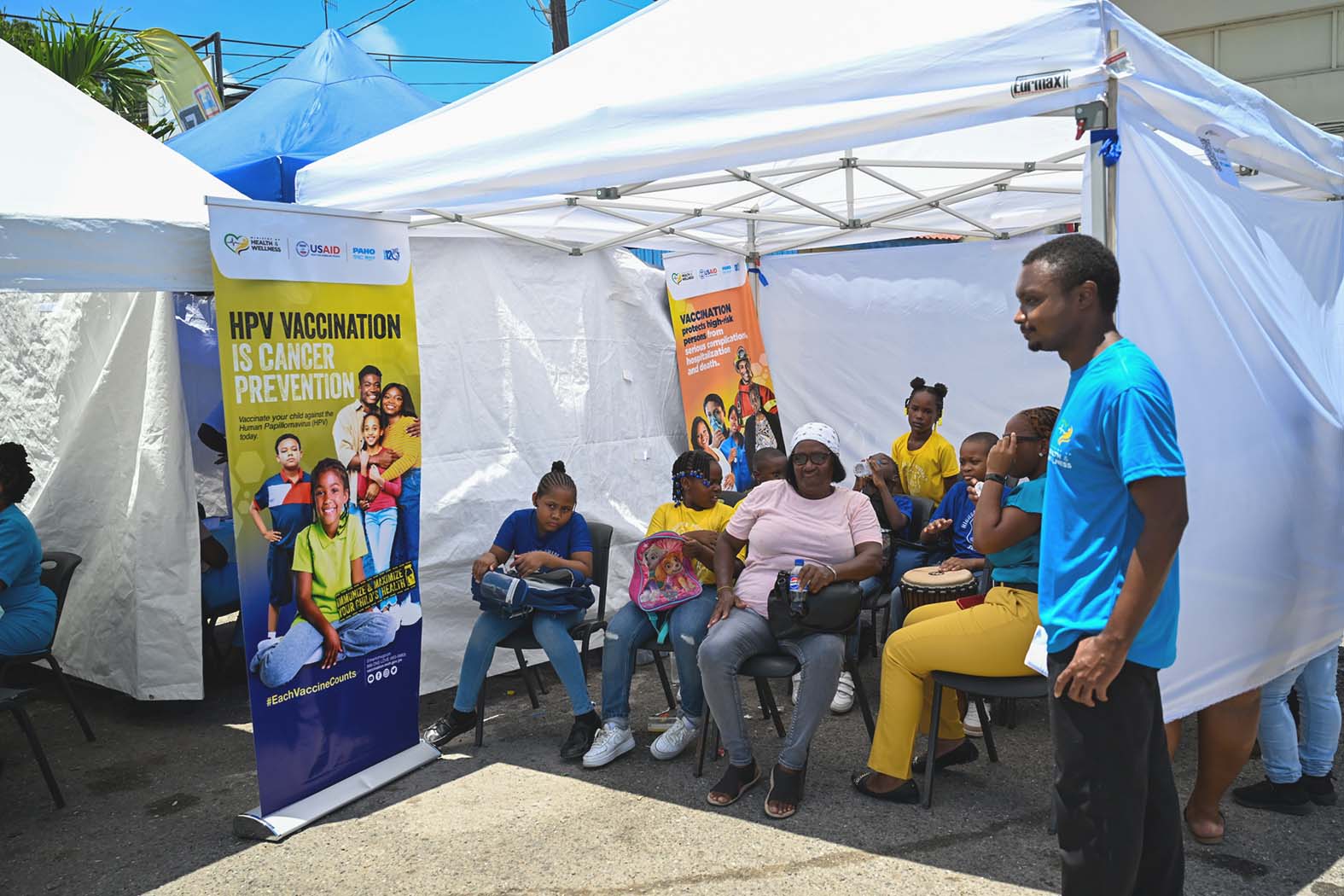 Medical Officer for Health Tamara Henry-Gilpin (far right)) posing with her team during health fair held in the Giant Family Mart Car Park, Port Maria, St Mary on April 30. Photo by Gareth Davis Sr.
-
Medical Officer for Health Tamara Henry-Gilpin (far right)) posing with her team during health fair held in the Giant Family Mart Car Park, Port Maria, St Mary on April 30. Photo by Gareth Davis Sr.
-
 Pan American Health Organization (PAHO)/World Health Organization (WHO) representative to Jamaica, Bermuda and the Cayman Islands, Ian Stein (second left); and Acting Director, Family Health Unit in the Ministry of Health and Wellness, Julia Rowe-Porter (left), present the Port Maria Health District with their prize for winning the HPV jingle competition during a Vaccination Drive and Health Fair. Contributed
Jamaicans should stop “playing around” with vaccination, St Mary Medical Officer of Health Dr Tamara Henry-Gilpin has warned, amid persistent hesitancy and low uptake of key vaccines.
Her warning comes amid efforts to boost HPV vaccination in communities where misinformation continues to shape decisions.
At a recent community health fair at the Giant Family Mart car park in Port Maria, to mark Vaccination Week in the Americas, residents voiced concerns reflecting a wider challenge: misinformation continues to fuel hesitancy around the HPV vaccine. Some, however, said they overcame their fears after receiving credible medical advice.
One resident, Oscar Kennedy, said misinformation initially made him hesitant.
"Mi always a take vaccine, but dis one is a lot different from the polio and the COVID vaccine. Dem say dat, as men, we are not going to be able to function normally with our women, and so mi did kinda a fret and so mi decide say mi 15-year-old son naah tek it," said Kennedy.
However, in the end, Kennedy stated that, after he spoke to a nurse in his community, he was more than convinced that the HPV vaccine was safe enough and that it would protect his son against various diseases and illnesses.
Speaking during Vaccination Week in the Americas, observed from April 25 to May 2 under the Pan American Health Organization (PAHO) campaign ‘Your Decision Makes A Difference. Immunisation For All’, Henry-Gilpin warned that complacency could undermine decades of progress.
“We really cannot play around with vaccination because they are so critical to the outcome of the nation,” she told The Gleaner.
At the Port Maria health fair, she said the Ministry of Health and Wellness (MOHW) is stepping up community outreach by providing vaccines, including HPV doses.
Introduced locally in 2017 — over a decade after its rollout in the United States — the vaccine initially targeted girls but now includes boys, offering protection against cancers of the cervix, anus, throat and penis.
NOTHING TO FEAR
Despite long-standing evidence of vaccines’ effectiveness, hesitancy persists, driven largely by concerns about safety, side effects and misinformation.
Another St Mary resident, Denton Hill, said he had been told that the male sex organ would become dysfunctional, while Marcia Dawson said she encountered numerous negative claims circulating on social media and within communities.
However, each eventually changed course after receiving credible medical guidance.
"After speaking to my doctor, I learned that the vaccine is safe and that there was nothing to fear from it. So I brought my teenage daughter here today,”” Hill said.
Dawson, meanwhile, said her own research led her to conclude that the claims being shared online were unfounded, prompting her to take her 13-year-old daughter to be vaccinated.
While residents grapple with fears at the community level, regional health officials say vaccination remains critical to protecting both individuals and the wider population.
Pointing to the importance of vaccines, Pan American Health Organization (PAHO)/World Health Organization (WHO) representative to Jamaica, Bermuda and the Cayman Islands Ian Stein said they protect individuals while also limiting the spread of disease within communities.
“It helps both individuals and the wider community,” Stein said.
He added that, by getting vaccinated against preventable diseases, Jamaicans also help protect the Caribbean and the wider Americas.
WIDE PROTECTION
Cervical cancer remains the third most common cancer among Jamaican women, with close to 400 new cases and more than 200 deaths annually. Among women ages 15 to 44, it is the second leading cause of cancer-related deaths.
The HPV vaccine protects against the most dangerous strains of the virus, responsible for about 70 per cent of cervical cancers, as well as the majority of certain head, neck and anal cancers.
“So, when you allow your children to get it, you're not protecting them against one thing but against multiple things,” Henry-Gilpin said.
Even so, uptake remains low. Health officials say lingering scepticism — compounded by disruptions during the COVID-19 pandemic — has slowed progress.
“We have a lot of people who are sceptical, persons not taking their kids to get vaccinated. We have situations where we have to go into the communities and find mothers and explain to them and guide them through why vaccination is so critical for the health of not only their child but the population in general,” she said.
Nordia Spencer De Kid, regional nursing supervisor, said the pandemic dealt a significant setback.
“So the uptake proved to be low and then, when COVID-19 occurred, we had a downward trend ... so, when strategies started post-COVID, we are struggling as a region (North East Regional Health Authority – NERHA) to achieve the targets,” she said.
Although uptake has improved since hitting a reported low of four per cent in early 2025, it remains below target.
“Yes there is improvement but not where we would like it to be; we are really hoping to reach our goals this year ... because the health (ministry) alone cannot do it,” De Kid noted regarding the region, which covers St Ann, St Mary and Portland.
In response, authorities are expanding outreach — particularly through schools — working with the Ministry of Education, Health and Family Life Education (HFLE) teachers and school nurses to reach eligible children.
For St Mary’s medical officer, the issue is not only about access, but also awareness.
“I really want to advocate and remind the public of the great impact that vaccines have had and where we are coming from as a people ... . We just want to remind the public because we really don’t want to get back to where we’re coming from,” Henry-Gilpin said.
She noted that St Mary’s general vaccination programme remains strong, with coverage between 95 and 100 per cent — levels sufficient to maintain herd immunity.
“We are noticing ... we are between 95 to 100 per cent ... and that is a good place to be, because what we have in terms of vaccination is what we called herd immunity.”
“At the same time,” she added, “we are within that sweet window and we are happy for that and we really want to continue to work with the public.”
However, she cautioned that those gains must not be taken for granted.
“Vaccine is a big part of why we are here today, as it decreases childhood deaths,” she noted.